
How to Search St. Lucie County Traffic Court Records
Traffic citations filed in St. Lucie County are searchable through the Clerk's Benchmark case search portal at courtcasesearch.stlucieclerk.gov. The portal covers active cases, closed cases, paid infractions, dismissed citations, and cases where the driver elected a driving school option. You can look up a case by citation number or by the driver's last and first name. Citation number is the faster path when you have the ticket in hand. Name searches work when the citation number is unavailable but may return multiple results if the name is common.
Before you start, gather what you have. The citation number appears in the upper section of the ticket. If you don't have the citation, the driver's full legal name and approximate violation date help narrow results. Date of birth further distinguishes drivers who share a name. The Clerk's general traffic services page at stlucieclerk.gov/services/traffic-tickets explains payment and election options alongside the portal link.
- Open the Benchmark search portal at courtcasesearch.stlucieclerk.gov and select the traffic or citation search option.
- Enter the citation number directly if you have it. This is the most reliable search method and returns the exact case record.
- If searching by name, enter the last name first, then the first name. Add date of birth if the name is common.
- Review the case summary, including violation date, statute, plea or election status, hearing date, fine amount, and current disposition.
- From the result screen, choose to pay the fine online, elect driving school if eligible, request a hearing to contest the citation, or note the next court date.
The portal is available around the clock. Paper copies and certified copies of traffic case records are available through the Clerk's office at 201 South Indian River Drive, Fort Pierce, FL 34950. The Clerk's contact page at stlucieclerk.gov/contact-us lists current hours and staff contacts.
Which Courts Handle St. Lucie County Traffic Cases
In Florida, civil traffic infractions are County Court matters. That means the St. Lucie County Court is the trial court for the vast majority of traffic tickets issued in the county. County Court handles non-criminal moving violations, equipment violations, and most standard infractions that carry a fine and possible points but no jail time. The Clerk of the Circuit Court and Comptroller serves as the records custodian for County Court, so all traffic case files flow through the Clerk's office regardless of case type.
Criminal traffic charges are a different category. DUI, reckless driving, driving with a suspended license, and similar offenses are criminal matters heard in the criminal division of County Court or, for felony-level charges, in Circuit Court. Those cases create criminal court records rather than simple infraction files. The Clerk's Benchmark portal covers both civil and criminal traffic cases under one search interface, though the case types and their consequences differ significantly.
| Court | Traffic Cases Handled | Records Location |
|---|---|---|
| St. Lucie County Court (civil infraction) | Speeding, red light, stop sign, equipment, non-moving, and other civil traffic infractions | Clerk's Benchmark portal and Clerk's office |
| St. Lucie County Court (criminal traffic) | Driving with suspended license (misdemeanor), reckless driving, leaving the scene (misdemeanor) | Clerk's Benchmark portal; criminal case file |
| St. Lucie Circuit Court (felony traffic) | DUI with serious injury or death, felony DWLS, vehicular homicide | Clerk's Benchmark portal; felony criminal case file |
Note: Photo-enforcement citations (red-light cameras) in Florida are civil notices, not criminal charges, and are handled separately from court-issued uniform traffic citations.
Types of St. Lucie County Traffic Cases on Record
The Clerk's traffic records cover a range of citation types. Each type has different rules for payment, elections, and potential consequences. Civil infractions are the most common. They carry fines and points but no criminal penalties. Criminal traffic offenses are less common but more serious. They can result in a criminal record, probation, or jail time. Knowing which category a citation falls into determines what options are available.
- Moving violations - Citations for speeding, running red lights, improper lane changes, following too closely, and similar acts while the vehicle is in motion; these carry points and affect the state driver record upon adjudication.
- Non-moving violations - Citations for equipment defects, window tint, expired tags, and registration issues; points are not normally assessed for non-moving violations.
- Parking citations - Local parking ordinance violations issued by municipalities or county agencies; these generally do not appear in the court case search system unless escalated to a court matter.
- Commercial vehicle and CDL citations - Citations involving vehicles requiring a commercial driver license; federal rules apply additional restrictions, and many deferred adjudication options are not available to CDL holders.
- Criminal traffic charges - DUI, reckless driving, driving with a suspended or revoked license, fleeing or eluding, and vehicular homicide; these are criminal offenses with potential jail time and appear in the criminal case index.
Florida also distinguishes between infractions that are adjudicated and those that are withheld. Adjudication means a conviction was entered and points flow to the state driver record. Withholding adjudication means the court did not formally convict but the infraction is still on the court record. Drivers sometimes use driving school elections to pursue a withholding outcome on eligible civil infractions.
What St. Lucie County Traffic Court Records Show
A traffic case record in the Clerk's system contains the full court file for the citation, from the date it was filed through final disposition and payment. The record reflects what happened in court, not what appears on the driver's license record. Some fields are visible in the online portal; others may require a formal records request or in-person review. The table below shows the standard fields found in a St. Lucie County traffic court record based on the information the Clerk maintains for traffic citations.
| Field | What It Shows |
|---|---|
| Citation Number | The unique number assigned to the ticket by the issuing officer; the primary identifier for the court case. |
| Defendant / Driver Name | Legal name of the person cited; used for name-based searches. |
| Violation Date | Date the offense occurred and the citation was issued. |
| Statute or Ordinance | The Florida Statute section or local ordinance the driver allegedly violated. |
| Offense Description | Plain-language description of the violation (e.g., speeding, improper lane change). |
| Court Date | Scheduled hearing date if the driver requested a hearing or if the case requires a court appearance. |
| Plea / Election | Whether the driver paid the fine, elected driving school, requested a hearing, or entered a plea. |
| Fine and Costs | Total amount owed including the base fine, court costs, and any applicable surcharges. |
| School Election | Indicates if the driver elected a basic driver improvement course to avoid points; available on eligible infractions. |
| Disposition | Final outcome: paid, dismissed, adjudicated, adjudication withheld, or contested. |
| Payment Status | Whether the fine has been paid in full, is outstanding, or is on a payment plan. |
| License Consequences | Any reported suspension or points action tied to the court's adjudication, if reported in the case file. |
The online portal shows a summary view. Full docket entries and supporting documents may require a visit to the Clerk's office or a written records request. Certified copies of traffic records, which are sometimes needed for insurance or license reinstatement purposes, are available through the Clerk.
Searching by Citation Number vs by Name
The Benchmark portal supports two main search paths. Citation number search is direct: you enter the number printed on the ticket and the system returns that specific case. Name search casts a wider net. If a driver's name is common, a name search may return dozens of records and require additional filtering by date of birth or violation date to locate the right case. Citation number search is the better choice whenever the ticket is available. Name search is useful for checking all open or past cases associated with a person.
| Search Field | Type | Required | Notes / Format |
|---|---|---|---|
| Citation Number | Text | Best for direct lookup | Enter the number exactly as printed on the ticket; leading zeros may matter. |
| Case Number | Text | Optional | Court-assigned case identifier; available after the citation is docketed. |
| Last Name | Text | Optional | Search by the driver's surname; combined with first name to narrow results. |
| First Name | Text | Optional | Use with last name; partial entries may return broader results. |
| Date of Birth | Date | Optional | Helps distinguish drivers with identical or similar names; format MM/DD/YYYY. |
| Search Button | Action | n/a | Submits the query; review all returned records before assuming no case exists. |
One common issue: a citation may not appear in the portal immediately after it is issued. New citations generally take a few business days to post to the Clerk's system. If a recent ticket is not showing up, check back after 3-5 business days or contact the Clerk's traffic division through stlucieclerk.gov/contact-us.
Note: Searching by name returns all traffic cases associated with that name in St. Lucie County's system, not a statewide record; out-of-county citations appear only in the court where they were filed.
Paying or Contesting a St. Lucie County Traffic Ticket
After receiving a citation, a driver in St. Lucie County has a deadline to respond. The ticket itself states the deadline, and the Clerk's traffic services page confirms options. Failing to respond by the deadline can result in a driver license suspension and additional penalties. Paying online through the Clerk portal is the fastest route for drivers who do not intend to contest the citation or elect driving school.
Drivers who want to contest a ticket or request a hearing must do so before the deadline. Contesting means you will appear before a County Court judge or magistrate and present your case. If found not liable, the citation is dismissed and no points or fine apply. If found liable, the fine and any points stand. For criminal traffic charges like DUI or reckless driving, the process is a full criminal case, not a simple infraction hearing.
- Read the citation carefully. Confirm the response deadline, fine amount, and whether the offense is a civil infraction or a criminal traffic charge. Criminal charges require a court appearance; civil infractions give you options.
- Go to the Clerk's traffic page at stlucieclerk.gov/services/traffic-tickets or the Benchmark portal and look up your citation to see the current status and available options.
- Choose your election. You can pay the fine and accept adjudication, elect a basic driver improvement course if eligible to avoid points, or request a hearing to contest liability before a judge or magistrate.
- If electing driving school, confirm eligibility first. Some violations and some drivers (those who recently used the school option) are not eligible. Complete the course within the required period and submit proof to the Clerk.
- If requesting a hearing, you will receive a court date. Gather any evidence (photos, witnesses, dashcam footage). Appear on time at the St. Lucie County courthouse; missing a hearing can lead to a default judgment and possible license suspension.
- Keep your receipt, proof of school completion, or hearing result. Check your driver record through the Florida DHSMV to confirm the outcome was reported correctly. For disputed driver record entries, contact the Clerk and DHSMV separately.
Online payment through the Clerk portal is accepted for eligible civil infractions. Fees for court copies and certified records are listed at stlucieclerk.gov/fees.
Public Access Laws for St. Lucie County Traffic Records
Traffic court records in St. Lucie County are public records under Florida law. Florida Statutes section 119.01 sets the state policy that public records are open for inspection and copying by any person. The Clerk of the Circuit Court and Comptroller, Michelle R. Miller, is the custodian of those records and must make them available subject to any statutory exemptions. Most traffic citation files contain no exempt information and are fully accessible online or in person.
Florida Rule of General Practice and Judicial Administration 2.420 governs the judicial branch specifically. Under this rule, court records are presumed public unless a specific exemption applies. For traffic matters, exemptions are uncommon. Social Security numbers and bank account information are redacted when they appear, but the citation details, names, fines, and dispositions are public. Sealed or expunged traffic records are the main category where access is cut off, and those require a prior court order.
Key Statutes:
Florida Statutes section 119.01 - The state's foundational public-records policy, establishing that all records made or received in connection with official business are open to inspection and copying.
Florida Statutes section 119.07 - Sets out how records custodians must respond to requests, when fees may be charged, and how exemptions must be identified and communicated.
Florida Statutes section 322.20 - Governs driver records and abstracts; traffic court outcomes reported to the state affect a driver's license record under this statute.
Anyone denied access to a traffic court record can ask the Clerk to identify the specific exemption. If no valid exemption applies, judicial review is available. The Florida Attorney General publishes open-government guidance, but the final word rests with the courts.
Court Traffic Records vs State Driver Records
These are two different files kept by two different agencies. The court traffic record is maintained by the Clerk of the Circuit Court and Comptroller and covers what happened in the St. Lucie County court case: the citation, the charge, how the driver responded, the fine, and the disposition. The state driver record is held by the Florida Department of Highway Safety and Motor Vehicles (DHSMV) and covers the driver's full license history, points assessed by the state, suspensions, and driving status. When a traffic case is resolved in court, the outcome is reported to DHSMV, which updates the driver record. But the two records are not the same file and are not updated simultaneously.
Correcting an error on one does not automatically fix the other. A driver who believes a disposition was incorrectly reported to DHSMV must contact both the Clerk's office and DHSMV separately. The Clerk handles the court record; DHSMV handles the driver record under Florida Statutes section 322.20.
The screenshot below shows the Florida Statutes page for section 322.20, which governs driver records and abstracts and explains how court outcomes flow from county clerks to the state licensing agency.
The screenshot was captured from the Florida Legislature's statutes site for section 322.20.
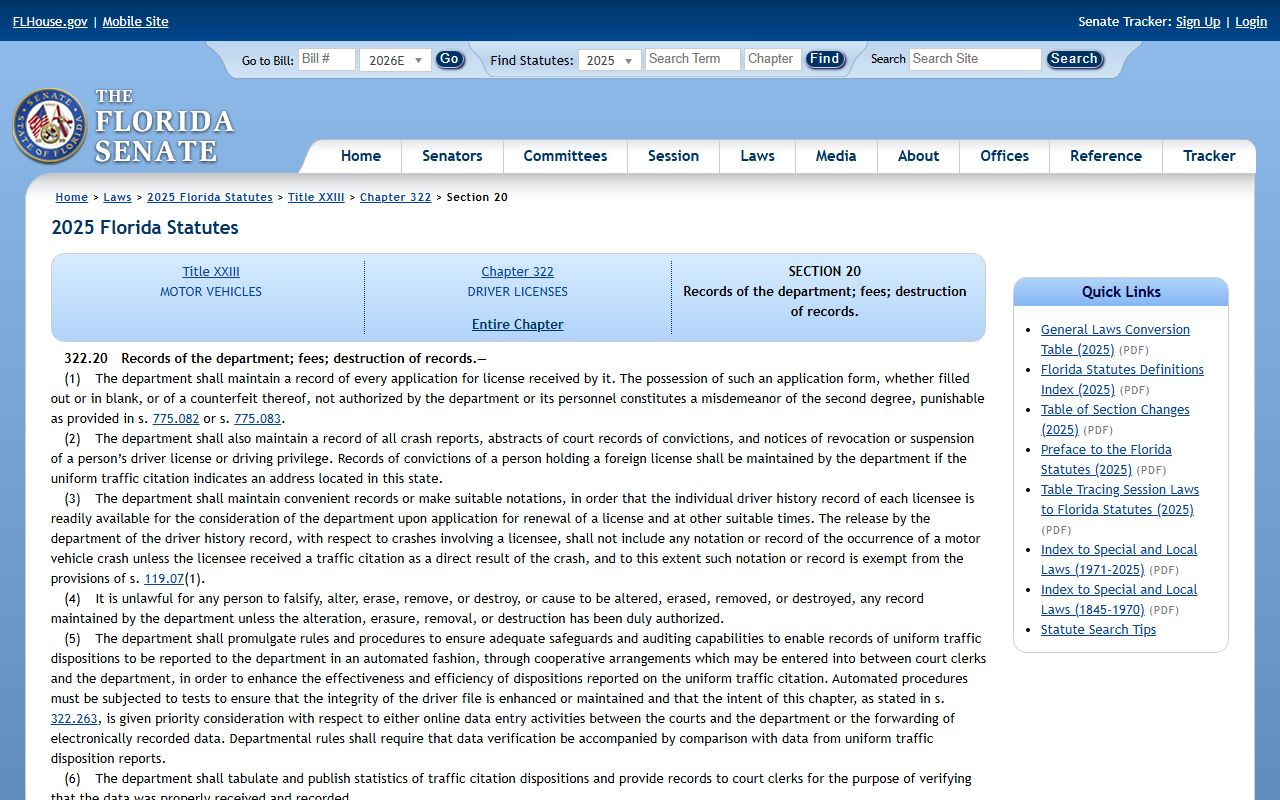
Section 322.20 requires clerks to report traffic case dispositions to the state so that DHSMV can update the driver record, including points and any license actions that follow from the court's adjudication decision.
| Record Type | Custodian | What It Contains | Where to Access | How to Correct Errors |
|---|---|---|---|---|
| Court Traffic Record | Clerk of the Circuit Court and Comptroller, St. Lucie County | Citation, court events, plea or election, fine, costs, and final court disposition | Benchmark portal at courtcasesearch.stlucieclerk.gov or Clerk's office in person | Contact the Clerk's office to request a correction; may require a court order depending on the issue |
| State Driver Record | Florida DHSMV | License status, points assessed, suspensions, revocations, conviction history, and driving history across all Florida courts | DHSMV driver record request portal (flhsmv.gov) under Florida Statutes section 322.20 | Contact DHSMV directly; disputes about reported convictions may also involve the original court clerk |
CDL and Commercial Driver Records in St. Lucie County
Commercial driver license holders face stricter rules when they receive a traffic citation in St. Lucie County. Federal law and Florida statutes prohibit CDL holders from masking certain convictions through deferred adjudication, driving school elections, or plea agreements that would otherwise keep a conviction off the driving record. A CDL holder convicted of a serious traffic violation in a commercial or personal vehicle must have that conviction reported to DHSMV, which in turn reports it to the state of CDL issuance and to the federal CDLIS system.
Serious violations for CDL purposes include excessive speeding, reckless driving, improper lane changes, following too closely, and traffic offenses committed in connection with a fatal accident. Two serious violations within three years can result in a 60-day CDL disqualification. Three serious violations within three years carry a 120-day disqualification. DUI convictions trigger a one-year minimum CDL disqualification for a first offense. CDL holders who receive a citation in St. Lucie County should treat every ticket as potentially career-affecting and may want to consult an attorney before electing any option, including paying the fine, since paying accepts adjudication and locks in the conviction.
Note: CDL holders cannot use a basic driver improvement course to avoid points or adjudication on most moving violations; the school election option available to non-CDL drivers does not apply in the same way.
DUI / DWI Cases in St. Lucie County
DUI charges are criminal, not civil traffic infractions. A DUI arrest in St. Lucie County creates a criminal case file, not a traffic infraction record. The case is handled through the criminal division of County Court for misdemeanor DUI or Circuit Court for felony DUI charges. Criminal DUI records appear in the criminal case index and carry different consequences: possible jail time, probation, mandatory fines, license revocation, and an ignition interlock requirement. These outcomes do not resolve through the same payment and school election process that applies to speeding tickets or other civil infractions.
For complete information on St. Lucie County DUI cases, criminal arrest records, and related court filings, see St. Lucie County criminal records. The Florida Department of Corrections offender search, shown in the screenshot below, is one resource for tracking state-level outcomes after criminal traffic convictions that result in prison sentences.
The following screenshot was taken from the Florida Department of Corrections Offender Search portal, which tracks individuals in state custody or supervision.
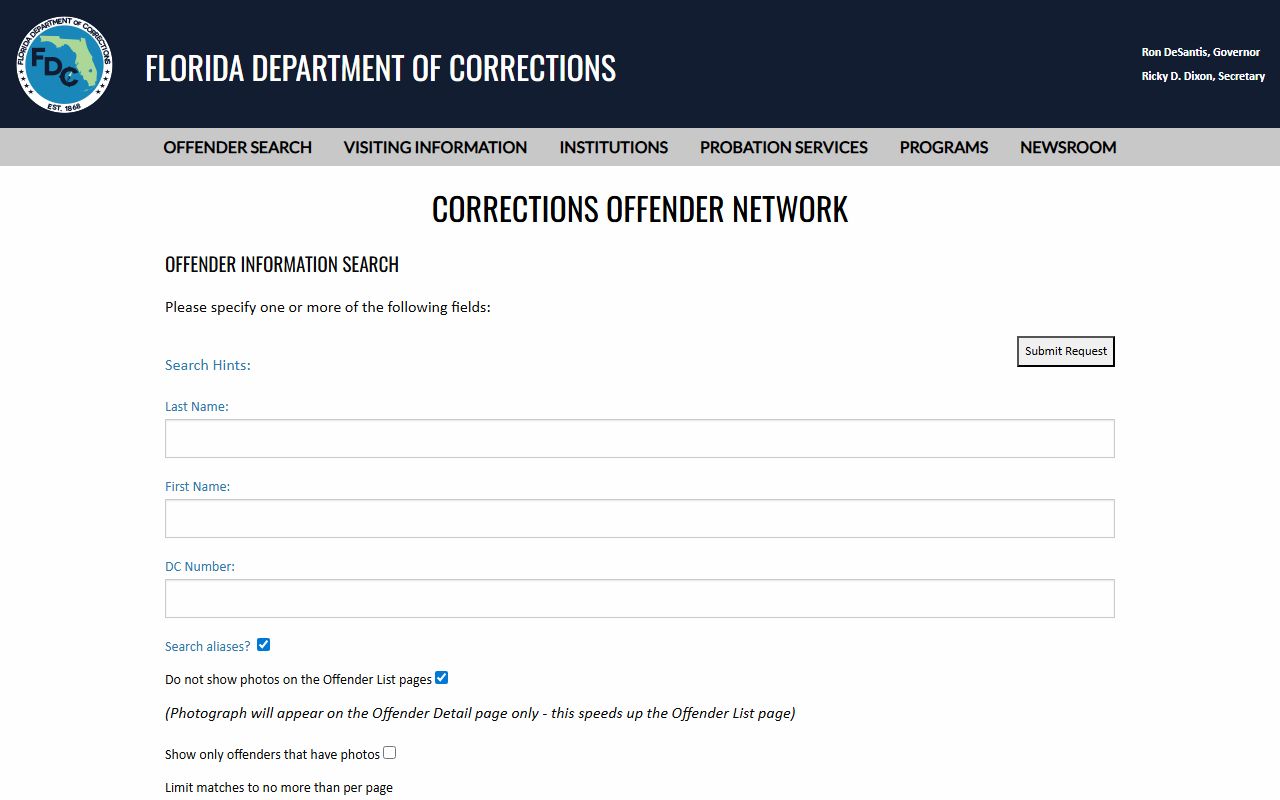
Felony DUI and vehicular homicide convictions that result in a prison sentence will appear in the FDOC offender database; this resource is separate from the Clerk's local traffic and criminal case files.
Deferred Adjudication and the Driving School Option
Florida does not use the term "deferred adjudication" in the same way some other states do, but it does allow drivers cited for eligible civil traffic infractions to elect a basic driver improvement course. When a driver elects this course and completes it within the required time period, the court may withhold adjudication. Withholding adjudication means no formal conviction is entered and no points are assessed on the state driver record, even though the citation itself remains a court record. This option is available once every 12 months and no more than five times total in a driver's lifetime for civil infractions.
Not all infractions are eligible. Some violations require a mandatory court appearance and do not allow the school election. Criminal traffic charges never qualify. CDL holders face separate federal restrictions that effectively block the school election option for many violations. Drivers who elect the course must pay the election fee, enroll in a state-approved basic driver improvement course, and provide proof of completion to the Clerk before the deadline. Missing the deadline can result in the election being voided and the citation being adjudicated. The fee for the school election and information about the enrollment process are listed on the Clerk's traffic services page at stlucieclerk.gov/services/traffic-tickets.
Sealing or Expunging St. Lucie County Traffic Records
Most civil traffic infraction records in Florida are not eligible for expunction or sealing. The expunction and sealing statutes, Florida Statutes section 943.0585 and section 943.059, apply to qualifying criminal history records, not to civil infraction court files. A driver who paid a speeding ticket or had one dismissed cannot expunge that court record under those statutes. The record remains in the Clerk's system as a matter of court history.
Criminal traffic charges that resulted in an arrest and were later dismissed or not prosecuted may qualify for expunction under section 943.0585, depending on the circumstances and the driver's record history. A charge that resulted in adjudication withheld may qualify for sealing under section 943.059, again depending on the full record. The Florida Department of Law Enforcement (FDLE) administers the expunction and sealing process at the state level. A driver seeking to seal or expunge a criminal traffic record must apply through FDLE, obtain a certificate of eligibility, and then petition the court. The Clerk's contact page can direct you to the relevant court division for filing such a petition in St. Lucie County.
The screenshot below is from the Florida Department of Corrections website, which maintains separate records for individuals who moved from county-level criminal traffic convictions to state prison.
The FDOC database is distinct from St. Lucie County's court records; it tracks individuals sentenced to state prison, which can occur after felony criminal traffic convictions that the county court record system records locally first.
Fees for St. Lucie County Traffic Record Copies
The Clerk of the Circuit Court and Comptroller charges fees for paper copies and certified copies of traffic court records. These fees are set by statute under Florida Statutes section 28.24, which authorizes clerk service charges for copies, certifications, and related court services. The research available for St. Lucie County does not include specific per-page dollar amounts published separately for traffic records, so exact fees should be confirmed directly with the Clerk before visiting or submitting a request.
The complete and current fee schedule is posted at stlucieclerk.gov/fees. The traffic services page at stlucieclerk.gov/services/traffic-tickets also lists fees related to payment, school elections, and hearings. Fees for viewing records online through the Benchmark portal are generally not charged for basic case lookups, but obtaining certified copies or paper records from the Clerk's office carries per-page costs as authorized by section 28.24.
State driver record copies are separate from court record copies and are requested through the Florida DHSMV, not through the Clerk. The DHSMV charges its own fee for driver record abstracts under Florida Statutes section 322.20. Those fees are listed on the DHSMV website at flhsmv.gov, not through the St. Lucie Clerk's office.
Note: Certified copies of traffic case records are sometimes needed for insurance purposes, license reinstatement applications, or out-of-state license processes; contact the Clerk's office to confirm the current per-page fee before requesting copies.