
How to Look Up St. Lucie County Jail Population Data
The official starting point for St. Lucie County jail population data is the St. Lucie County Sheriff's Office inmate information page. That page anchors the public-facing custody resources, including the live inmate lookup, the release report, and contact details for the detention facility. The Sheriff's site does not publish a standalone real-time population counter, but the live roster represents the current custody count at any moment it is viewed. Because bookings and releases happen around the clock, the count shifts continuously.
For aggregate population statistics, annual averages, trends, and demographic breakdowns, official sources include the Sheriff's annual report and the county budget, both of which may appear on the county government and Sheriff's Office websites. The Bureau of Justice Statistics (bjs.ojp.gov) publishes national jail census data every year or two, and those reports include state-level and size-category breakdowns that place a county's figures in context. The Census Bureau's QuickFacts page for St. Lucie County provides the county population denominator needed to calculate a rate per 100,000 residents. When a specific St. Lucie figure is not confirmed in an official local document, the data below is labeled as state or national to avoid conflating the two.
The screenshot below shows the Sheriff's inmate information landing page, which routes visitors to the custody search and related jail services.
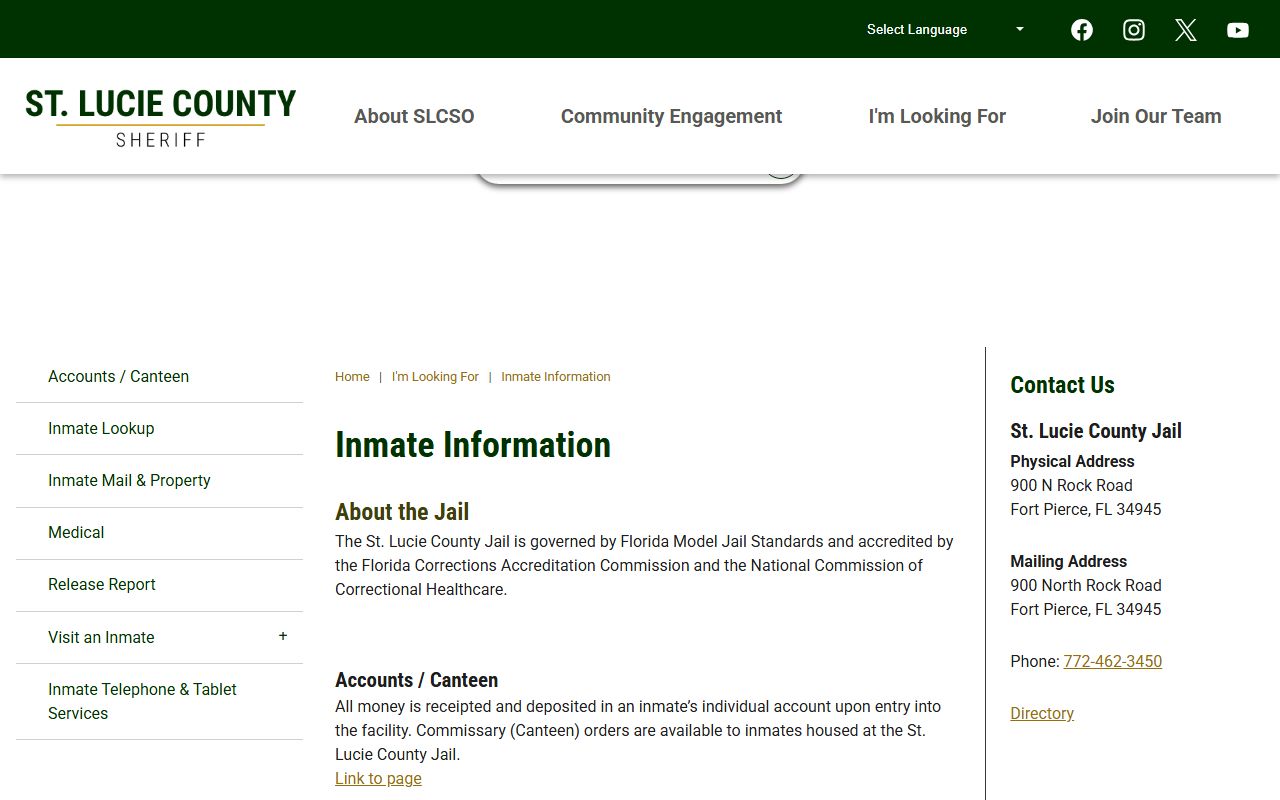
The inmate information hub links out to inmate lookup, release reports, visitation scheduling, mail rules, and inmate account services, all maintained by the Sheriff's Office.
St. Lucie County Jail Capacity Overview
The St. Lucie County detention facility is operated by the St. Lucie County Sheriff's Office. It holds people at various custody levels, including pretrial defendants awaiting first appearance or trial, people serving county sentences for misdemeanor convictions, probation and community-control violators, individuals held on out-of-county or state warrants, and sometimes federal or other-agency holds. The facility is the county's primary jail and detention operation. A precise rated capacity figure was not confirmed in the official public sources inspected during research. The table below reflects what is known and what remains to be verified from official county budget documents or the Sheriff's annual report.
| Facility | Rated Capacity | Current Population |
|---|---|---|
| St. Lucie County Jail / Detention Facility | Not confirmed in inspected sources, verify via Sheriff's Office or county budget | See live roster at Sheriff inmate lookup |
Note: Official capacity and internal housing-unit details were not located in the publicly accessible pages inspected. The county adopted budget, Sheriff's annual report, or a Florida jail inspection report are the correct sources for a verified bed count. Do not rely on third-party data sites for a capacity figure, as those numbers are often outdated or sourced from informal surveys.
St. Lucie County Average Daily Population
Average daily population (ADP) is the standard metric used to compare jail sizes and workloads over time. It is calculated by dividing total annual inmate-days by 365. A county's ADP is the figure most often cited in budget requests, inspection reports, and BJS census responses. For St. Lucie County, a confirmed ADP figure for recent years was not located in the official public sources reviewed during research preparation. The Sheriff's annual report, if published, is the primary local document that would carry this number. The county budget may also include a projected or prior-year ADP figure as a performance measure tied to jail staffing and operations funding.
At the state level, Florida jails collectively hold a large daily population. BJS data consistently shows Florida among the larger jail-state systems nationally, given its population size and court volume. When a St. Lucie ADP figure becomes available from official sources, it can be compared against the BJS national median for jails of similar size to gauge whether the county is above or below the norm for its population tier.
The on-site visitation rules page, shown below, reflects an operational aspect of managing jail population, visitor access policy is directly tied to facility capacity and current population levels.
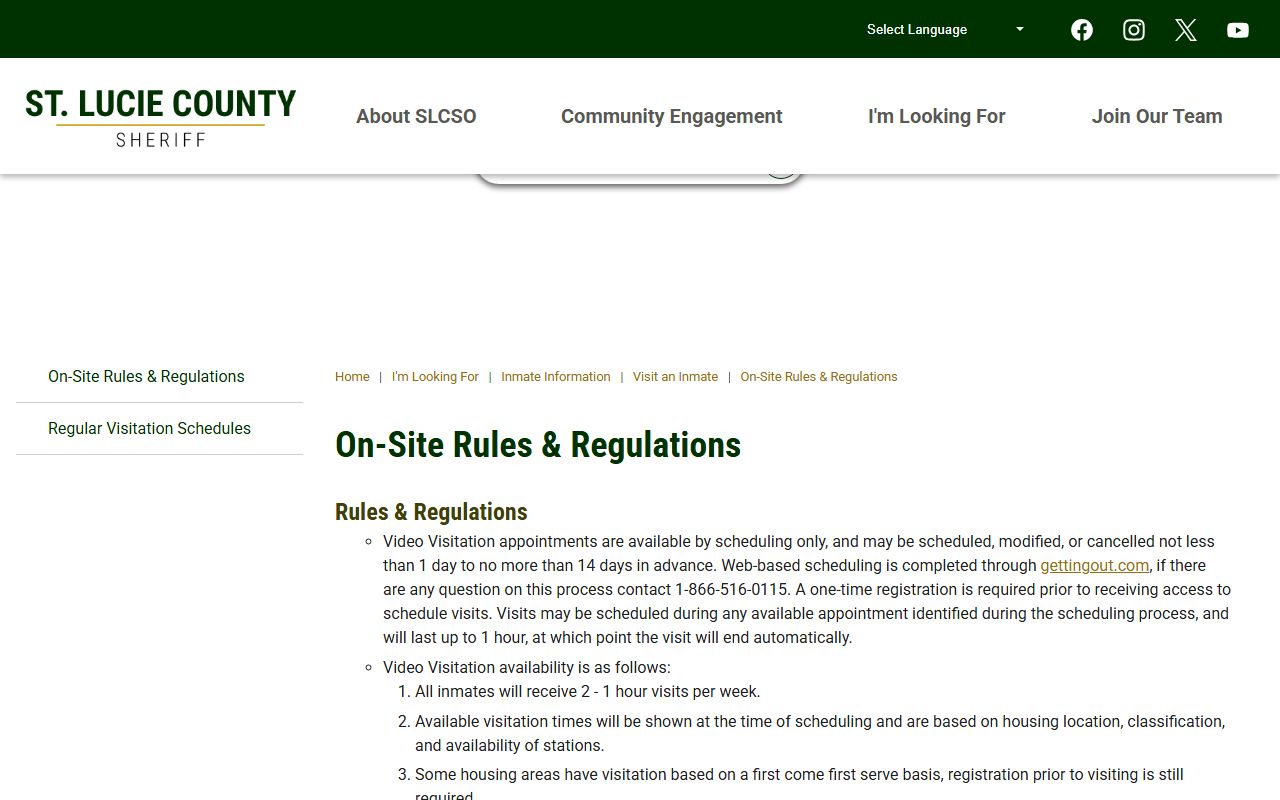
Visitation rules at the St. Lucie County jail set the access framework that applies to all persons in custody, regardless of their pretrial or sentenced status.
Demographic Breakdown of St. Lucie County Inmates
Jail populations across the United States show consistent demographic patterns documented by BJS in its annual jail surveys. Nationally, men make up roughly 85 percent of the jail population. Women represent about 15 percent, a share that has grown over the past two decades. Racial and ethnic data show that Black and Hispanic individuals are overrepresented relative to their share of the general population, a pattern seen in virtually every state and documented extensively in BJS reports and Vera Institute research. Age distribution typically skews younger, with a large share of the jail population between 20 and 39 years old.
For St. Lucie County specifically, a confirmed demographic breakdown was not found in the official public sources inspected during research. The table below presents national benchmarks from BJS for context. When the Sheriff's annual report or a county-sourced document confirms local figures, those numbers should replace the national estimates in any updated version of this data.
| Group | National Jail Average (BJS) | St. Lucie County |
|---|---|---|
| Male | Approx. 85% | Not confirmed, see Sheriff's annual report |
| Female | Approx. 15% | Not confirmed, see Sheriff's annual report |
| Age 18-39 | Majority of total population (BJS midyear reports) | Not confirmed locally |
Census QuickFacts for St. Lucie County, shown below, provides the general population context needed to calculate local rates per 100,000 residents once facility counts are confirmed.
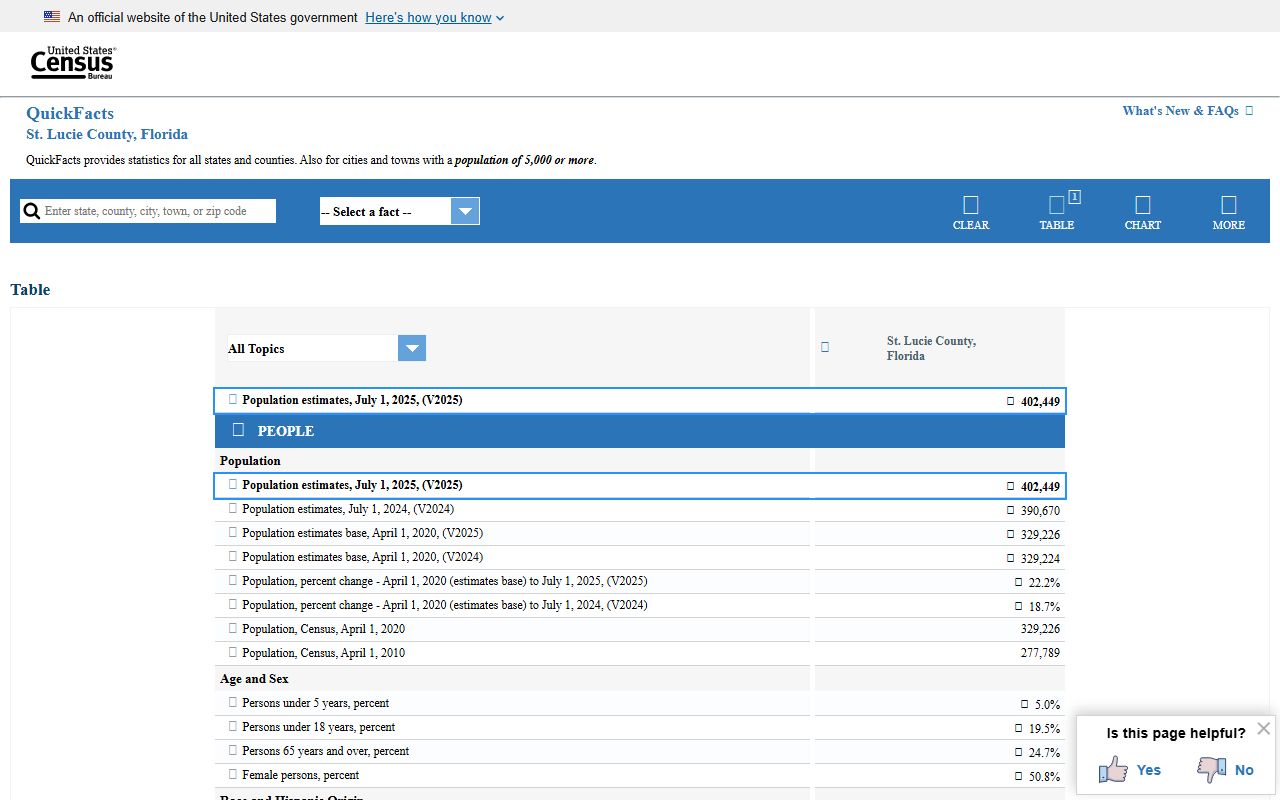
QuickFacts data shows St. Lucie County's total resident population, age distribution, and race and ethnicity breakdown, the denominators used to calculate per-capita incarceration rates.
Note: National demographic figures are sourced from BJS Jail Inmates reports; they are national averages, not St. Lucie County-specific data.
Pretrial vs. Sentenced Population in St. Lucie County
The pretrial share of jail population is one of the most debated metrics in criminal justice research. Nationally, BJS data shows that more than 70 percent of the people held in local jails on any given day have not yet been convicted of the charge for which they are held. They are awaiting first appearance, bail hearing, arraignment, plea, or trial. The remaining share are people serving county sentences, usually misdemeanor terms of a year or less, or people held on probation or parole violations pending a hearing.
St. Lucie County follows Florida's pretrial process, which requires a first appearance hearing within 24 hours of arrest under Florida criminal procedure rules. At that hearing a judge reviews bond eligibility, issues conditions of release or no-bond orders, and in some cases releases defendants on their own recognizance. People who cannot meet bond conditions remain in custody as pretrial detainees. The longer a case takes to resolve, the longer pretrial detention continues. For people charged with felonies, which are handled in Circuit Court, pretrial stays can run months if continuances, discovery, or complex legal issues delay the case.
| Status | National Average (BJS) | St. Lucie County |
|---|---|---|
| Pretrial (unconvicted) | Approx. 70-75% | Not confirmed locally, see Sheriff/county budget |
| Sentenced | Approx. 25-30% | Not confirmed locally, see Sheriff/county budget |
People convicted of felonies and sentenced to state prison are transferred out of the county jail to Florida Department of Corrections custody. They are no longer counted in the local jail population once that transfer occurs. This distinction matters when reading county population figures: a large pretrial share can grow when state prison transfers slow down or when court backlogs keep cases pending longer.
Misdemeanor vs. Felony Population
Florida uses Circuit Court for felony cases and County Court for misdemeanor cases. In practical jail terms, this means the local detention facility holds people from both courts at the same time. Felony defendants waiting for a Circuit Court proceeding represent a large share of any Florida county jail population because felony cases take longer to resolve and the stakes of pretrial release decisions are higher. Misdemeanor defendants in the St. Lucie County jail may be held pretrial awaiting County Court proceedings or serving a short county sentence after conviction.
People convicted of felonies and sentenced to a state prison term are removed from county custody and transferred to the Florida Department of Corrections. Once that transfer happens, they are no longer part of the county jail count. Probation and community-control violators can return to county custody pending a violation-of-probation hearing even after their original case closed. Those re-entries add to the daily count without representing new criminal charges.
A confirmed felony-to-misdemeanor ratio for the St. Lucie County jail was not located in the accessible public sources reviewed during research. The Sheriff's annual report, county budget, or an official jail inspection report from the Florida Department of Corrections inspection program would be the correct source for that breakdown. The mail rules page, shown below, offers one view of how the jail manages population logistics for all custody categories.
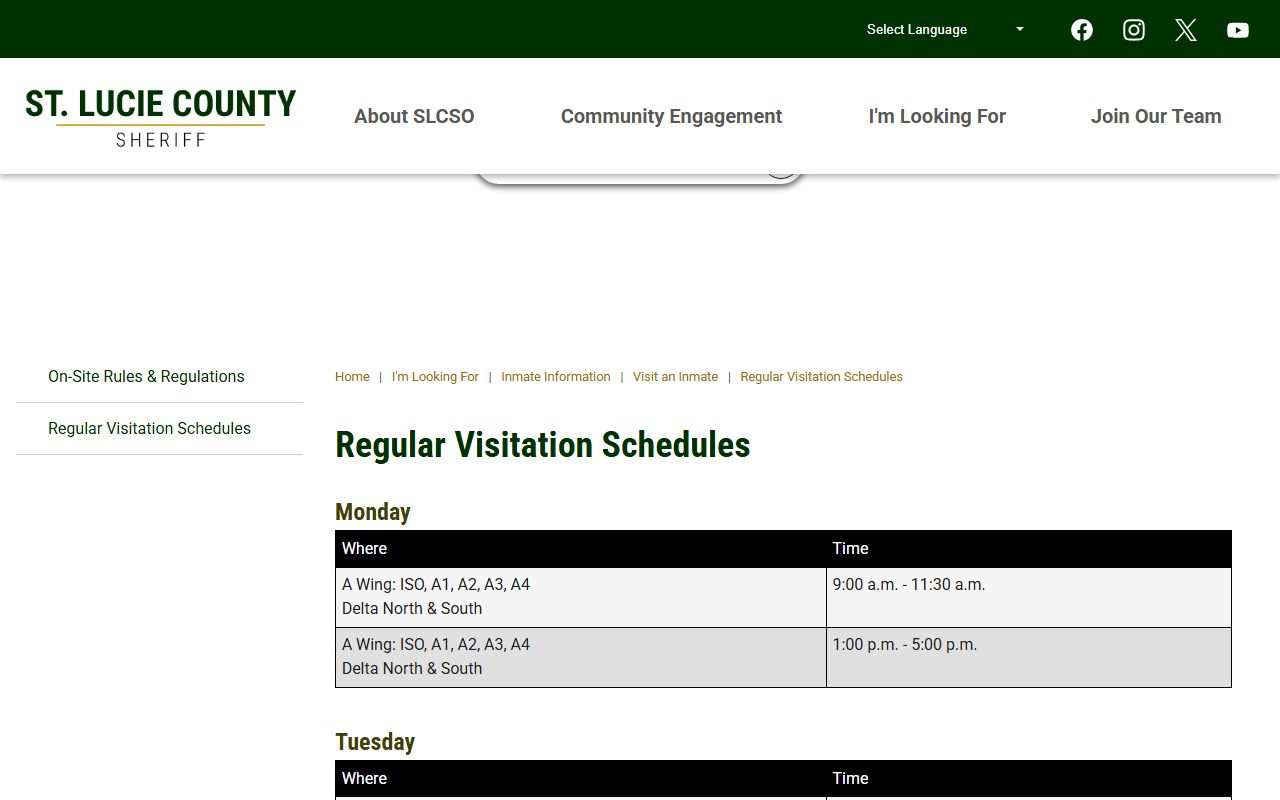
Mail rules apply equally to all people in custody, whether held pretrial on a felony, serving a misdemeanor sentence, or detained on a violation hold.
Mental Health and Medical Population
Mental health needs in jails have grown sharply across the United States over the past two decades. BJS surveys and Vera Institute research document that a significant share of people in local custody, estimates range from 20 to over 40 percent depending on the study and screening method, have a diagnosable mental health condition. Jails have increasingly become de facto mental health facilities, particularly in areas where community behavioral health resources are limited or underfunded.
Florida's Baker Act (Florida Statutes Chapter 394) allows for involuntary examination of a person experiencing a mental health crisis. Some people in county jails had Baker Act involvement before or during the same event that led to their arrest. Others have serious mental illnesses that affect their competency to stand trial, which can significantly extend pretrial detention while the court manages competency proceedings. The Nineteenth Judicial Circuit, which includes St. Lucie County, operates through the circuit court structure that handles competency evaluations and Baker Act-related civil commitments at the same courthouse complex.
Medical needs also affect jail population management. Older inmates, people with chronic conditions, and those with substance-use disorders require health services that go beyond basic sick call. Jail population managers track medical beds, health service contracts, and infirmary use as part of capacity planning. A specific mental health or medical population figure for the St. Lucie County jail was not confirmed in publicly accessible sources reviewed during research preparation. The Sheriff's Office inmate information page is the best entry point for current operational detail.
National and State Context for St. Lucie County Jail Population
The Bureau of Justice Statistics publishes the Census of Jails and the Annual Survey of Jails, which are the primary national benchmarks for local jail population data. The most cited summary statistic is the jail incarceration rate: the number of people in jail per 100,000 U.S. residents. Nationally, BJS data puts that rate in the range of 220 to 230 per 100,000 in recent mid-year reports, down from a peak of around 260 per 100,000 before 2008. The COVID-19 period (2020-2021) produced a sharp temporary drop as many jurisdictions reduced jail populations in response to health risk. Post-COVID figures have partially recovered but remain below pre-2020 levels in many states.
Florida's statewide jail rate is generally near the national average or slightly above, reflecting a large and active criminal court docket across 67 counties. The Vera Institute of Justice tracks jail trends at a county level and has documented wide variation within states: large urban counties often have lower rates per capita than mid-size or rural counties, because urban courts typically have more diversion programs and bail reform initiatives in place. St. Lucie County is a mid-size coastal county, and its rate per 100,000 would be expected to fall somewhere in the mid-range for Florida counties of similar size and court volume. The screenshot below captures the BJS website, which houses all national jail reports.
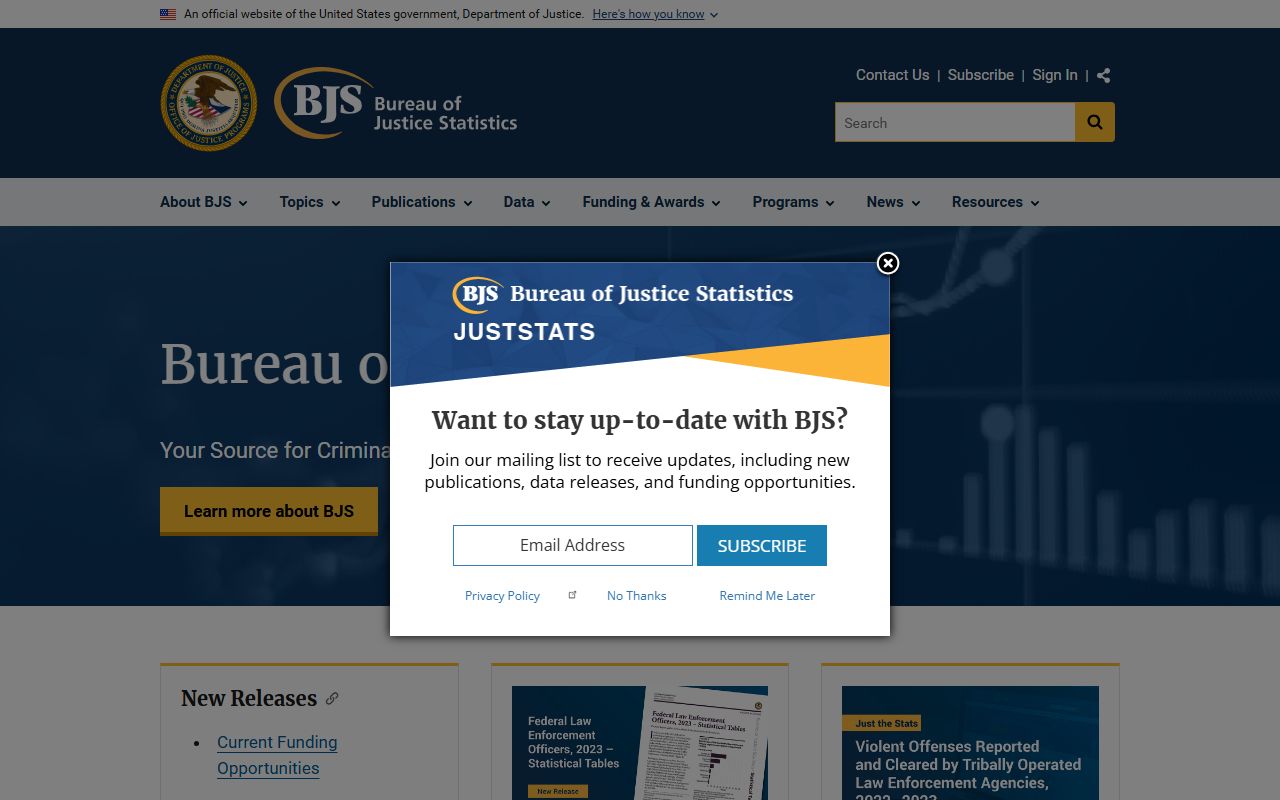
BJS publishes detailed methodology notes with each jail report, including how facilities self-report ADP, capacity, and inmate characteristics, context that helps interpret any county figure.
The comparison table below uses BJS national figures and Florida context. The St. Lucie County row reflects the absence of a confirmed official figure and points to where that number should be sought.
| Level | Jail Population per 100,000 Residents | Source |
|---|---|---|
| St. Lucie County | Not confirmed, verify via Sheriff annual report or county budget | Sheriff's Office |
| Florida (statewide) | Near national average; varies by county (BJS state tables) | BJS Annual Survey of Jails |
| National | Approx. 220-230 per 100,000 (recent BJS midyear data) | BJS Census of Jails |
Note: BJS national figures come from Jail Inmates midyear reports; Florida and county-level figures should be verified against the most recent BJS state-level tables and local official sources.
St. Lucie County Jail Population Trends Over Time
A confirmed five-year trend for the St. Lucie County jail was not located in the accessible public sources reviewed during research. The research file notes this gap explicitly. The correct sources for a verified local trend are: (1) the St. Lucie County adopted budget, each year's budget document may include prior-year jail population actuals alongside the next-year projection; (2) the Sheriff's annual report, if published; (3) county commission agenda packets and related budget workshops, which sometimes include jail operations summaries; and (4) any Florida jail inspection reports filed with the Florida Department of Corrections.
At the national level, BJS data shows a clear long-term arc. Jail populations grew steadily from the 1970s through the mid-2000s. They peaked around 2008, declined modestly through the 2010s, then dropped sharply in 2020 when COVID-19 prompted emergency population reductions across most jurisdictions. The post-2020 recovery has been uneven, some counties rebounded to near pre-pandemic levels while others stayed lower, driven by bail reform, citation release policies, and diversion program growth. Florida counties generally saw the same COVID-period drop, and many are now operating at 2019-era levels or slightly below.
For St. Lucie County, local driving factors likely include felony case filings in Circuit Court, probation supervision volume handled by the state Department of Corrections supervision office, local law enforcement activity levels, and decisions by the State Attorney and courts on diversion and bond conditions. All of these feed or draw from the local jail count. The St. Lucie County public transit resource page, shown below, is one example of the county service infrastructure that supports reentry and alternatives to incarceration.

Local transit and community services affect reentry outcomes, which in turn affect recidivism patterns and whether former inmates cycle back into the jail population.
Searching St. Lucie County Inmate Records by Name
Aggregate St. Lucie County jail population data, total counts, demographic patterns, pretrial shares, and national context, is what the sections above cover. Individual inmate records and the live roster are separate. For name-based inmate searches, the correct resource is St. Lucie County inmate records, which covers the Sheriff's live custody search, booking details, charge information, and bond status. The Sheriff's inmate lookup at stluciesheriff.com is the official tool for finding a specific person currently in custody. For people who have been released, the released inmates page covers the Sheriff's release report, Florida DOC transfers, and VINELink notifications.
Where the St. Lucie County Jail Data Comes From
Population and capacity data for the St. Lucie County jail comes from several official layers. The primary local source is the St. Lucie County Sheriff's Office, which operates the detention facility and reports to the county commission and the public through budget documents, annual reports, and its public website at stluciesheriff.com. The Sheriff's Office also participates in state-level reporting to the Florida Department of Corrections, which conducts jail inspections and compiles statewide jail data. Those inspection reports are a secondary official source for capacity, staffing, and population figures.
At the federal level, the Bureau of Justice Statistics surveys local jails as part of its Census of Jails (full census conducted periodically) and Annual Survey of Jails (sample-based, most years). Jails above a certain size threshold are included in the annual survey. BJS publishes these results with state-level and national breakdowns, making them the standard reference for comparing one county's population against peers. The Vera Institute of Justice also compiles county-level jail population data and trends, drawing on BJS surveys and supplementary local sources, and makes these available through its research publications. The Census Bureau's QuickFacts page for St. Lucie County provides the resident population figure used as the denominator in per-capita rate calculations.
For criminal records and court case information related to people in custody, the St. Lucie Clerk of the Circuit Court and Comptroller maintains the official docket and case records through the court case search portal at stlucieclerk.gov. Warrant information relevant to holds and custody is tracked through the warrant records page.