
St. Lucie County Court Overview
The County Court is the lower of Florida's two trial-court levels. It sits below the Circuit Court in the state's four-tier judicial structure and handles a broad range of matters that do not rise to circuit-level jurisdiction. In St. Lucie County, the County Court operates within the Nineteenth Judicial Circuit alongside Martin, Indian River, and Okeechobee counties. The Nineteenth Judicial Circuit's administrative structure and judge assignments are listed at circuit19.org, and that site is the best place to confirm current divisions and judicial staff.
County Court is not a specialized court. It is the general lower trial court for the county and deals with the everyday matters that affect residents most often. Misdemeanor criminal cases, civil infractions, traffic tickets, small claims, landlord-tenant evictions, county civil collections, and local ordinance enforcement all belong in this court. Matters involving felony charges, family law, probate, guardianship, or larger civil disputes are not County Court matters; those go to the Circuit Court. If you are unsure which court has jurisdiction over a case, the Florida Courts website explains the division of authority between county and circuit courts.
Both the County Court and the Circuit Court share the physical courthouse at 218 South 2nd Street in Fort Pierce. The Clerk of the Circuit Court and Comptroller, Michelle R. Miller, maintains case files for both courts and provides public access through online portals and in-person service locations in Fort Pierce and Port St. Lucie.
St. Lucie County Court Divisions
The County Court hears several distinct types of cases. Each category has its own filing rules, procedures, and fee schedules. The table below shows the main divisions and the case types assigned to each.
| Division | Case Types | Location |
|---|---|---|
| County Criminal / Misdemeanor | First- and second-degree misdemeanors, criminal traffic offenses other than felony DUI, and local ordinance violations carrying criminal penalties | St. Lucie County Courthouse, 218 South 2nd Street, Fort Pierce |
| County Civil | Civil claims within county-court jurisdictional limits, consumer collections, contract disputes, and civil enforcement matters not assigned to Circuit Court | St. Lucie County Courthouse, 218 South 2nd Street, Fort Pierce |
| Small Claims | Low-value money disputes filed through the small claims process; service available through the Clerk at stlucieclerk.gov/services/small-claims | St. Lucie County Courthouse, 218 South 2nd Street, Fort Pierce |
| Traffic | Civil traffic infractions, moving violations, and non-criminal traffic citations; criminal traffic DUI/reckless matters may go to the misdemeanor or circuit division depending on degree | Handled through Clerk traffic services at stlucieclerk.gov/services/traffic-tickets |
| Eviction / Landlord-Tenant | Residential and commercial eviction proceedings, writs of possession, and landlord-tenant matters filed in the county civil division | St. Lucie County Courthouse, 218 South 2nd Street, Fort Pierce |
Note: Division assignments and case routing can change with judicial order or administrative directive. Confirm the correct division for a filing with the Clerk or the Nineteenth Judicial Circuit before submitting documents.
How to Search St. Lucie County Court Records
County Court case records in St. Lucie County are searched through the same Benchmark portal used for Circuit Court cases. The Clerk maintains one unified case search system at courtcasesearch.stlucieclerk.gov. You can reach it directly or from the public search landing page at stlucieclerk.gov/public-search-gen/search-court-cases. The portal covers both circuit-level and county-level cases. When you search by name or case number, results may include cases from either court level, so check the Division column to confirm you are looking at a County Court record.
A step-by-step process for looking up a County Court case:
- Go to the Benchmark public search portal through the Clerk's case search page.
- Select your search mode. The portal typically allows search by party name, case number, or citation number.
- Enter a case number if you have one. A full case number is the fastest way to find a specific file. If you only have a name, enter last name first, then first name.
- Use the Division or Court Type filter if the portal shows one. Select county criminal, county civil, traffic, or small claims to narrow results to County Court cases.
- Review the results list. Check the Division column and the Case Type field to confirm the match.
- Open the case detail page to see docket entries, parties, hearing dates, and any available documents.
- For documents that are not shown online or are restricted, contact the Clerk of the Circuit Court and Comptroller for copy and access instructions.
The search-field table below shows the inputs available in the Benchmark portal for St. Lucie County Court case searches.
| Field Label | Type | Required | Format Notes |
|---|---|---|---|
| Search Type / Search By | Tab or dropdown | Required | Choose party name, case number, or citation number mode |
| Last Name / Business Name | Text | Conditional | Required when searching by party; spelling matters |
| First Name | Text | Optional | Narrows person searches with common last names |
| Case Number | Text | Conditional | Best identifier; use exact format from court notices |
| Citation Number | Text | Conditional | Used for traffic ticket and citation records |
| Filing Date From / To | Date | Optional | Use MM/DD/YYYY format; narrows by date range |
| Court Type / Division | Dropdown | Optional | Select county civil, county criminal, traffic, or small claims |
| Party Role | Dropdown | Optional | Plaintiff, defendant, petitioner, respondent |
Public online access does not equal complete document access. Confidential records, sealed cases, juvenile matters, adoption files, and documents with protected personal information are withheld or redacted under Florida Statutes section 119.0714 and Florida Rule of General Practice and Judicial Administration 2.420. If a case does not appear online, contact the Clerk to ask whether the record exists in another format or is subject to a confidentiality restriction.
St. Lucie County Court Traffic Cases
Traffic matters make up a large share of County Court activity in St. Lucie County. Civil traffic infractions, moving violations, and most routine traffic citations are heard in the County Court traffic division. The Clerk's traffic services page at stlucieclerk.gov/services/traffic-tickets is the official starting point for paying a ticket, selecting a driving school election, requesting a hearing, or looking up a citation. You can search by citation number, case number, or driver name through the Benchmark portal.
Criminal traffic offenses are handled differently. A DUI or a reckless driving charge that rises to the level of a criminal offense is not treated as a civil infraction. Those cases route through the County Court misdemeanor division or, if the DUI involves serious injury or death, through Circuit Court as a felony. See the criminal records page for more on how DUI and criminal traffic charges are processed.
The comparison below shows the difference between a County Court traffic record and a Florida state driver record. These are two separate files held by separate agencies.
| Topic | County Court Traffic Record | State Driver Record |
|---|---|---|
| Custodian | Clerk of the Circuit Court and Comptroller | Florida driver licensing agency |
| What It Shows | Citation number, court events, fine amount, plea or election, and disposition | License status, convictions, point totals, and suspension history |
| Primary Use | Court compliance, ticket payment, and case lookup | Driving history for insurance, employment, or licensing purposes |
| Where to Search | Clerk traffic page and Benchmark case portal | State driver record request process |
Note: A paid or dismissed citation in the County Court record does not automatically remove points from a state driver record; those are separate reporting processes governed by Florida Statutes section 322.20.
Small Claims and County Civil in St. Lucie
Small claims is a simplified civil process within the County Court for lower-value money disputes. It is designed so that people can file and appear without an attorney, though having one is allowed. The Clerk's small claims page at stlucieclerk.gov/services/small-claims provides forms, instructions, and fee information. Common small claims matters include unpaid debts, damage to personal property, security deposit disputes, and consumer contract disagreements.
County civil cases are the broader civil docket that includes matters beyond small claims but still within county-court jurisdiction. These can include collection actions, civil judgment enforcement, and lower-value civil disputes that do not qualify for Circuit Court. When a judgment is entered in County Court, the prevailing party can use post-judgment collection tools such as garnishment or levy to satisfy what is owed.
Eviction cases, also called unlawful detainer or residential eviction proceedings, are filed in the county civil division. A landlord who needs to remove a tenant after a lease violation or nonpayment files a complaint in County Court. The case proceeds quickly under Florida's eviction timeline rules. Both the complaint and any resulting judgment are public records searchable through the Clerk's Benchmark portal. Tenants who receive eviction notices should check the case status online and respond before any hearing deadlines pass.
St. Lucie County Court Location
The County Court operates at the St. Lucie County Courthouse in downtown Fort Pierce. The courthouse is located at 218 South 2nd Street, Fort Pierce, Florida 34950, near Orange Avenue and South Indian River Drive in the county's downtown government district. Both the County Court and the Circuit Court hold hearings at this location.

The map above shows the main courthouse location in downtown Fort Pierce where St. Lucie County Court hearings and filings take place. Arrive early to allow time for security screening, and confirm your specific courtroom or Clerk service counter before your visit because County Court and Circuit Court activity both take place in the same building. Clerk service is also available at the St. Lucie West branch at 250 Northwest Country Club Drive, Port St. Lucie, Florida 34986, though not all court functions are available there.
Visitors should bring a case number or citation number when possible. Government identification may be needed for requests involving certified or protected records. Courthouse security includes bag screening and metal detection.
County Court vs. Circuit Court vs. Municipal Court
Understanding which court handles a matter matters. Filing in the wrong court can delay a case or result in dismissal. The table below compares the three main court levels that affect St. Lucie County residents.
| County Court | Circuit Court | Municipal / Code Court | |
|---|---|---|---|
| Civil Jurisdiction | Lower-value civil claims, small claims, evictions, and county civil matters within statutory limits | Higher-value civil cases, real property disputes, injunctions, and complex civil litigation | Not a general civil court; limited to local ordinance enforcement and code proceedings where applicable |
| Criminal Jurisdiction | First- and second-degree misdemeanors, criminal traffic at the misdemeanor level | Felony offenses, felony DUI with injury or death, and felony-level criminal traffic | Local ordinance violations carrying civil or administrative penalties depending on city rules |
| Family Cases | No; family-law matters are Circuit Court | Yes; divorce, custody, paternity, domestic violence injunctions, dependency | No; not a family court |
| Probate / Guardianship | No; probate is a Circuit Court division | Yes; estates, wills, guardianship, and trust matters | No |
| Appeals From This Level | County Court decisions appeal to Circuit Court | Circuit Court decisions appeal to the District Court of Appeal | Varies by city charter and ordinance structure |
For cases that belong in Circuit Court, see the Circuit Court page for details on the Nineteenth Judicial Circuit, its divisions, and how to search circuit-level cases.
How a Case Moves Through St. Lucie County Court
Cases in the County Court follow different paths depending on whether they are criminal, civil, or traffic matters. The process below covers the two main tracks most common in the County Court.
Misdemeanor criminal flow:
Arrest or citation › First appearance before a judge › Arraignment (charges read, plea entered) › Pretrial motions and hearings › Plea or trial › Sentencing if convicted › Appeal to Circuit Court if applicable
Civil / small claims / eviction flow:
Complaint or petition filed with Clerk › Summons issued and served › Defendant answers or defaults › Hearing or mediation › Judgment entered › Post-judgment collection or enforcement › Appeal to Circuit Court if applicable
The appeal path is a key distinction. When a party loses in County Court and wants to challenge the outcome, the appeal goes up to the Circuit Court. It does not go directly to the District Court of Appeal. That second level of appeal is available from Circuit Court decisions. The full Florida court hierarchy runs: County Court › Circuit Court › District Court of Appeal › Florida Supreme Court for certain matters.
All docket entries for County Court cases, including filings, hearing dates, orders, and dispositions, are accessible through the court dockets page and the Benchmark portal. The court records page explains in detail what fields appear in a public case record and how to read the docket chronologically.
Florida Court Access Rules and County Court Records
Florida's public-record framework gives broad access to County Court records. The state's public-record policy under Florida Statutes section 119.01 favors inspection and copying of public records. Court records are further governed by Florida Rule of General Practice and Judicial Administration 2.420, which sets out confidential categories and the procedures for protecting them. The practical result in St. Lucie County is that most County Court dockets, filings, and judgments are publicly accessible online, but specific documents and protected fields may be redacted or withheld.
Restricted material in County Court records can include personal identifiers such as Social Security numbers and bank account numbers, victim information in domestic violence or stalking cases, protected addresses in certain safety cases, and sealed or expunged criminal history. The sealing and expunction statutes, section 943.059 for sealing and section 943.0585 for expunction, allow qualifying defendants to have County Court misdemeanor records restricted or removed from public access after meeting eligibility requirements. A sealed record still exists in the court system but is not available to the public. An expunged record is removed from public access more completely.
The Florida Courts Standards of Access to Electronic Court Records sets the statewide framework for what can and cannot be made available through online portals. Those standards directly shape what the Clerk's Benchmark portal shows to the public for County Court cases in St. Lucie.
The Florida Courts Standards of Access page shown above governs what County Court records can appear in online public portals like the one the St. Lucie Clerk operates. Understanding these standards helps explain why some case documents are visible while others are listed but not downloadable.
Misdemeanor Cases in St. Lucie County Court
First- and second-degree misdemeanors are the main criminal category in the County Court. Common first-degree misdemeanors include simple battery, petit theft, driving with a suspended license (certain degrees), and misdemeanor-level domestic-related offenses. Second-degree misdemeanors carry lower maximum penalties. Both are distinct from infractions, which are civil matters, and both are distinct from felonies, which go to Circuit Court.
A misdemeanor case typically starts with an arrest or a notice to appear. The Clerk assigns a case number and the case appears on the Benchmark portal. The defendant goes through first appearance, arraignment, and any pretrial hearings before a plea or trial resolves the matter. The disposition, whether a dismissal, a plea, or a conviction, appears in the public case docket along with any sentence, probation terms, fines, court costs, and conditions.
The State Attorney's Office for the Nineteenth Judicial Circuit handles prosecution of County Court criminal cases. The Public Defender's Office represents eligible defendants. Both offices operate within the same circuit-wide structure as the Circuit Court. Defense counsel, whether public or private, can file motions, seek discovery, negotiate pleas, and appear at hearings. All of that activity creates docket entries visible in the public case record.
Misdemeanor convictions can affect employment, housing applications, professional licenses, and immigration status. A person who received a qualifying misdemeanor disposition and has no disqualifying history may be able to petition for sealing or expunction under Florida law. That process begins with an eligibility determination and a petition to the same County Court that handled the original case. See the criminal records page for more on sealing and expunction procedures.
Note: Ordinance violations that carry criminal penalties are also heard in County Court under the misdemeanor or quasi-criminal docket depending on how the ordinance is written and what penalty it authorizes.
Official St. Lucie County Court Resources
Several official sources support County Court users in St. Lucie. The Florida Courts website at flcourts.gov provides statewide self-help resources, court forms, and information on the structure and operation of Florida's court system. The Nineteenth Judicial Circuit site at circuit19.org covers local judicial administration, judge assignments, specialty court programs, and circuit-wide resources relevant to both County Court and Circuit Court.
The Clerk of the Circuit Court and Comptroller is the primary local resource for County Court filings and records. The main Clerk site at stlucieclerk.gov includes links to the case search portal, the traffic ticket payment page, the small claims forms and instructions, official records search, fees, and contact information for both service locations. The Clerk's fee schedule at stlucieclerk.gov/fees covers County Court filing fees, copy fees, certification charges, and other service costs authorized under Florida Statutes section 28.24.
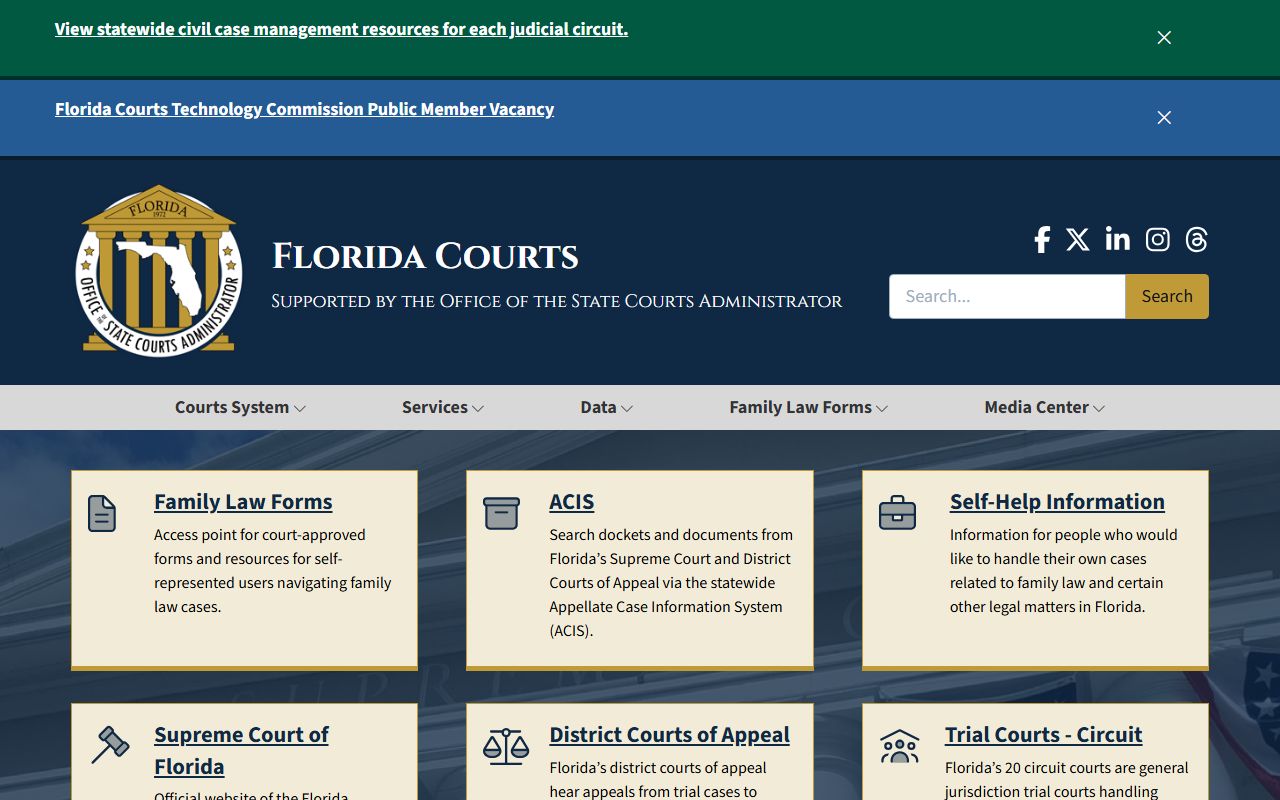
The Florida Courts official site shown above is a key resource for County Court users who need court forms, legal self-help guides, or an explanation of how Florida's lower trial court system works. The site's self-help center and forms library are available to unrepresented parties at no charge.
For the Clerk's office directly:
201 South Indian River Drive
Fort Pierce, FL 34950
stlucieclerk.gov/contact-us
A branch service location is also available at 250 Northwest Country Club Drive, Port St. Lucie, Florida 34986. Not all County Court services are available at the branch; confirm which services you need before traveling.