
Arrest Records in St. Lucie County
An arrest record is created when a person is taken into custody and booked at the St. Lucie County jail. The booking process produces a record that includes the person's name, date of birth, the arresting agency, the charges listed at intake, a booking number, and a booking photograph. The St. Lucie County Sheriff's Office is the primary agency handling local bookings and maintains the public-facing inmate lookup and release report for the county detention facility.
Arrest records and criminal court records overlap but are not the same document. An arrest record is an administrative product of the booking process. It shows what a person was charged with at the time of arrest. A criminal court record is a judicial document that begins when charges are formally filed with the court, and it tracks everything that happens after: the arraignment, plea, motions, hearings, orders, and final disposition. For the full court file on a criminal case, search through the court records portal maintained by the Clerk of the Circuit Court and Comptroller. That system holds the docket, filings, and case outcomes. Arrest records held by the Sheriff are a starting point, not the complete picture.
In St. Lucie County, felony arrests lead to Circuit Court proceedings. Misdemeanor arrests are processed through County Court. Both court types share the same Clerk office, and both types of criminal case files are searchable through the same Benchmark court case search portal.
How to Search St. Lucie County Arrest Records
Several tools are available depending on what you need. The Sheriff's inmate lookup covers people currently in custody. The Clerk's court case search covers criminal cases that have been filed with the court. FDLE's statewide tool covers Florida criminal history across all counties. Use the right tool for your question.
- Sheriff inmate lookup: Go to stluciesheriff.com/215/Inmate-Lookup and search by last name or first name. This shows people currently booked at the county detention facility. It does not show people who have been released, transferred, or who have older arrests.
- Sheriff release report: Recent releases are listed at stluciesheriff.com/218/Release-Report. This page reflects people recently released from local custody and can be useful for confirming a release date or recent arrest history.
- Clerk court case search (Benchmark portal): Search criminal case files at courtcasesearch.stlucieclerk.gov. Enter a party name or case number. Filter by division (felony, misdemeanor) if the portal exposes that option. This system shows the court docket, charges, dispositions, and case events after charges were filed.
- FDLE Computerized Criminal History: For a statewide Florida criminal history search, use the public search at cchinet.fdle.state.fl.us. This database covers arrests and dispositions reported to FDLE by agencies across Florida, not just St. Lucie County. A fee applies for some search types.
If you cannot find a record through the public portals, it may be sealed, expunged, confidential, or simply not yet entered in the online system. Contact the Clerk's office or the Sheriff directly for records that do not appear in the public search.
Note: Booking data on the Sheriff's site reflects real-time custody status. A person may appear in the system one day and not the next if they posted bond, were released by court order, or were transferred. Always verify current status before relying on the result.
Arrest Records vs. Criminal Court Records
The confusion between these two record types is common. An arrest record is created at booking by a law enforcement agency. A criminal court record is created by the court clerk when charges are filed. Both are public in most cases, but they contain different information and are held by different offices. Knowing which office has what you need saves time.
| Arrest Record | Criminal Court Record | |
|---|---|---|
| Held by | Sheriff / arresting agency | Clerk of the Circuit Court |
| Created when | Person is booked into jail | Charges are filed with the court |
| Key contents | Name, booking number, charges at arrest, booking photo, bond, arresting agency | Case number, docket entries, pleadings, motions, orders, hearings, disposition, sentence |
| Where to search | Sheriff inmate lookup, release report | Benchmark court case search portal |
| Shows outcome? | No (only arrest-time charges) | Yes (disposition, verdict, sentence) |
An arrest does not always lead to charges being filed. A prosecutor may decline to file, charges may be amended, or the case may be dismissed. The arrest record remains even if no court case follows. That is one reason why an arrest record alone does not tell the full story of a person's legal history.
Charges vs. Convictions in St. Lucie County
A charge is an accusation. A conviction is a finding of guilt. These are not the same thing, but both can appear on a criminal background report or in the court case file. Florida law treats charges and convictions differently in many contexts, from employment to licensing to eligibility for record sealing or expunction. Understanding the difference matters when reading a criminal case record.
In St. Lucie County, the Office of the State Attorney for the Nineteenth Judicial Circuit decides whether to file formal charges after a law enforcement arrest. The State Attorney may file by information (a formal written charging document), or a grand jury may return an indictment for certain offenses. Filing charges starts the court case. What happens next determines whether the charge becomes a conviction.
| Charge | Conviction | |
|---|---|---|
| What it is | A formal accusation of a crime | A finding or admission of guilt |
| Legal standard | Probable cause (lower bar) | Beyond a reasonable doubt |
| How it comes about | Information filed by State Attorney or grand jury indictment | Guilty plea, no-contest plea, or trial verdict |
| Public record? | Yes, unless sealed or expunged | Yes, unless sealed or expunged |
| Can be resolved without conviction | Yes (dismissed, acquitted, nolle prosequi) | No (a conviction is the end result) |
| Eligible for sealing or expunction? | Sometimes, if case ended without conviction | Generally no (most convictions disqualify) |
What a St. Lucie Criminal Case Record Contains
A criminal case file in the Clerk's Benchmark portal includes a defined set of fields. Not every field shows on every case, and some data is redacted or withheld depending on the case type, the judge's orders, or applicable confidentiality statutes. The list below reflects what a typical public criminal case record in St. Lucie County may include.
| Field | What It Shows |
|---|---|
| Case Number | The alphanumeric court identifier assigned by the Clerk when the case was opened. |
| Filing Date | Date the information, indictment, or complaint was filed with the court. |
| Division | Felony (Circuit Court) or misdemeanor (County Court); may also show traffic or juvenile division. |
| Case Status | Open, pending, disposed, closed, transferred, or sealed/restricted. |
| Defendant Name | Full legal name as entered in the court file; State of Florida is often the plaintiff. |
| Charges | Statute number, offense description, degree (felony or misdemeanor class), and count number. |
| Attorneys | Defense counsel and prosecutor names when associated with the case and public. |
| Judge | Assigned judicial officer; may change during the case. |
| Docket Entries | Chronological log of filings, notices, motions, orders, hearing dates, and continuances. |
| Bond | Bond type, amount, surety, or no-bond status; updated after first appearance or bond hearings. |
| Hearings | Scheduled court dates, hearing types, and courtroom assignments when public. |
| Disposition | Outcome of each charge: guilty, not guilty, nolle prosequi (dropped), dismissed with/without prejudice, or adjudication withheld. |
| Sentence | Probation terms, incarceration, fines, restitution, community service, or other conditions if conviction resulted. |
| Financials | Court costs, fines, fees, restitution amounts, and payment status. |
| Redactions | Social Security numbers, victim identifying data, minor information, protected addresses, medical information, and sealed material are withheld. |
Documents such as plea forms, sentencing orders, and probable cause affidavits may or may not be downloadable from the portal. Some require a copy request through the Clerk's office. Certified copies cost more than plain copies and are required for legal proceedings.
FDLE Statewide Criminal History Search
Florida's statewide criminal history database is the FDLE Computerized Criminal History system. It pulls arrest and disposition data reported by law enforcement agencies and courts across Florida. A search here covers more than just St. Lucie County, making it useful for a more complete Florida criminal background picture. It is not limited to active custody or recent arrests.
The FDLE criminal history records page explains the difference between a public records name check and a more detailed background check. The public search at cchinet.fdle.state.fl.us lets anyone search by name. Results show arrests, charges, and dispositions reported to FDLE. Fees and rules about how results can be used depend on the purpose of the search and whether the request falls under Florida's public-records framework or a more regulated background-check process.
The image below shows the FDLE Computerized Criminal History public search interface. It is the official state-level entry point for Florida criminal history lookups that go beyond a single county system.
The FDLE public search at cchinet.fdle.state.fl.us/search/app/default?0 is the starting point for statewide criminal history name checks in Florida.
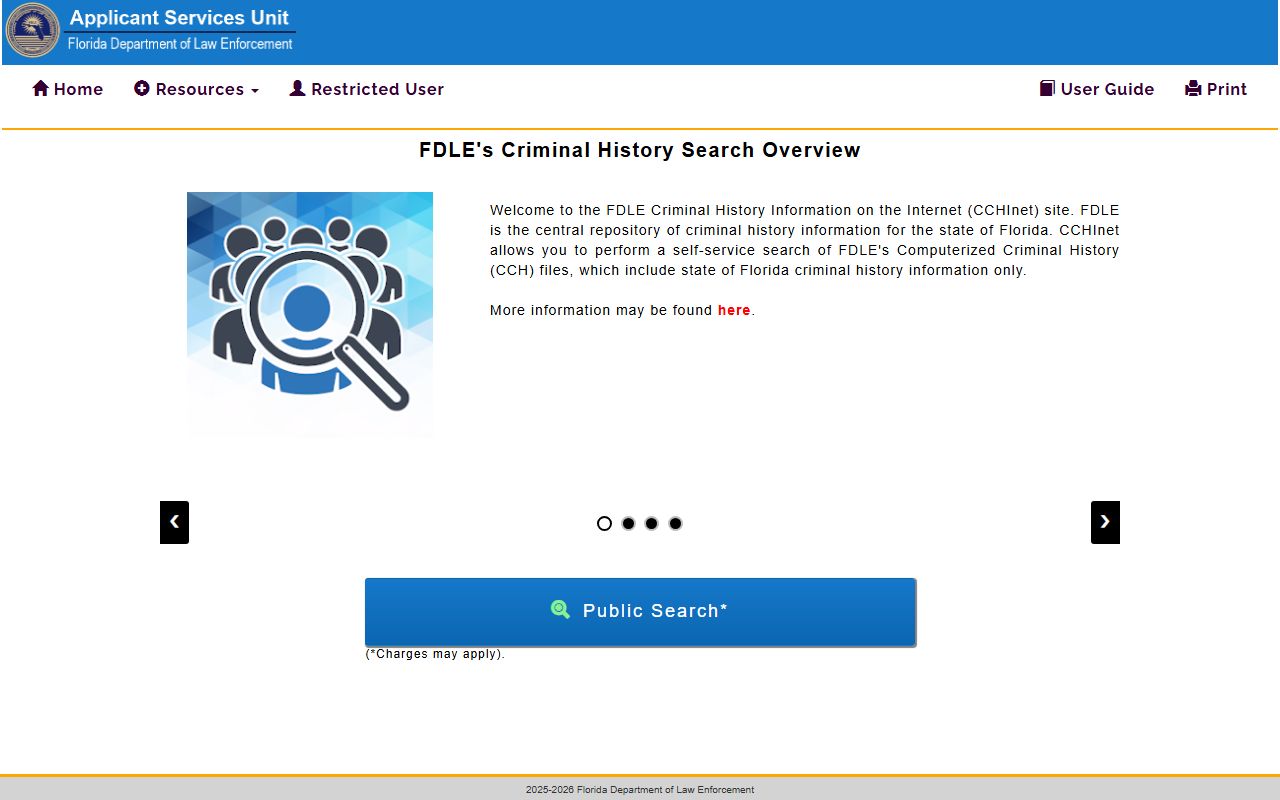
FDLE's system draws from law enforcement and court reporting statewide, so a St. Lucie County arrest that has been reported to FDLE will appear in results alongside records from other Florida counties.
Note: FDLE criminal history results are a reporting product. If an agency did not submit data or submitted it late, the record may be incomplete. For the most current and complete local picture, combine an FDLE search with the Clerk's Benchmark portal and the Sheriff's inmate lookup.
Booking Photos and Mugshots in St. Lucie County
A booking photo, or mugshot, is taken at intake when a person is booked into the St. Lucie County jail. It is part of the arrest record, not the court case file. The Sheriff's Office may show booking photos in the public inmate lookup system alongside the inmate's name, charges, and booking date. Whether a photo is visible depends on the Sheriff's display settings and any applicable legal restrictions.
Florida does not have a general statute that removes mugshots from public access. However, the booking photo relates to an arrest, not a conviction. A photo may remain publicly visible even if charges were never filed, were dropped, or resulted in an acquittal. People who believe a mugshot is being used to extort them or has no legitimate purpose may want to consult an attorney about options under Florida law. The court case record held by the Clerk does not typically include booking photos; those stay with the arresting agency.
Sealed vs. Expunged Records in St. Lucie County
Florida allows qualifying individuals to seal or expunge criminal records under specific conditions. These are separate legal processes with different effects. Both require a petition to the court that handled the original case, and both require meeting statutory eligibility criteria. The Clerk of the Circuit Court and Comptroller processes these court orders once granted. The FDLE criminal history records page explains the certificate of eligibility process that precedes most petitions.
The statutes that govern these processes are Florida Statutes section 943.059 for sealing and Florida Statutes section 943.0585 for expunction. Both statutes set out who qualifies, what offenses are excluded, and what effect the order has on the record. Most convictions disqualify a person from either remedy. The typical qualifying scenario is an arrest that did not result in a conviction, or a case where adjudication was withheld.
| Sealed Record (Fla. Stat. 943.059) | Expunged Record (Fla. Stat. 943.0585) | |
|---|---|---|
| What happens | Record is restricted from public access; it still exists | Record is removed from public access and treated as if it did not occur; physical destruction or obliteration may follow |
| Visible to public? | No (hidden from general public inspection) | No (more completely removed than sealing) |
| Visible to law enforcement? | Limited access for authorized agencies | Very limited; statutory exceptions apply |
| Typical qualifying scenario | Adjudication withheld; no prior sealing or expunction; offense not excluded | Case dismissed or no information filed; no prior sealing or expunction; offense not excluded |
| Can you deny the record exists? | Generally yes, with statutory exceptions (e.g., certain government employment) | Generally yes, with statutory exceptions |
| Process starts with | FDLE certificate of eligibility, then court petition | FDLE certificate of eligibility, then court petition |
The image below is from the Florida Senate's official statutes page for section 943.0585, which governs court-ordered expunction in Florida.
Florida Statutes section 943.0585 is published at flsenate.gov/Laws/Statutes/2025/943.0585 and sets out the full expunction eligibility rules and process.
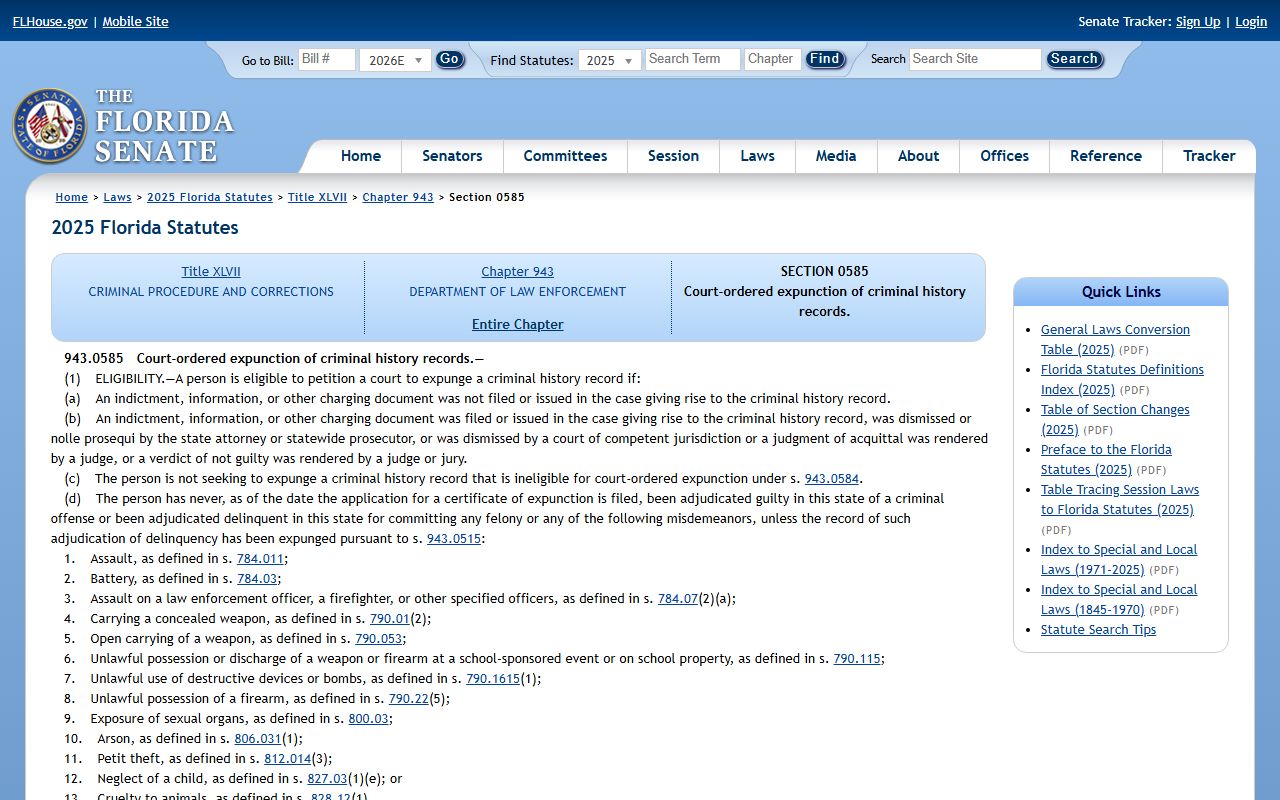
Section 943.0585 controls expunction eligibility, the FDLE certificate requirement, disqualifying offenses, and how agencies must respond after an order is entered.
The image below covers the sealing statute, section 943.059.
Florida Statutes section 943.059 is published at flsenate.gov/Laws/Statutes/2025/943.059 and explains the sealing process, including eligibility criteria and the effect of a sealing order on public and agency access.
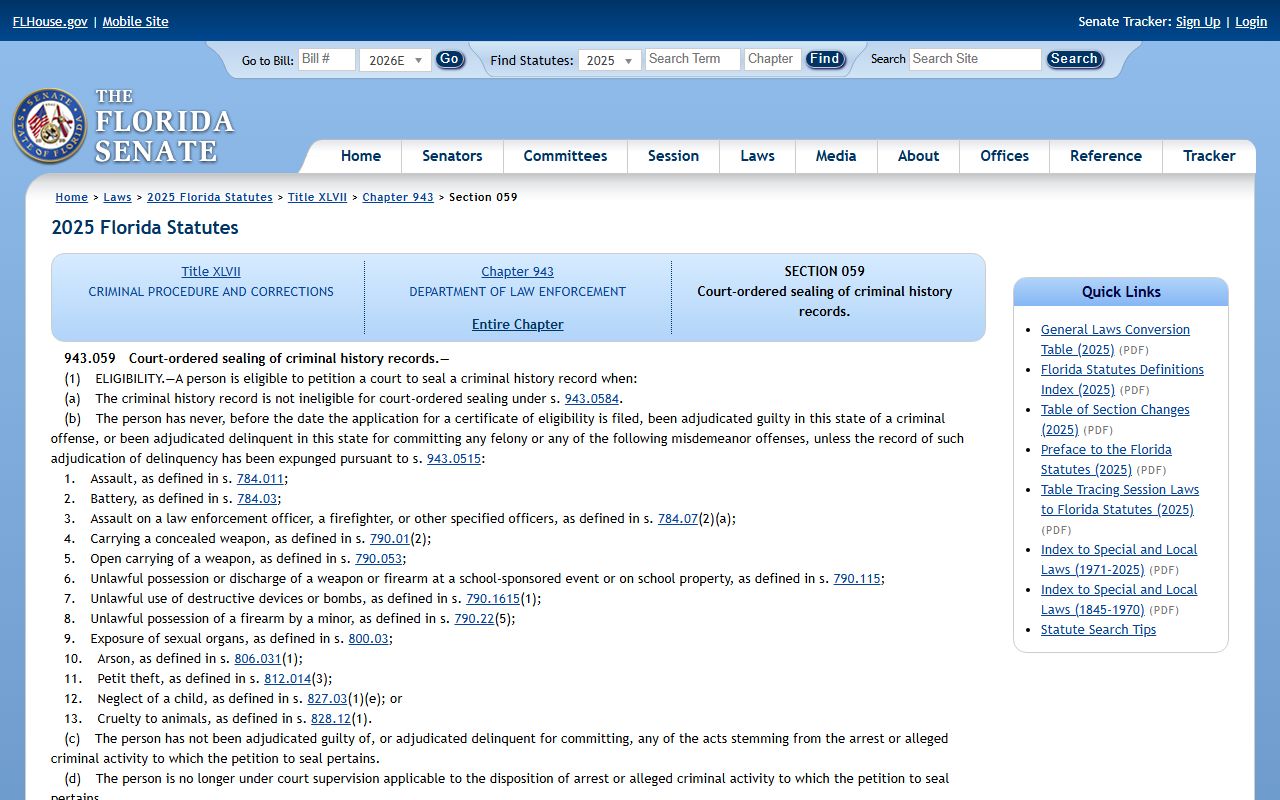
If a St. Lucie criminal case was sealed or expunged, it will not appear in the public Benchmark portal or the FDLE public search. That absence does not mean the record never existed.
Restricted Criminal Records in St. Lucie County
Not all criminal or arrest-related records are publicly accessible. Several categories of records are restricted by Florida statute or court rule, and the Clerk must withhold or redact that material from public searches. Being aware of these categories helps explain why a search may return no results or a result with limited information.
- Juvenile delinquency records: Governed by Florida Statutes section 985.04. Juvenile case records are restricted to authorized parties and agencies. Adult-style public case lookup does not apply to juvenile delinquency matters.
- Sealed records: Governed by Florida Statutes section 943.059. The record exists but public access is blocked. The case may not appear in the public portal at all.
- Expunged records: Governed by Florida Statutes section 943.0585. Public access is removed more completely than with sealing. Agencies treat the record as expunged under the statute.
- Mental health and Baker Act records: Governed by Florida Statutes section 394.4615. Clinical and treatment material connected to mental health court proceedings is confidential even when the related criminal docket is public.
- Grand jury materials: Grand jury proceedings are traditionally secret. Related documents are not available for public inspection except as Florida law specifically permits.
- Victim and witness identifying information: Protected by public-record exemptions and court rules in many criminal contexts. Addresses, identifying details, and protected contact information may be redacted from otherwise public dockets.
- Ongoing investigation records: Active law-enforcement investigation materials are exempt from public records disclosure under Florida Statutes section 119.071 until the investigation is closed or prosecution is concluded.
Florida Rule of General Practice and Judicial Administration 2.420 governs how clerks handle confidential court records. When a case is open but restricted, the docket may show a case number with limited details, or it may not appear at all. The Clerk is the proper contact for questions about access to records that are not showing in the public portal.
The State Attorney and Criminal Prosecution
Once a St. Lucie County arrest is made, the decision to file charges rests with the State Attorney's Office for the Nineteenth Judicial Circuit. The State Attorney can file an information, seek an indictment, decline to file, or enter a diversion arrangement depending on the evidence, the offense, and the defendant's history. What the State Attorney decides shapes whether an arrest leads to a court case at all.
The State Attorney's charging decision is the bridge between the arrest record and the criminal court record. If the State Attorney files, a case is opened in the Clerk's system and a case number is assigned. From that point forward, the Clerk's Benchmark portal is the place to track the case. Plea negotiations, pretrial motions, scheduled hearings, and dispositions all appear in the court docket. If the State Attorney does not file, the arrest record may exist at the Sheriff level without any corresponding court case in the Clerk's system.
The Public Defender for the Nineteenth Judicial Circuit at pd19.org provides legal representation for qualifying defendants who cannot afford private counsel. Self-represented defendants can find general guidance through Florida Courts and the Clerk's self-help resources, though neither office can give legal advice on individual cases.
Note: A nolle prosequi entry in a court docket means the State Attorney dropped the case. Dismissed with prejudice means it cannot be refiled. Dismissed without prejudice means it may be refiled within any applicable time limit.
Background Check Considerations
Public criminal records, including arrest records and court case data, are accessible through government portals. But there is a legal distinction between reviewing a public record and using that record for a regulated purpose such as employment, housing, or credit decisions. The Fair Credit Reporting Act governs how consumer reporting agencies can compile and share background-check data for those uses.
An arrest record does not equal a conviction. Employers, landlords, and others who use background checks for regulated decisions are subject to FCRA rules about how they handle and disclose arrest-only records. Florida also has state-level rules about what employers and agencies can ask about and use. A person who is denied employment or housing based on a background check has specific rights under federal and state law. Checking a public court portal is different from ordering an FCRA-regulated background check, and the two should not be confused.
Important: St. Lucie County Court Records is not a consumer reporting agency under the Fair Credit Reporting Act. Information here may not be used for employment, credit, housing, insurance, or other FCRA-regulated purposes.
Specialty Courts and Diversion Programs
The Nineteenth Judicial Circuit operates problem-solving court programs that can affect the criminal case record for eligible participants. These include drug court, veterans treatment court, and mental health or behavioral health dockets. Participation in and successful completion of these programs may produce different docket entries than a traditional criminal case, and the outcome may differ from a straight guilty plea or trial verdict.
Drug court participants typically face regular court reviews, treatment requirements, drug testing, and supervision conditions. A defendant who completes drug court may receive a benefit such as reduced sanctions or case dismissal depending on how the program was structured and what plea arrangement was made at entry. Records from drug court participation are part of the criminal case file in the Clerk's system.
Veterans treatment court in the Nineteenth Circuit connects eligible justice-involved veterans with treatment, VA resources, peer mentors, and judicial supervision. Eligibility depends on offense type, criminal history, treatment need, and the positions of the State Attorney and Public Defender. The Nineteenth Judicial Circuit programs and services page is the official starting point for confirming program availability and referral criteria. These programs can change, so check the current circuit page rather than relying on older descriptions.