
Common Questions About St. Lucie County Court Records
How do I search St. Lucie County court cases online?
The main free tool is the Benchmark court case search portal run by the St. Lucie Clerk of the Circuit Court and Comptroller. You can search by case number, party name, citation number, or case type. Case number is the most precise option. If a name search returns too many results, add a date range or case type to narrow down. Some older or archived cases may not appear in the online system. If you cannot find what you need, contact the Clerk directly. For a full walkthrough, see the court records page on this site.
Are St. Lucie County court records free to search?
Basic docket searches through the public portal are free. You can pull up case numbers, party names, filing dates, charges, and docket entries at no cost. What does cost money is copies. Plain copies, certified copies, exemplified copies, and some staff-assisted research all carry statutory fees set by Florida law. Fees vary by document type and page count. The full fee schedule is on the Clerk's fee schedule page. See the Clerk of the Circuit Court page for more detail on what services cost and how to request them.
Can I view actual case documents online?
Not always. Florida court access rules restrict many documents from public online viewing even when the docket itself is visible. Records that are sealed, confidential, or protected under Florida Rule of General Practice and Judicial Administration 2.420 do not appear in full online. Juvenile records, adoption files, mental health materials, victim-identifying information, and some financial disclosures are among the categories that are restricted. If the docket shows an entry but no document link, the document may require an in-person copy request or a formal written request to the Clerk. For a breakdown of what is and is not public, see court records and public records.
Where do I get a certified copy of a court record?
Certified copies come from the Clerk of the Circuit Court and Comptroller. You will need the case number, names of the parties, the record type, and a date range if you have one. The Clerk has offices at 201 South Indian River Drive in Fort Pierce and a branch at 250 Northwest Country Club Drive in Port St. Lucie. You can also submit requests by mail or through the Clerk's online services. Fees apply per page and per certification. Certified copies carry a raised seal and are accepted in legal proceedings; uncertified printouts from the online portal are not.
How do I look up an inmate at the St. Lucie County Jail?
Use the St. Lucie County Sheriff's inmate lookup tool. You can search by name or booking number. The result shows the person's charges, booking date, bond amount, and custody status. Custody status changes quickly, so call the jail to confirm current status before acting on the information. Bond information on the site reflects what was set at first appearance but may be different after a court hearing. The inmate records page covers the full lookup process, what each field means, and what to do when a person does not appear in the system.
How do I find recently released inmates?
The Sheriff's release report lists people recently released from the St. Lucie County Jail. For individuals who have been transferred to state prison, search the Florida Department of Corrections offender search. For people in federal custody, use the Bureau of Prisons inmate locator. You can also set up automated custody notifications through VINELink, which sends an alert when a person's custody status changes. The released inmates page covers all of these tools in detail.
How do I search for active warrants in St. Lucie County?
Florida does not publish a single county-level warrant list. The best starting point is the FDLE wanted persons search, which pulls from statewide data. Not every warrant appears there. For local bench warrants or capiases issued by the Circuit Court or County Court, you would need to contact the issuing court or the St. Lucie County Sheriff's Office directly. Online results are not guaranteed to be current. If you believe you or someone you know may have an outstanding warrant, consult an attorney before approaching law enforcement. The warrant records page explains the types of warrants and how to handle them.
What court handles divorce cases in St. Lucie County?
Divorce is a family-law matter handled by the Circuit Court in the Nineteenth Judicial Circuit. The Clerk of the Circuit Court and Comptroller accepts divorce filings, assigns case numbers, maintains the docket, and stores the file. Divorce records are part of the court case system and are searched through the same Benchmark portal. Some divorce documents that involve minor children, financial disclosures, or domestic violence matters may be partially or fully restricted from public view. For information on divorce filings, certified copies of final judgments, and related marriage records, see the marriage and divorce records page.
Where are probate records located?
Probate in St. Lucie County is handled by the probate division of the Circuit Court. There is no separate elected probate court. Cases such as estates, wills, guardianships, and conservatorships are filed with the Clerk of the Circuit Court and Comptroller and appear in the Benchmark court case search portal under probate case types. Some sensitive probate materials, including certain medical and financial records, may be restricted from public access. Certified copies of probate orders or letters of administration are available from the Clerk with the proper request and fee. More detail is on the probate records page.
Are juvenile records public in St. Lucie County?
Most juvenile records are confidential or restricted under Florida law. Dependency records involving child welfare cases are protected under Florida Statutes Section 39.0132. Juvenile delinquency records are protected under Section 985.04. Access depends on case type, the age of the juvenile, the charges involved, and whether a court order allows disclosure. In some serious cases, a minor tried as an adult may have records that are more accessible. If you need access to a juvenile file, consult an attorney or contact the Clerk to find out what the specific case rules allow. See criminal records for more context.
What is the difference between sealing and expunction?
Both restrict public access to a criminal record, but they work differently. Sealing under Florida Statutes Section 943.059 means the record is closed to public view but still exists. Expunction under Section 943.0585 takes it further and removes the record from ordinary public access more completely. Both require statutory eligibility and a court order. Not every case qualifies. Some agencies such as law enforcement, courts, and licensing boards can still see sealed or expunged records depending on the circumstances. The process for either starts with a FDLE eligibility determination and a petition to the court. See the criminal records page for more on restricted and expunged records.
The State Attorney's Office for the Nineteenth Judicial Circuit, accessible at sao19.org, handles criminal prosecution for St. Lucie County. Their office can answer questions about open criminal cases and plea agreements that affect a record.
The screenshot below shows the State Attorney's Office website, which handles criminal prosecution for St. Lucie County cases in the Nineteenth Judicial Circuit.
The State Attorney prosecutes felony and misdemeanor cases that result in the court records held by the Clerk of the Circuit Court and Comptroller.
How do I pay a traffic ticket in St. Lucie County?
Go to the Clerk's traffic ticket page for payment instructions. Have your citation number, case number, driver's license information, and payment method ready. The Clerk's system allows payment online, by mail, or in person at a clerk location. Pay before the deadline printed on the citation. Late payment can lead to a license suspension or additional fees. If you want to contest a ticket or elect a driver improvement course, you must act before the deadline. Missing the deadline can result in a default judgment or a license hold. For a full breakdown of options, see traffic court records.
How do I get a marriage license in St. Lucie County?
Review the Clerk's marriage license page before you go. Both applicants must appear in person with required government-issued identification. Florida has a three-day waiting period after the license is issued unless both applicants complete a state-approved premarital preparation course. The course waives the waiting period and may reduce the license fee. Fees and required documents are listed on the Clerk's page. The license is valid for 60 days from issue. Marriage records and certified copies of marriage licenses are maintained by the Clerk and searched through the official records system. See marriage and divorce records for more.
How do I file a small claim in St. Lucie County?
Small claims are filed in the County Court. The Clerk's small claims page has the forms, fee schedule, and filing instructions. You file in the county where the defendant lives or where the claim arose. Pay the filing fee, which varies by the amount of the claim. After filing, the Clerk issues a summons and you arrange service on the defendant. Small claims are designed for self-represented parties, but reviewing the Florida small claims rules before your hearing date is a good idea. The County Court handles small claims up to a certain dollar threshold under Florida law.
Who is the prosecutor for criminal cases in St. Lucie County?
The Office of the State Attorney, Nineteenth Judicial Circuit, prosecutes state criminal cases in St. Lucie County. The State Attorney's Office handles felonies and misdemeanors filed in Circuit Court and County Court. The Nineteenth Judicial Circuit covers St. Lucie, Martin, Indian River, and Okeechobee counties. Federal cases are prosecuted by the U.S. Attorney's Office for the Southern District of Florida, which is separate from the state system. See criminal records for more on how criminal cases work in St. Lucie County.
How do I get a public defender in St. Lucie County?
You do not hire a public defender directly. You ask the court for appointed counsel at your first appearance or arraignment, then complete the court's financial eligibility process. The Public Defender, Nineteenth Judicial Circuit, represents people who qualify based on income and case type. Private attorneys are also available through the Florida Bar Lawyer Referral Service. If you are not facing criminal charges but need legal help with a civil matter, see the self-help resources offered through Florida Courts.
Florida Courts maintains a self-help center with forms, guides, and links to local resources for people who represent themselves in court matters including family law, small claims, and landlord-tenant cases.
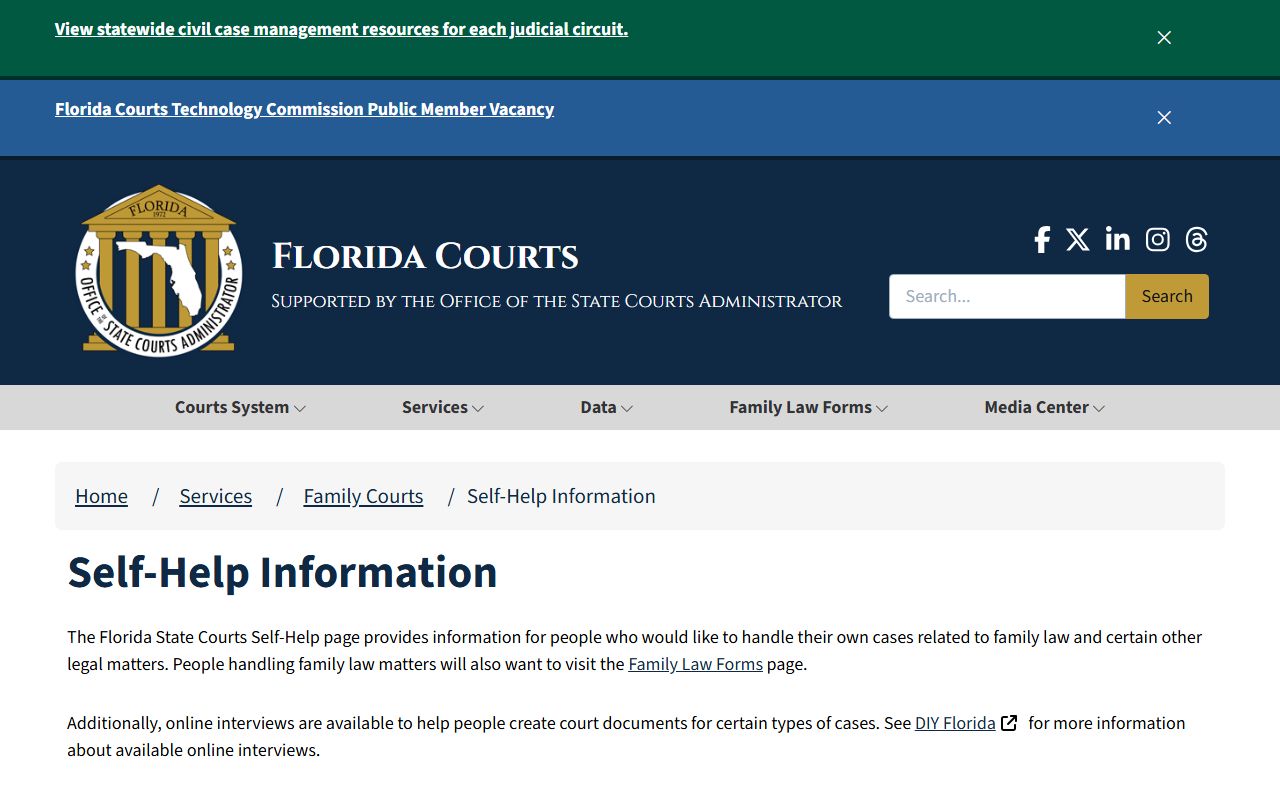
The Florida Courts self-help page is useful for St. Lucie County residents who need court forms and plain-language guidance before filing or appearing in court without an attorney.
What if I miss a court date in St. Lucie County?
Missing a court date is serious. The court can issue a bench warrant or capias for your arrest, forfeit any bond you posted, impose a default judgment in a civil case, and suspend your driver's license depending on the case type. Act fast. Call the Clerk to confirm what happened in your case, then contact your attorney or the court to find out how to address the missed date. In some cases a motion to set aside a default or a motion to quash a warrant is possible, but time matters. See the warrant records page for information on bench warrants and how to resolve them.
How do I request ADA accommodation for a court proceeding?
Contact the court administration office or the Clerk's office as early as possible before the scheduled proceeding. Include the case number, the date of the hearing, and a description of the accommodation you need. Florida courts are required to provide reasonable accommodations under the Americans with Disabilities Act. Requests made close to the hearing date may be harder to fulfill, so contact the court at least a week in advance when possible. The Nineteenth Judicial Circuit website lists contact information for court administration. The Clerk's contact page at stlucieclerk.gov/contact-us also covers service contacts by division.
How do I search federal court cases connected to St. Lucie County?
Federal cases are separate from state court records. The U.S. District Court for the Southern District of Florida has a courthouse in Fort Pierce at 101 South U.S. Highway 1. Federal dockets are searched through PACER, which requires a free account. Federal bankruptcy cases are handled by the U.S. Bankruptcy Court for the Southern District of Florida and are also on PACER. Federal cases do not appear in the Benchmark state court portal. See court records for a comparison of state and federal systems.
Can I access adoption records in St. Lucie County?
Adoption records are confidential under Florida Statutes Section 63.162. They are not available through the standard public court case search portal. Access generally requires statutory authorization, a court order, or an agreement between the parties. Florida has a mutual consent adoption registry that can facilitate contact between adult adoptees and birth parents in certain circumstances. If you have a legal need to access an adoption file, consult an attorney who handles family law matters. The Clerk handles adoption filings but cannot release confidential adoption records without proper legal authority.
The Florida Bar's lawyer referral service can connect you with an attorney who handles family law or record-access matters in St. Lucie County, including questions about sealed records, adoption files, and expunction petitions.
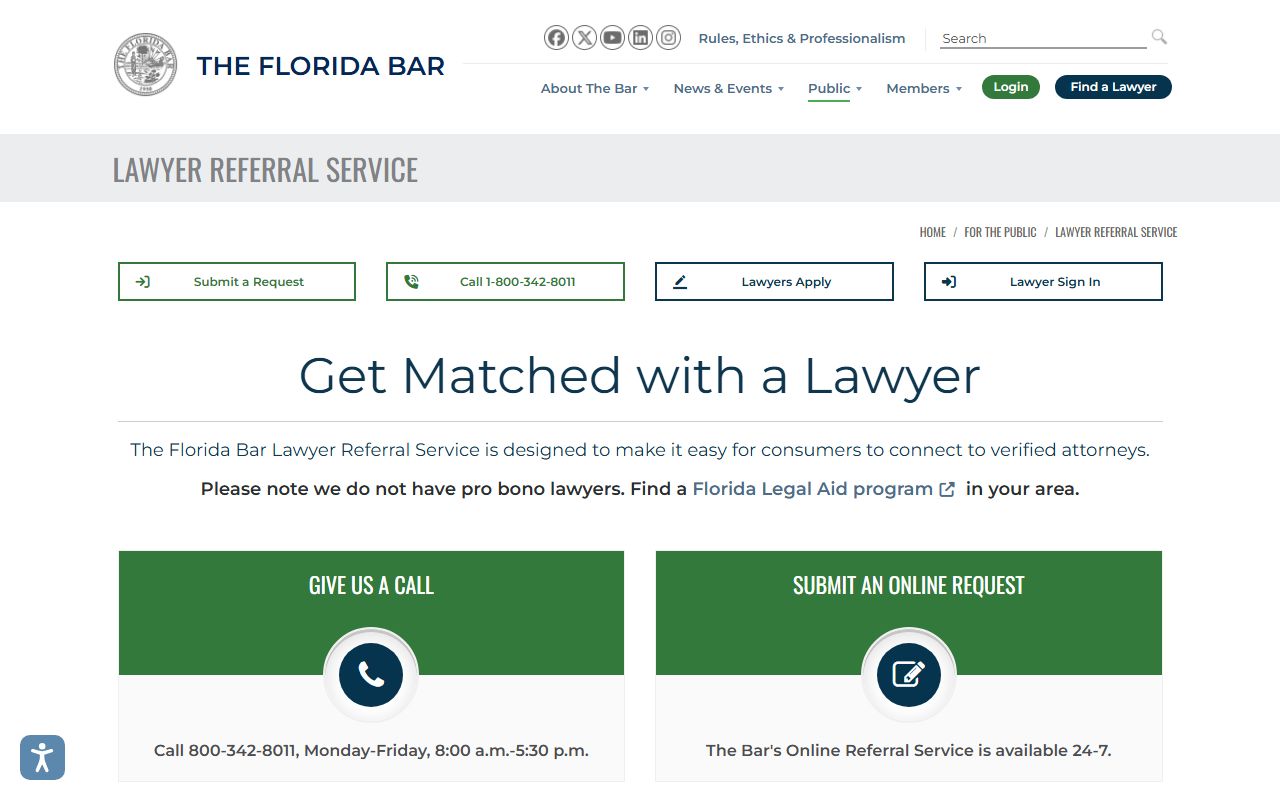
The Florida Bar Lawyer Referral Service is a starting point for anyone who needs an attorney for court-records access issues, expunction petitions, or legal proceedings in St. Lucie County.
What are official records, and how are they different from court records?
Official records are recorded instruments such as deeds, mortgages, liens, plats, satisfactions, easements, and related documents. They are filed with the Clerk as recorder, not as court file custodian. Official records are searched through the Clerk's official records search, which is a separate portal from the court case search tool. A deed is an official record. A divorce judgment is a court record. Both are public, but they live in different systems and are requested differently. See public records for more on how these categories work under Florida law.
How long do court records stay available online?
Online availability depends on the Clerk's system coverage, case type, retention schedules, and confidentiality rules. Not all older cases have been loaded into the current digital system. Cases from before electronic filing began may exist only in paper form in the Clerk's archive. If a case does not appear in the Benchmark portal, it may still exist. Contact the Clerk to request a manual search of older or archived records. Some records are removed from public access after a sealing or expunction order. For rules on how long records must be kept, see Florida Statutes Section 119.07 and the related court rules. More on this is on the court dockets page.
Still Have Questions?
For the right office, see Clerk of the Circuit Court. For broader access rules, see public records. For records by topic, browse court records, criminal records, inmate records, warrant records, marriage and divorce, or probate records. The Clerk's contact page at stlucieclerk.gov/contact-us lists current phone numbers, locations, and hours for all Clerk service counters.