
Marriage License Requirements in St. Lucie County
The Clerk of the Circuit Court and Comptroller issues all marriage licenses in St. Lucie County. Both applicants must appear together in person and present valid government-issued photo identification. The Clerk's office is located at 201 South Indian River Drive, Fort Pierce, FL 34950. For current service hours and any branch-location options, the Clerk's contact page at stlucieclerk.gov/contact-us is the best source. Michelle R. Miller currently serves as St. Lucie Clerk of the Circuit Court and Comptroller.
Both parties must be at least 18 years old to marry without parental or judicial involvement. Florida law does permit younger applicants under specific conditions, but those cases involve additional legal steps. Neither party can be currently married to someone else. If either applicant was previously married, documentation of how that marriage ended is required at the time of application. Acceptable forms of documentation include a divorce decree, a death certificate, or an annulment order. The Clerk will verify these documents at the counter before issuing the license.
Florida has a three-day waiting period between issuance of the license and the date of the ceremony, unless both applicants complete an approved premarital education course. That course must meet state requirements and be delivered by a licensed or authorized provider. Couples who complete the course can apply to have the waiting period waived. The course completion certificate must be presented to the Clerk at the time of application. Check the current Clerk page at stlucieclerk.gov/services/marriage-licenses for accepted providers and any updated guidance.
Once issued, a marriage license is valid for 60 days. The ceremony must take place within that window. After the ceremony, the officiant signs and dates the license and returns it to the Clerk's office for recording. The Clerk then creates the official marriage record, which becomes part of the county's official records system.
Clerk of the Circuit Court and Comptroller
201 South Indian River Drive
Fort Pierce, FL 34950
How to Apply for a Marriage License
Both applicants must be present at the Clerk's office at the same time. The process cannot be started online or by one party alone. Bring all required documents with you, since the Clerk cannot issue the license if documentation is missing or incomplete. If you completed a Florida-approved premarital education course, bring the certificate so the three-day waiting period can be waived at the counter.
- Review the current requirements and any online pre-application steps on the Clerk's marriage license page at stlucieclerk.gov/services/marriage-licenses.
- Gather valid government-issued photo identification for both applicants, such as a driver's license, state ID card, or passport.
- If either applicant was previously married, bring proof of how that marriage ended: a certified divorce decree, death certificate, or annulment order.
- If you completed an approved Florida premarital education course, bring the signed completion certificate to waive the three-day waiting period.
- Both applicants appear together at the Clerk's office in Fort Pierce and provide personal information, identification, and any required documents.
- Sign the application under oath. Both applicants must certify the accuracy of the information provided.
- Pay the license fee. Verify the current amount at stlucieclerk.gov/fees before your visit, since fees are set by state law and may change.
- Observe the waiting period if applicable, or confirm the waiver was recorded if you submitted a premarital course certificate.
- Have your ceremony performed by an authorized officiant within 60 days of issuance.
- Ensure the signed license is returned to the Clerk's office for recording. After recording, you can request certified copies.
The Clerk's marriage license page is the authoritative source for any changes to this process, including whether walk-in service is available or whether appointments are required. Service methods and hours can change, so confirm before your visit.
St. Lucie County Marriage License Application Fields
When both applicants appear at the Clerk's office, the following information is collected for the marriage license application. Having this information ready in advance makes the process faster. Each applicant provides the same categories of information. The Clerk records this data under Florida Statutes section 28.222, which designates the Clerk as the county recorder responsible for official records including marriage licenses.
| Field | Required | Notes |
|---|---|---|
| Applicant 1 full legal name | Yes | Name as it appears on government-issued ID. |
| Applicant 2 full legal name | Yes | Name as it appears on government-issued ID. |
| Date of birth (each applicant) | Yes | Used to confirm minimum age eligibility. |
| Residential address | Yes | Current mailing or residential address for each applicant. |
| Identification type and number | Yes | Government-issued photo ID; driver's license, state ID, or passport accepted. |
| Social Security Number | Conditional | May be required depending on state or federal reporting rules; Clerk will advise. |
| Prior marriage information | Conditional | If previously married: how marriage ended (divorce, death, annulment) and the date it ended. Supporting document required. |
| Premarital education course certificate | Optional | Submitted to waive the three-day waiting period. Must be from an approved Florida provider. |
| Oath and affirmation | Yes | Both applicants sign and certify that all information provided is accurate. |
The Clerk's office reviews each field at the counter before the license is issued. Incomplete applications or missing documents will delay the process. Do not leave any required field blank.
The screenshot below is from the Clerk's official marriage license page at stlucieclerk.gov/services/marriage-licenses, where current requirements and any online pre-application steps are published.
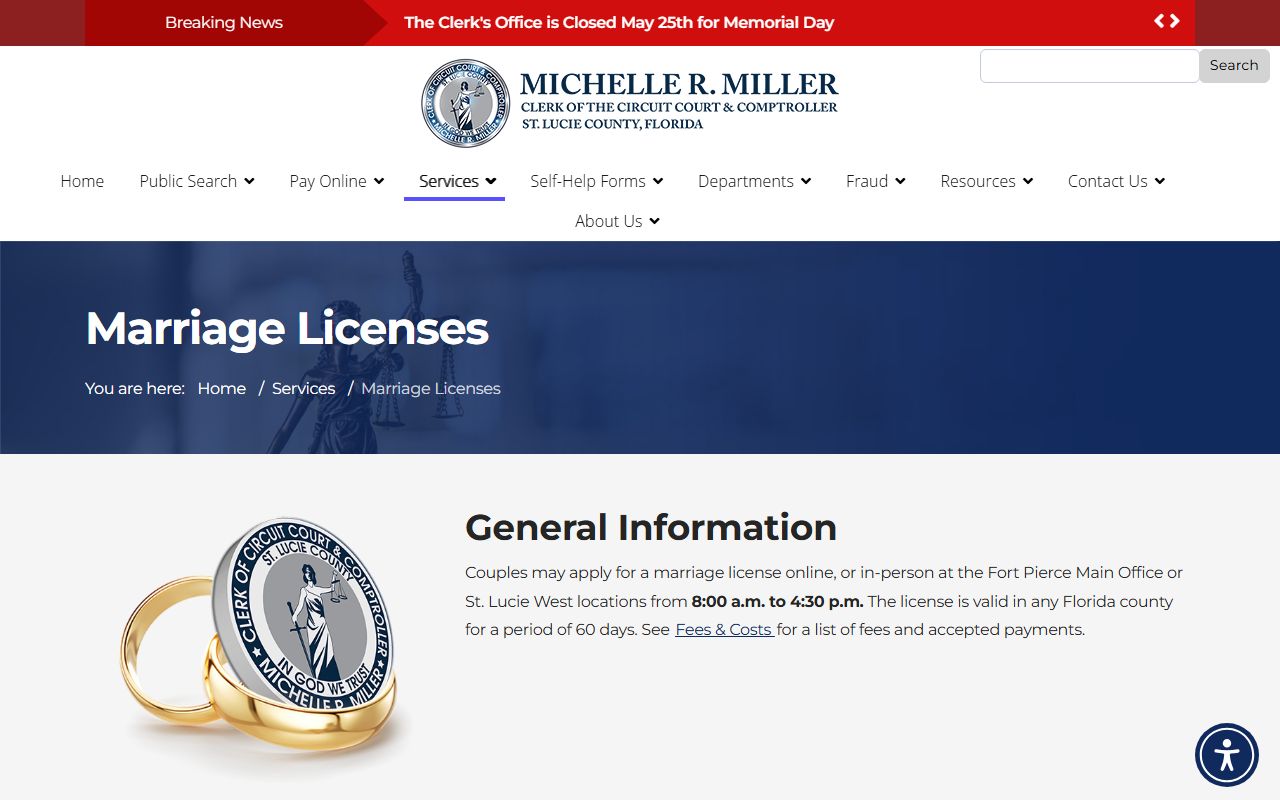
The Clerk updates the marriage license page when Florida law or local procedures change, so reviewing it before your appointment is always the right step.
St. Lucie County Marriage and Divorce Record Fees
Florida sets the baseline fee structure for marriage licenses, and the Clerk charges for certified copies and other record services. The research for this site did not locate specific dollar amounts in the Clerk's publicly available materials, so no fees are listed here to avoid publishing incorrect figures. Fees can also change when the Florida Legislature adjusts the statutory amounts. Always check the current fee schedule directly before your visit or request.
| Category | Where to Verify |
|---|---|
| Marriage license fee | stlucieclerk.gov/fees |
| Premarital course discount or waiver (affects license fee) | stlucieclerk.gov/services/marriage-licenses |
| Certified copy of a marriage record | stlucieclerk.gov/fees |
| Divorce (dissolution of marriage) filing fee | stlucieclerk.gov/fees |
| Civil indigency / fee waiver application | stlucieclerk.gov/services/family |
| Certified copy of a divorce decree | stlucieclerk.gov/fees |
| Plain (uncertified) copy of court record | stlucieclerk.gov/fees |
Note: Certified copies are required for legal proceedings and most government purposes; an uncertified printout from an online portal is not a substitute for a certified copy issued by the Clerk.
How to Search St. Lucie County Marriage Records
After a marriage license is returned and recorded, it becomes part of the official records maintained by the Clerk of the Circuit Court and Comptroller. The Clerk maintains two separate search systems, and which one you need depends on what you are looking for. Official recorded documents, including recorded marriage certificates, are searched through the official records portal. Court case files, including divorce proceedings, are searched through the court case portal at Benchmark.
To find a marriage record, you will generally need the names of both parties and the approximate year the license was issued or recorded. Having the exact date helps narrow results. The Clerk's official records search allows searches by name, instrument number, and date range. If you need a certified copy of a recorded marriage certificate, the request is made through the Clerk's office either in person at Fort Pierce or by mail. Fees for certified copies are listed on the Clerk's fee schedule at stlucieclerk.gov/fees.
Florida also allows certified copies of marriage records to be obtained through the Florida Department of Health vital records office for marriages recorded statewide. The Department of Health vital records program maintains copies of marriages going back to a certain year and can issue certified copies. This is a separate process from requesting a copy through the local Clerk. For older records or statewide searches, the Florida Department of Health vital records program may have the record even if the county-level copy was lost or is incomplete.
Finding St. Lucie County Divorce Records
Divorce cases in Florida are filed in the Circuit Court under the family-law division. In St. Lucie County, that means the Nineteenth Judicial Circuit. The Circuit Court handles all dissolution of marriage petitions, including cases involving property division, alimony, child custody, and child support. The Clerk of the Circuit Court maintains the docket and files for these cases.
Divorce case records are searched through the Benchmark court case portal at courtcasesearch.stlucieclerk.gov. You can search by party name or by case number. A dissolution of marriage case will appear in the family division of the case search results. The docket shows all filings, orders, and hearing dates in the case. The case record may include the final judgment of dissolution, which contains the terms the court ordered.
Not all of a divorce file is public. Florida law and court rules allow certain portions of dissolution cases to be withheld or redacted. Financial affidavits filed in family cases are typically confidential and are not available to the general public. Information about minor children, including their addresses, school records, and social security numbers, is protected. If a protective order was entered as part of the case, the victim's address and contact information will be redacted. The Clerk applies these restrictions automatically when responding to public records requests for family court files.
For more detail on how Florida family law cases proceed, the Clerk's family services page at stlucieclerk.gov/services/family lists self-help resources and forms for parties without attorneys.
Filing for Dissolution of Marriage in St. Lucie County
Florida does not require a party to prove fault to obtain a dissolution of marriage. The sole legal ground is that the marriage is irretrievably broken, meaning there is no reasonable chance the parties will reconcile. Fault-related facts may still come up in specific issues such as alimony, property distribution if dissipation of assets is alleged, or parenting time if abuse is relevant, but fault is not a requirement to open the case.
The steps below apply to a standard uncontested or contested dissolution petition filed at the St. Lucie Clerk's office.
- Confirm that at least one party has been a Florida resident for the past six months before filing. This residency requirement must be met before the Circuit Court has jurisdiction.
- Download or pick up the correct family-law forms packet from the Florida Courts self-help resources or from the Clerk's office. The packet varies depending on whether minor children are involved.
- Complete the petition for dissolution of marriage and all required attachments. If children are involved, a parenting plan and child support worksheets are required.
- File the petition with the Clerk in the family division at 201 South Indian River Drive, Fort Pierce, FL 34950. Pay the filing fee or submit a civil indigency application if you cannot afford the fee.
- Serve the other party with a copy of the petition and summons according to Florida Rules of Civil Procedure. The Clerk can issue the summons; a process server or sheriff delivers it.
- File a financial affidavit as required by Florida Family Law Rules of Procedure. Both parties typically file one, and this document is confidential under court rules.
- If children are involved, complete any required parenting course before the case is finalized. Florida requires both parents to take an approved course in most cases involving minors.
- Attend mediation if ordered by the court. Many family cases go to mediation before a final hearing.
- Attend any scheduled hearings. In an uncontested case, there may be only one brief final hearing.
- After the judge signs the final judgment, obtain certified copies from the Clerk for your records. The certified final judgment is the legal document confirming the dissolution.
Florida does not recognize common-law marriages created within the state after 1968, but it may give legal effect to a valid common-law marriage from another state or jurisdiction that recognized them. If you have questions about that status, consult a family law attorney.
Premarital Course Rules and Waiting Period
Florida law provides an incentive for couples who complete an approved premarital education course before applying for a marriage license. Couples who finish the course may have the three-day waiting period waived. The course covers topics such as conflict resolution, financial management, and communication. It must be delivered by a licensed or authorized provider and meet state requirements for content and length.
At the time of application, the completion certificate must be presented to the Clerk's counter staff. The Clerk reviews the certificate and, if it meets the requirements, applies the waiver. This means the couple can have their ceremony on the same day the license is issued, or any time within the 60-day validity window. Couples who do not complete the course must wait three days after the license is issued before the ceremony can take place.
The Clerk's marriage license page at stlucieclerk.gov/services/marriage-licenses lists any accepted course providers and any changes to the waiver rules. Florida law may also affect the license fee for couples who complete the course, so check both the services page and the fee schedule at stlucieclerk.gov/fees for the current fee.
Note: The three-day waiting period and the premarital course waiver apply to the license issuance date, not the date of the application or payment.Certified Copies of St. Lucie County Marriage and Divorce Records
A certified copy is a copy of an official record that the Clerk has authenticated with an official seal or stamp. Courts, government agencies, passport offices, banks, and many other institutions require certified copies rather than plain copies or printouts from online portals. An uncertified copy printed from the Benchmark case portal or any other online system is not accepted as a certified copy for legal purposes.
Certified copies of marriage records are available from the Clerk's office in Fort Pierce. Requests can be made in person or by mail. To request by mail, include the full names of both parties, the approximate date of the marriage, and the type of copy needed. Also include a check or money order for the fee. The Clerk will not mail certified copies until payment is confirmed. Check the fee schedule at stlucieclerk.gov/fees before sending payment.
Certified copies of divorce decrees or final judgments of dissolution come from the same Clerk's office, since the Clerk maintains the court file. You will need the case number or the parties' names and the approximate year the case was finalized. The Clerk charges per page plus a certification fee. These amounts are listed on the official fee schedule page.
The screenshot below is from the Florida Statutes page for section 28.222, which defines the Clerk's duty as county recorder and authorizes the Clerk to issue certified copies of recorded instruments including marriage records.
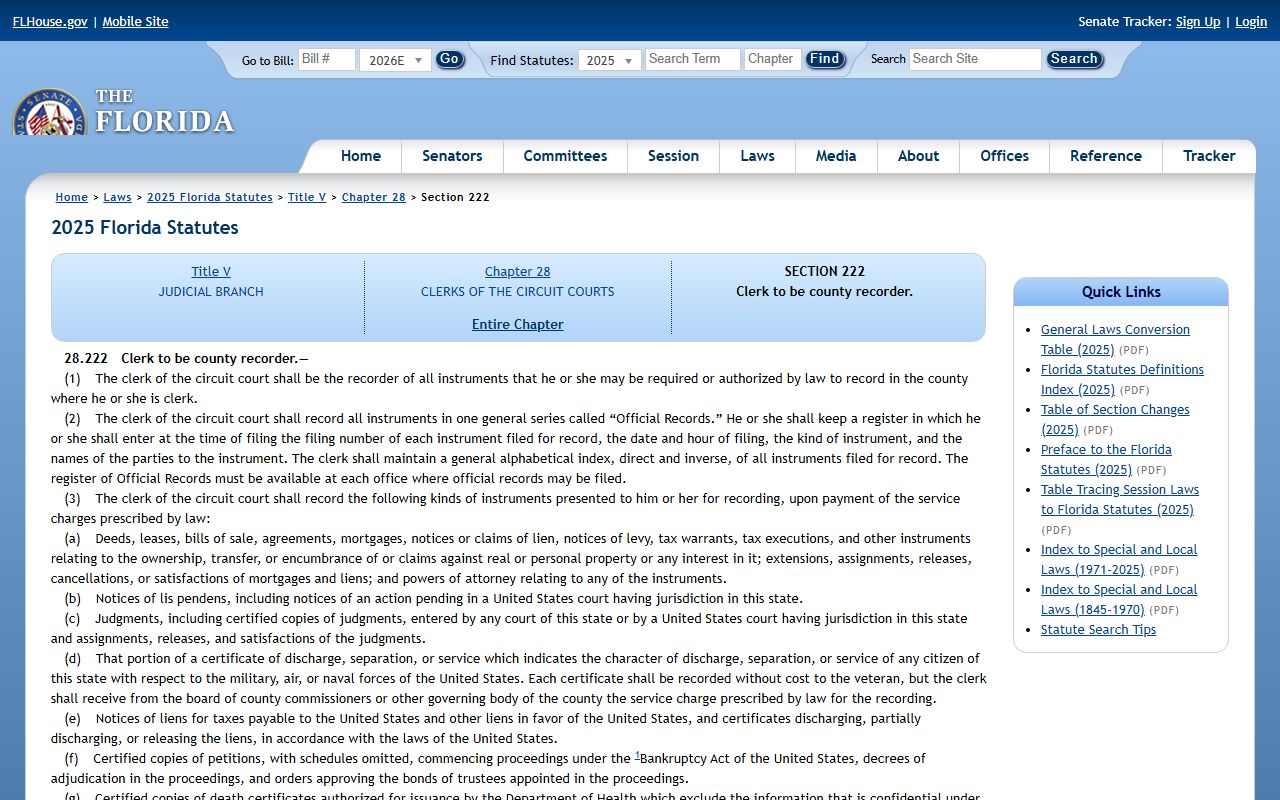
Under Florida Statutes section 28.222, the Clerk of the Circuit Court serves as the county recorder, which is the legal basis for the Clerk's authority to issue and certify copies of recorded marriage licenses and other official records in St. Lucie County.
Florida Vital Records and Statewide Marriage Data
The Florida Department of Health maintains a statewide vital records program that holds copies of marriages, divorces, births, and deaths recorded in Florida. For marriages, the Department of Health holds records going back to June 1927. Certified copies from the Department of Health are issued by the Bureau of Vital Statistics and carry the same legal weight as copies from the county Clerk.
The Department of Health vital records program is a separate system from the Clerk's official records search. If a marriage took place in St. Lucie County, you can get a certified copy from either the local Clerk or from the state vital records office. For marriages that happened in a county other than St. Lucie, or if you need statewide records for multiple counties, the Department of Health is the right starting point.
The Florida Department of Health vital records office also handles certified copies of divorce records for dissolutions finalized in Florida from June 1927 onward. These are sometimes called "divorce certificates" or "dissolution certificates" and are shorter, summary documents rather than full copies of the court file. If you need the full file including the final judgment, exhibits, and docket entries, you must request that from the Clerk of the Circuit Court where the case was filed.
Florida Department of Health, Bureau of Vital Statistics
P.O. Box 210
Jacksonville, FL 32231-0042
Older Marriage and Divorce Records in St. Lucie County
St. Lucie County was created in 1905 from a portion of Brevard County. Records from before that date were held by Brevard County. The Florida Department of Health holds statewide vital records going back to June 1927 for marriages and divorces. Records from before 1927 may be held only at the county level, and the condition or completeness of older records varies. If the Clerk's online search does not return a result for an older marriage, contact the Clerk directly to ask about archive access or microfilm records.
For genealogical research involving older St. Lucie County marriage records, the Florida State Archives and the State Library of Florida maintain collections that may include historical county records. Some records have been digitized and are accessible through the Florida Memory project. The Clerk's office can advise on the oldest records available through its systems and point researchers toward external archives when the local record does not exist in searchable form.
Note: Marriage and divorce records from other Florida counties are not held by the St. Lucie Clerk; contact the Clerk of the county where the event occurred or use the Florida Department of Health statewide program.