
About the St. Lucie County Clerk's Office
Michelle R. Miller serves as the St. Lucie Clerk of the Circuit Court and Comptroller. The position is elected countywide and carries a four-year term under Florida law. The Clerk is a constitutional officer, which means the office is independent from the Board of County Commissioners and the judicial circuit it supports. That independence matters: the Clerk sets local policies for file access, copy requests, and payment methods within the framework of state law and Florida Supreme Court rules.
The unified structure of the office means a single elected Clerk oversees both Circuit Court and County Court records, as well as the recording of official instruments, marriage license issuance, and the county comptroller function. There is no separate district clerk or county clerk in Florida. All court filings, copy requests, and certified-copy orders go through the same office regardless of whether the underlying case is a felony, a small-claims dispute, a family matter, or a probate proceeding. For information about the specific courts the Clerk serves, see the Circuit Court and County Court pages.
Clerk of the Circuit Court and Comptroller
Clerk: Michelle R. Miller
201 South Indian River Drive
Fort Pierce, FL 34950
St. Lucie West Branch Office
250 NW Country Club Drive
Port St. Lucie, FL 34986
The main courthouse office is in Fort Pierce at the St. Lucie County Courthouse on South Indian River Drive. The St. Lucie West branch serves residents in Port St. Lucie without requiring a trip across the county. Both locations handle clerk transactions including copy requests, filings, and payments. Current phone numbers and hours are posted on the Clerk contact page because office hours and direct phone lines can change after administrative updates or elections.
Clerk Duties in St. Lucie County
The St. Lucie Clerk of the Circuit Court and Comptroller carries a broad set of responsibilities that touch nearly every part of the local court system and county government. The office accepts filings for all Circuit Court and County Court cases, collects filing fees and fines, and maintains the official docket for each case. Court records are a core product: anyone who needs a copy of a judgment, a divorce decree, a criminal disposition, or a probate order turns to this office.
Beyond the courts, the Clerk serves as the county recorder of official records. That role includes recording deeds, mortgages, satisfaction of mortgage, liens, plats, easements, and other instruments that affect real property or create a public record. These documents are searchable through a separate official records portal at stlucieclerk.gov/public-search-gen/search-official-records. Note that a court case search and an official records search are two different systems. A divorce case is found in the court case search; a deed transferring property out of an estate is found in official records.
The comptroller function adds a third layer. The Clerk serves as the county's fiscal officer, auditing and accounting for public funds. That work runs parallel to the court and records side of the office. For most public record requests, the court and official records functions are the relevant ones. The clerk's home page at stlucieclerk.gov links all major service areas.
- Accept and docket civil, criminal, family, probate, traffic, and guardianship filings
- Maintain court case files and issue certified copies of court records
- Record official instruments including deeds, mortgages, liens, and plats
- Issue marriage licenses and record marriage-related documents
- Process traffic ticket payments and maintain traffic case records
- Perform county comptroller and fiscal officer duties
- Respond to public records requests under Florida Chapter 119
St. Lucie County Court Records Search
The Clerk maintains two distinct online search systems. The court case search portal is the starting point for judicial case records. It covers Circuit Court and County Court cases including civil, criminal, family, probate, guardianship, juvenile (where public access applies), and traffic matters. The portal is accessible from stlucieclerk.gov/public-search-gen/search-court-cases, which leads to the Benchmark public search interface. A case can be searched by party name, case number, or citation number depending on the module loaded. For a full walkthrough of the search portal and its fields, see the court records page.
Case records in the search system can show the case number, filing date, court or division, case type, status, party names and roles, attorney names, docket entries, hearing dates, and financial balances where applicable. Some documents are available as PDFs; others require a copy request to the Clerk. Confidential material such as adoption records, juvenile records, sealed files, and protected personal identifiers is withheld or redacted under Florida court access rules and Florida Statutes section 119.0714.
The official records portal is separate and covers recorded instruments. A deed, mortgage, lien, plat, or recorded marriage certificate is in official records, not in the court case search. Both portals are free to search publicly. Copies carry fees set by the Clerk under Florida Statutes section 28.24.
Note: Online search results do not include every document in the file. Sealed records, protected records, and documents withheld under confidentiality rules will not appear or will show limited data.
Official Records and the Comptroller Role
Florida Statutes section 28.222 designates the Clerk of the Circuit Court as the official recorder for the county. In St. Lucie County that recorder function is part of the same unified Clerk of the Circuit Court and Comptroller office. Instruments eligible for recording include warranty deeds, quit-claim deeds, mortgages and notes, satisfactions of mortgage, lis pendens notices, mechanic's liens, judgment liens, easements, plats of subdivision, and other instruments authorized by law.
Recording a document creates a permanent public record in the official records index. The recorded instrument receives a book and page number or an instrument number, and it is indexed by grantor and grantee names and by property parcel where applicable. Once indexed, the record is retrievable through the official records search at stlucieclerk.gov/public-search-gen/search-official-records. Fees for recording, indexing, and certified copies of recorded instruments are listed on the Clerk's fee page at stlucieclerk.gov/fees and are governed by the fee schedule established under section 28.24.
The recorder role intersects with real estate and probate work. A deed that transfers property out of a deceased person's estate must be recorded to become effective against third parties. That recording goes through the same Clerk office that handled the original probate case. For more on probate filings and estate case searches, see the probate records page.
The screenshot below is taken from the St. Lucie Clerk fee schedule landing page at stlucieclerk.gov/fees, which lists the current fee categories for court copies, recording, civil filing, probate, marriage, and traffic.
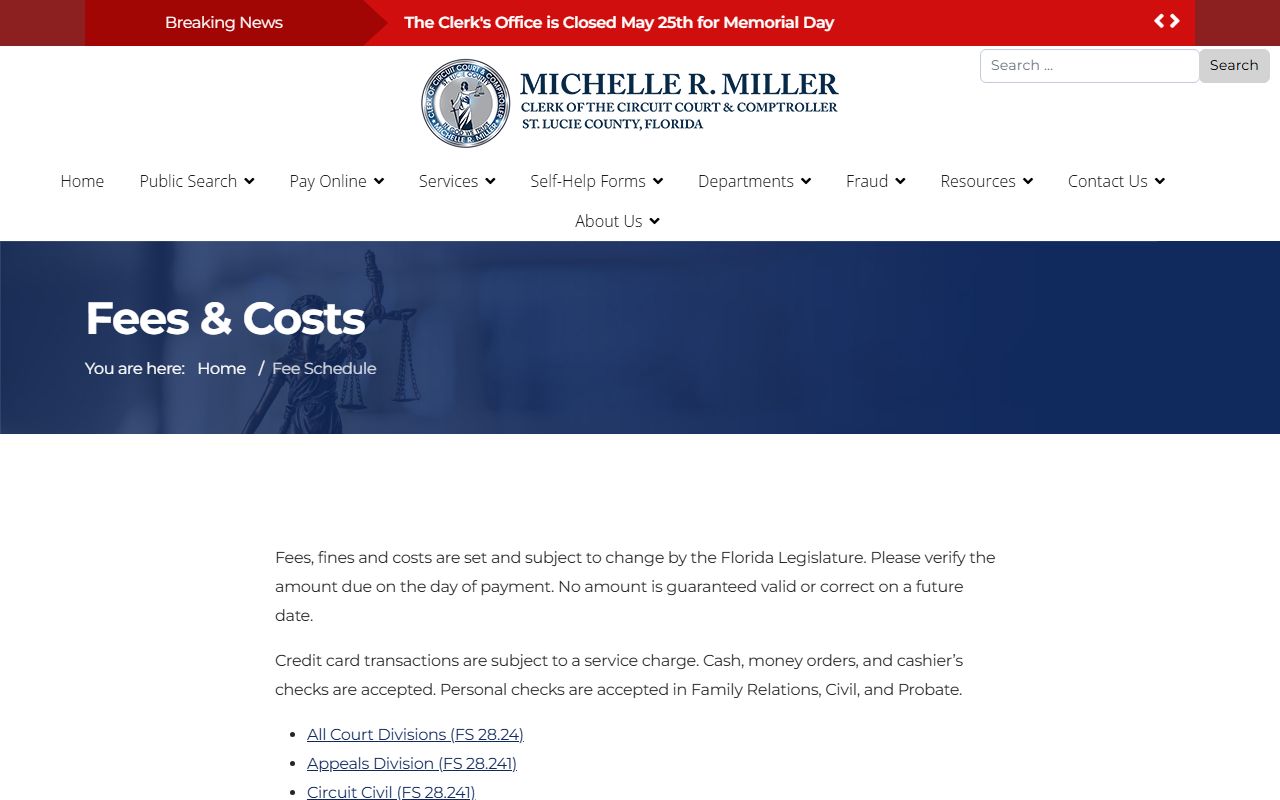
The fee schedule page organizes charges by service type, making it straightforward to find the current cost for a certified copy, a recording, or a civil filing before visiting the office or submitting a request by mail.
St. Lucie Clerk Fee Schedule Reference
The Clerk sets fees for court copies, official record copies, civil and criminal filings, probate, marriage licenses, and recording under Florida Statutes section 28.24. No fixed dollar amounts are listed here because fees can change by legislative session or administrative update. The current schedule is always posted at stlucieclerk.gov/fees. The table below lists the main fee categories and where to confirm each charge before submitting a request.
| Fee Category | Where to Verify | Statutory Authority |
|---|---|---|
| Plain copy per page | stlucieclerk.gov/fees | Fla. Stat. §28.24 |
| Certified copy (per page + certification) | stlucieclerk.gov/fees | Fla. Stat. §28.24 |
| Civil filing (circuit civil, county civil, small claims, eviction, family, appeal) | stlucieclerk.gov/fees | Fla. Stat. §28.24 |
| Criminal and traffic | stlucieclerk.gov/fees | Fla. Stat. §28.24 |
| Probate and guardianship filing | stlucieclerk.gov/fees | Fla. Stat. §28.24 |
| Marriage license | stlucieclerk.gov/fees | Fla. Stat. §28.24 |
| Official records recording and indexing | stlucieclerk.gov/fees | Fla. Stat. §28.222 |
Florida Statutes section 28.24 is the primary fee statute for clerk service charges. It sets per-page copy fees, certification fees, search fees, and filing fees across all case types. Section 28.222 covers recording fees specifically. Both statutes are updated periodically by the Florida Legislature, so the current fee schedule on the Clerk's site is the authoritative source for any transaction you plan to submit.
How to Request a Certified Copy
A certified copy carries the Clerk's official seal and signature, confirming the document is a true copy of the record on file. Banks, lenders, courts in other jurisdictions, immigration authorities, and some employers require certified copies rather than plain photocopies. A plain copy works for personal reference. If the copy needs to be presented as evidence or used for a legal transaction, get the certified version. The step-by-step process below applies to both in-person and mail requests for St. Lucie County court records.
- Find the case number or instrument number. Check any prior court notices, judgments, or prior copies you received. A case number is the fastest path to the right file. If you don't have a number, search the Clerk's court case portal at stlucieclerk.gov/public-search-gen/search-court-cases by party name and date range to locate the case before you request.
- Identify the document you need. Be specific: a final judgment, a divorce decree, a recorded deed, or a specific docket entry. Vague requests slow processing and may result in the wrong documents or a clarification request from the Clerk's office.
- Choose your request method. You can appear in person at the Fort Pierce main office or the St. Lucie West branch, submit a written request by mail, or use the Clerk's online services where available. Each method has different processing times. In-person requests for readily available documents can often be fulfilled the same day.
- Gather the required information for the request form. See the records request field inventory in the next section for a full list of what the Clerk typically asks for. At minimum: your name, contact information, the case or instrument number, the record type, the number of copies, and your preferred delivery method.
- Calculate the fee and prepare payment. Review the current certified copy fees on the Clerk's fee schedule at stlucieclerk.gov/fees before you submit. Fees are per page plus a certification charge. Mail requests should include a check or money order as instructed on the Clerk's contact page; do not send cash by mail unless the current Clerk page explicitly says it is accepted.
- Submit the request. In person, hand your written request to the clerk window at either service location. By mail, send to the Fort Pierce courthouse address with your request letter and payment. Online, follow the Clerk's current e-service instructions at stlucieclerk.gov.
- Receive the certified copy. In-person requests for available documents are often completed at the window or within the same visit. Mail requests take additional time for processing and return postage. The Clerk may contact you if fees need adjustment or if the record requires additional search time.
Note: Certified copies of sealed, expunged, juvenile, or adoption records are not available to the general public and will not be issued regardless of payment.
Records Request Form Field Inventory
When you submit a copy or public-records request to the St. Lucie Clerk of the Circuit Court, the office needs specific information to locate the file and process the order. The table below lists the fields typically required or requested on a St. Lucie Clerk records request form. Providing complete and accurate information speeds up the process. Required fields vary slightly depending on whether you are requesting court records, official records, or other clerk documents.
| Field Label | Required | Notes |
|---|---|---|
| Requester name | Yes | Used for copy requests and public-record requests; provide full legal name. |
| Contact phone | Yes | Used for clarification calls; include area code. |
| Email address | Yes (if electronic response) | Used for response, invoice, and clarification messages. |
| Mailing address | Conditional | Required if requesting mailed copies; include street, city, state, and ZIP. |
| Case number or instrument number | Optional but strongly recommended | Court case numbers or official record book/page/instrument identifiers speed retrieval significantly. |
| Party names | Optional | Use full legal names; include aliases if known to help locate the record. |
| Record type | Yes | Court record, official record, marriage record, probate, traffic, criminal, family, civil, or certified copy. |
| Date range | Optional | Useful when the exact case or instrument number is unknown. |
| Copy type | Yes | Plain copy, certified copy, exemplified copy, electronic copy, or mailed copy. |
| Delivery method | Yes | Email, mail, pickup at Fort Pierce or St. Lucie West, or online download if available. |
| Payment method | Yes (if fee due) | Follow clerk payment instructions; confirm accepted methods at stlucieclerk.gov/contact-us. |
For marriage license records or certified copies of marriage certificates, the Clerk's marriage license page at stlucieclerk.gov/services/marriage-licenses/ has the current application and copy request guidance. Those requests follow a similar field structure but may include additional details such as the license date and the parties' names as they appear on the license. For broader record types, see the public records page for details on Florida Chapter 119 request procedures.
Clerk Services by Subject Area
The St. Lucie Clerk of the Circuit Court and Comptroller organizes its services into functional areas accessible through the main site. The list below links directly to the relevant Clerk service pages for the most common needs. Each service area has its own page with current instructions, forms, and where applicable, links to online portals.
- Traffic tickets - pay or contest a citation, set up a hearing, or check ticket status
- Marriage licenses - apply, check requirements, and get certified copies
- Probate and guardianship - file an estate case, check procedures, and review forms
- Family law - family case records, forms, and filing assistance
- Small claims - file or respond to a small claims case in County Court
- Jury duty - report status, postponement requests, and service information
For marriage and divorce records, the Clerk holds both marriage license records (issued through this office) and the court case records for dissolution of marriage proceedings filed in Circuit Court. A divorce case number comes from the court case search portal; a marriage license record is a separate official record. Both types of certified copies can be ordered through the Clerk. See the marriage and divorce records page for a full breakdown of the two record types and how to access each.
Electronic Filing and Online Access
Florida uses a statewide electronic filing system for court pleadings and filings. Attorneys practicing in St. Lucie County are generally required to use the Florida e-Filing Portal to submit documents electronically to the Clerk. Self-represented litigants in many case types can also use the portal to file without appearing in person. The Clerk processes e-filed documents according to court rules and local workflow standards established by the Nineteenth Judicial Circuit and the Florida Supreme Court.
Online access for the public runs through two separate portals maintained by the Clerk. Court case records are searchable through the Benchmark portal linked from stlucieclerk.gov/public-search-gen/search-court-cases. Official recorded instruments are searchable through the official records portal linked from stlucieclerk.gov/public-search-gen/search-official-records. Traffic ticket payments and citation status checks are handled through the traffic ticket page at stlucieclerk.gov/services/traffic-tickets/. All three are accessible without creating an account, though some document downloads or copy orders may require additional steps.
The image below shows the Florida Statutes section 28.24 page at flsenate.gov, which is the primary authority governing clerk service charges for copies, certifications, filings, and related services across all Florida clerk offices including St. Lucie County.
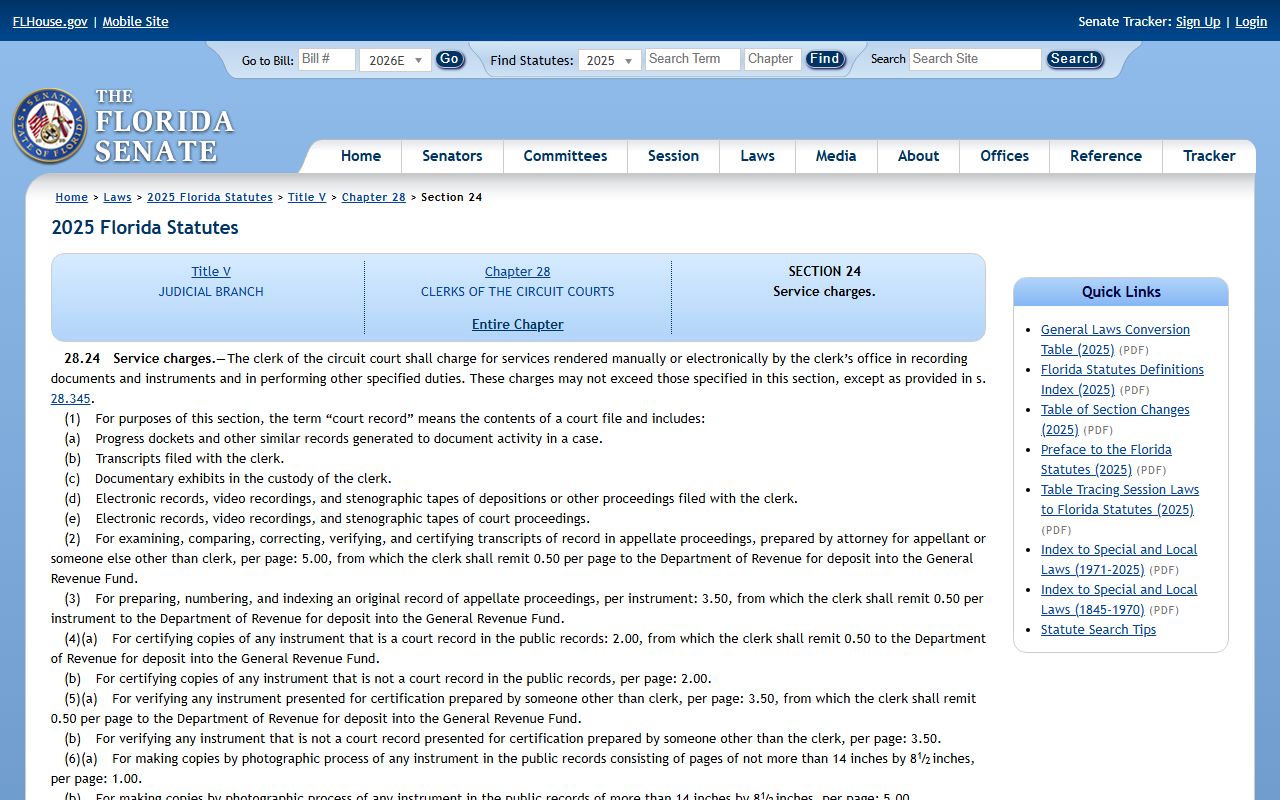
Section 28.24 sets the baseline fees that the St. Lucie Clerk applies to copies and filings; the current amounts are verified at stlucieclerk.gov/fees since the Legislature can adjust them in any session.