
How to Find Recently Released St. Lucie County Inmates
The St. Lucie County Sheriff's Office publishes a release report at stluciesheriff.com/218/Release-Report. This is the official local starting point when you need to confirm that someone has left the county detention facility. The report may be date-based, showing who was released on a specific day or over a recent period. Because release events happen around the clock, the page reflects recent activity rather than a complete historical archive.
Not finding a name on the current inmate lookup does not confirm a person was formally released. People leave local custody in several ways. A bond may have been posted. A judge may have issued an order. The person may have been transferred to the Florida Department of Corrections to begin a state sentence. Federal authorities may have taken custody. An immigration or other agency hold may have moved the person to a different facility entirely. Each of those paths leads to a different search tool.
The release report search form on the Sheriff's site uses the fields shown below. Fields may vary depending on how the report system is configured when you access it.
| Field Label | Type | Required | Notes |
|---|---|---|---|
| Date / Release Date | Date | Optional if shown | Reports are often filtered by release date. Select the date range you need. |
| Name | Text | Optional if shown | Search by the released person's name if a name filter is available. |
| Search / Submit | Button | n/a | Runs the report based on the selected filters. |
| Print / Export | Button / Link | n/a | May be available depending on the reporting system in use at the time. |
If you need to check whether a person is still in local custody rather than released, the St. Lucie County inmate records lookup page covers the current jail roster and booking details. For current population data, see the inmate population page.
Setting Up Release Notifications
VINELink is a national custody status and notification portal used by many county jails, state prison systems, and other agencies. When a participating agency updates a custody record, VINELink can send an alert to registered contacts by phone, email, or text. For victims, family members, and others who need to know the moment someone is released, transferred, or receives a change in custody status, setting up a VINELink notification is more reliable than manually checking a release report each day.
The VINELink portal at vinelink.com allows users to search for an offender by name or ID number, identify the state or agency, and register for ongoing alerts. The registration process requires contact information and a PIN for verification. Some agencies publish direct VINELink enrollment links from their own inmate information pages. St. Lucie Sheriff's inmate information is at stluciesheriff.com/213/Inmate-Information.
The screenshot below, from the VINELink site, shows the national custody status interface used to register for release alerts.
Visit vinelink.com to access the notification portal directly.
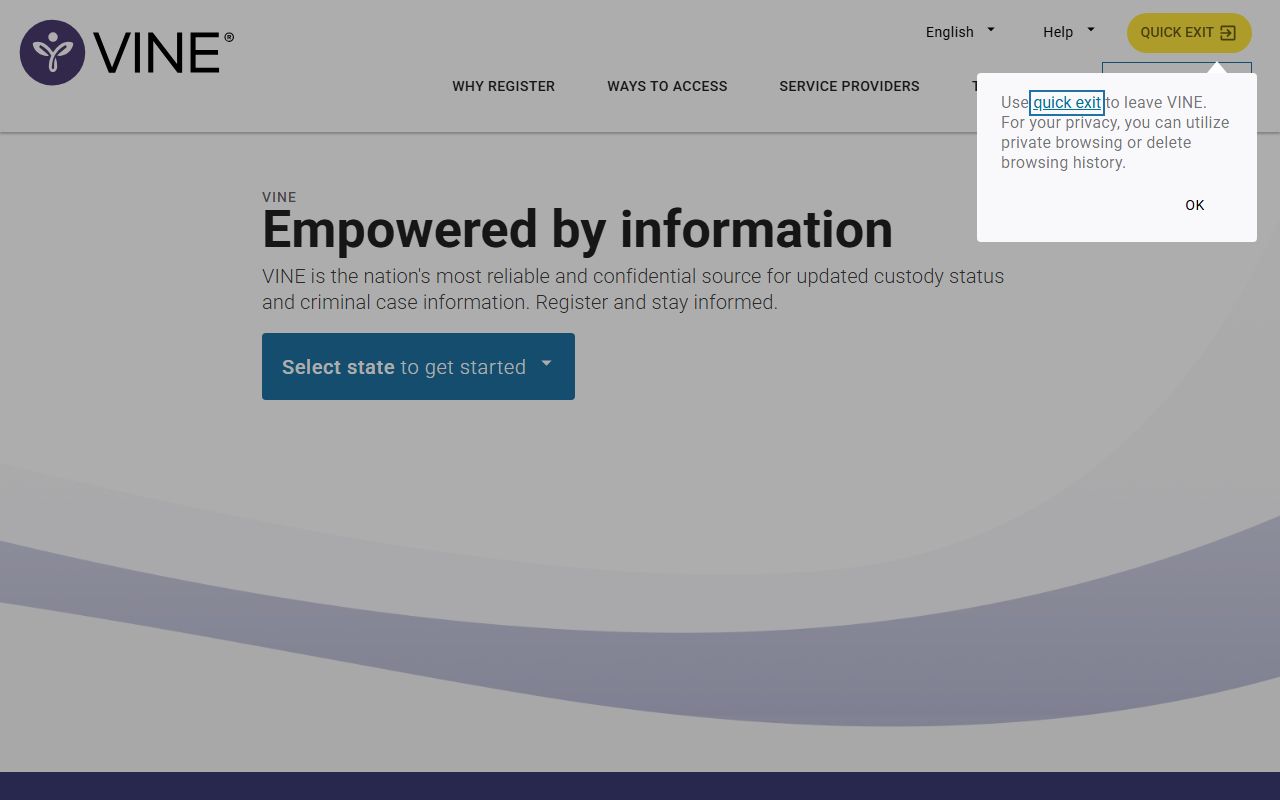
VINELink notifications are useful when custody moves across facilities or agencies, since local release data may not capture transfers to state or federal custody.
Steps to register for a VINELink release alert:
- Go to vinelink.com and choose to search for an offender.
- Select Florida as the state, or use a national search if the person may be held in multiple states.
- Search by the offender's name or ID number to find the matching custody record.
- Select the correct person from the results and choose to register for notifications.
- Provide your phone number, email address, notification method preference, and create a PIN for verification.
- Confirm registration and save your PIN. VINELink will contact you when the custody status changes.
Note: VINELink coverage depends on agency participation. Not every local or state facility uploads data in real time, so notifications supplement but do not replace direct contact with the jail or court.
Searching State and Federal Released Inmates
When a person is convicted of a Florida felony and sentenced to more than a year, they move from county jail to Florida Department of Corrections custody. The county jail no longer holds them; they are now a state inmate. The Florida DOC offender search at dc.state.fl.us covers current and released state inmates, people on probation or community supervision, and those who have completed their sentence. This tool is separate from the Sheriff's local inmate lookup and is the right tool when someone has been transferred to a state prison or is under DOC supervision after release.
The Florida DOC search returns a profile that can include the DC number (the state offender identifier), current location or supervision status, sentence information, and release or projected release date. For people who have already completed their sentence, the DOC may still maintain a record that confirms the prior incarceration. The fields used to search the Florida DOC portal are listed in the table below.
| Field Label | Type | Required | Notes |
|---|---|---|---|
| DC Number | Text | Optional | Florida DOC offender identifier; most precise search input if you have it. |
| Last Name | Text | Optional | Name search; exact spelling helps narrow results. |
| First Name | Text | Optional | Use with last name to reduce false matches. |
| Race | Dropdown | Optional | Options vary by DOC form version; helps narrow common names. |
| Sex | Dropdown | Optional | Male / Female as shown by the portal. |
| Search | Button | n/a | Runs the offender query. |
A Florida DOC offender profile may show fields such as: name and DC number; race, sex, age; current facility or supervision status; offense description and statute; sentence dates; projected or actual release date; and county of commitment (the county where the case originated). For St. Lucie County cases, the county of commitment will reflect the Nineteenth Judicial Circuit prosecution.
Federal custody is a separate track. When a person is charged with a federal crime, they are held in federal or contract facilities and prosecuted by the U.S. Attorney's Office for the Southern District of Florida, at justice.gov/usao-sdfl. After sentencing, federal inmates are placed in Bureau of Prisons facilities anywhere in the country. The screenshot below shows the BOP inmate locator interface.
The Federal Bureau of Prisons inmate locator is available at bop.gov/inmateloc.
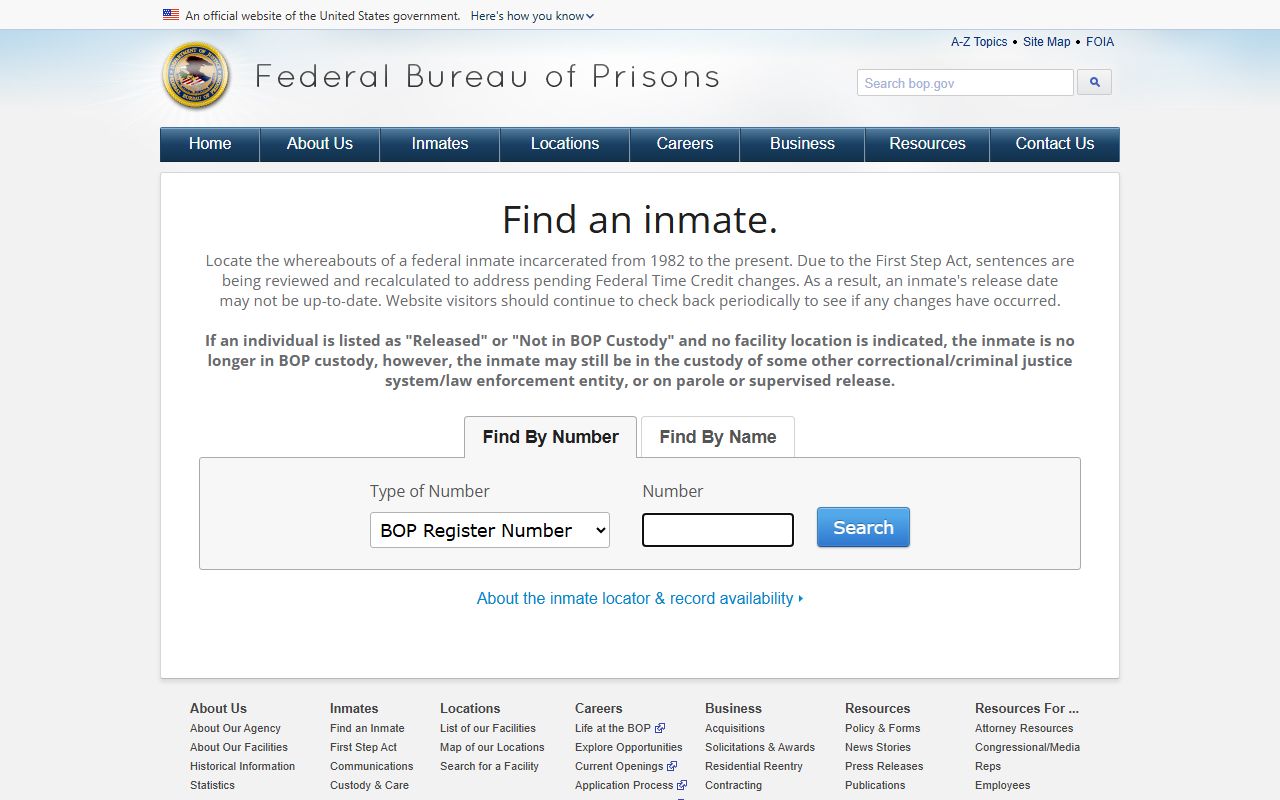
The BOP locator covers inmates currently in federal custody as well as those released within the past year, making it useful for tracking recently released federal prisoners connected to St. Lucie County cases.
| Field Label | Type | Required | Notes |
|---|---|---|---|
| Find by Number | Radio / Tab | Optional | Accepts BOP Register Number, DCDC number, FBI number, or INS number. |
| Find by Name | Radio / Tab | Optional | Name search mode; requires last name at minimum. |
| First Name | Text | Optional | Name search; use exact spelling. |
| Last Name | Text | Required for name search | Exact spelling helps avoid false matches on common names. |
| Race | Dropdown | Optional | BOP-defined options for narrowing results. |
| Sex | Dropdown | Optional | BOP-defined options. |
| Age | Text | Optional | Numeric age; helps narrow results with common names. |
Verifying Release in Person or By Phone
Online release data can lag behind real-time custody events. A person may show up as still booked in the jail roster while bond has already been posted and processing is underway. In those cases, calling or visiting is more accurate than waiting for a web update. The St. Lucie Sheriff's inmate information page at stluciesheriff.com/213/Inmate-Information is the official contact point; it publishes current contact details for the jail records line and inmate information staff.
When calling, have the full name, booking number if known, and date of birth ready. Jail staff can confirm whether someone is still in custody, has been released, or has been transferred. They cannot provide detailed case strategy or legal advice, but they can tell you custody status and, in many cases, the reason for release such as bond, court order, or transfer.
The Clerk case docket is also worth checking. A search through the St. Lucie County court records portal can show bond orders, release orders, disposition entries, sentencing events, and notices of transfer that explain a custody change even before the jail's online roster updates. The Nineteenth Judicial Circuit courthouse is at 218 South 2nd Street in Fort Pierce, and the Clerk's Fort Pierce office is at 201 South Indian River Drive.
If you believe someone was transferred to a state or federal facility, the Florida DOC and BOP tools described above are faster than calling the jail for that information. Jail staff handle local detention; once a person leaves their custody, they can only confirm the transfer, not the destination facility details.
Florida Sex Offender Registry
Florida requires sex offenders and sexual predators to register with local law enforcement and maintain current address information. The Florida Department of Law Enforcement maintains the statewide registry at offender.fdle.state.fl.us. When a registered sex offender is released from local custody in St. Lucie County, they must comply with registration and reporting requirements as a condition of their release. The FDLE registry is the official source for checking whether a person near you is a registered offender or predator.
The registry separates "sexual offenders" from "sexual predators." Predators face more strict registration requirements and community notification. Both categories appear in the public search. The search supports name-based lookups, address and city filters, county filters (so you can search specifically within St. Lucie County), and geographic radius searches by ZIP code. The search-field table below describes the available inputs.
| Field Label | Type | Required | Notes |
|---|---|---|---|
| Name | Text | Optional | Search for a registered offender or predator by name. |
| Address / City / County | Text / Dropdown | Optional | County dropdown can be set to St. Lucie to find local registrants. |
| ZIP Code / Radius | Text / Dropdown | Optional | Geographic search; select a radius to see registrants near an address. |
| Offender Type | Checkbox / Dropdown | Optional | Filter by sexual offender, sexual predator, or both. |
A registry profile typically includes the registrant's name, photo, date of birth, address, offense, and conviction information. Physical descriptors and vehicle information may also be shown. The registry reflects current registration data as reported by the offender and verified by law enforcement; it may not update the same day as a release from custody. If you have safety concerns that cannot wait for a registry update, contact local law enforcement directly.
The image below is from the U.S. Attorney's Office for the Southern District of Florida, which prosecutes federal sex-offense cases involving St. Lucie County and the surrounding Treasure Coast region.
The Southern District federal prosecution office is at justice.gov/usao-sdfl.
Federal sex offense convictions can also place a person on the national sex offender public website, which aggregates state and federal registry data for cross-state lookups.
Parole and Probation in Florida
Florida largely abolished parole for offenses committed on or after October 1, 1983. People sentenced under the current system are not generally eligible for traditional parole board release. They serve the sentence imposed, subject to gain-time rules, mandatory minimums, and Florida Department of Corrections policies. The Florida Commission on Offender Review (formerly the Parole Commission) still handles cases involving older offenses that predate the current sentencing structure, conditional release supervision, control release, and related programs. Victims and others who need to track a parole hearing or supervision condition tied to an older conviction should check the Commission's official resources.
Probation is different from parole. Probation is a sentencing option, not a prison release program. A judge may sentence a defendant to probation in place of, or in addition to, incarceration. Probation is supervised by the Florida Department of Corrections Office of Community Corrections. Conditions typically include reporting to a probation officer, maintaining a lawful address, avoiding new arrests, paying restitution and supervision fees, submitting to drug testing, completing required treatment or community service, and staying away from restricted persons or places. A probation violation can result in a warrant, a new custody period, and a hearing before the sentencing judge.
For Florida DOC community supervision contact information, use the official DOC site:
For St. Lucie County residents under DOC supervision, the supervising probation office will be assigned based on the person's approved residence. Contact the DOC directly or use the DOC offender search to find supervision status and assigned officer information for a specific person.
Reentry Resources in St. Lucie County
People leaving the St. Lucie County jail or returning from state prison face practical challenges on release day and in the weeks that follow. Released inmates usually receive stored personal property according to jail procedures and should also receive court paperwork, release conditions, any mandatory reporting instructions, and contact information for supervision if applicable. Future court dates and compliance deadlines do not pause because of a release; missing them can generate new warrants.
Florida has a network of reentry support programs tied to the courts, the DOC, and community nonprofits. The Nineteenth Judicial Circuit at circuit19.org/programs-services lists specialty court programs and services that overlap with reentry needs, including treatment courts, veterans services, and behavioral health programs. The Public Defender's office at pd19.org and the Florida Courts self-help resource at flcourts.gov both provide access to forms and procedural guidance for people navigating post-release legal matters.
Key reentry support areas for St. Lucie County residents:
- Legal Aid: Florida Rural Legal Services provides civil legal aid to parts of the Treasure Coast region; verify current St. Lucie County coverage and office contacts through official legal-aid pages before relying on any specific contact.
- Employment: Goodwill-type workforce programs, county workforce development services, and Florida's career center network are available in the Fort Pierce and Port St. Lucie area. DOC-connected employment programs may also apply during supervision.
- Housing: Transitional housing options in St. Lucie County should be verified through the county social services and official referral pages; program availability changes and waiting lists are common.
- Substance Use and Behavioral Health: The Nineteenth Judicial Circuit treatment court programs, county behavioral health services, and DOC-mandated treatment referrals can connect returning residents with drug, alcohol, and mental health treatment.
- Veterans Services: Eligible veterans may access VA services, veterans treatment court programs, and peer mentor support through the Nineteenth Judicial Circuit veterans court program.
Transportation on release day matters. Jail releases can occur at any hour, including nights and weekends. Plan pickup in advance. The jail does not guarantee transportation, and county transit routes may not cover the release facility at all hours. Check St. Lucie County transit and nearby services before the release date.
Civil Rights Restoration After Release
Florida law on civil rights restoration after a felony conviction is set primarily by the state constitution and by statute. A person convicted of a felony loses the right to vote, serve on a jury, hold public office, and possess firearms. Restoration rules vary by the type of offense and whether all terms of a sentence, including financial obligations, have been completed.
Voting rights: Florida's Amendment 4, passed in 2018, restored voting eligibility for most people who have completed all terms of their sentence, including parole, probation, and payment of fines, fees, and restitution. However, murder and felony sex offense convictions are excluded from automatic restoration and require a separate clemency process through the Florida Board of Executive Clemency. People with qualifying convictions who have completed all sentence terms, including unpaid financial obligations, may be eligible to register to vote. The Florida Division of Elections and official state clemency pages are the correct sources for current eligibility rules, because court interpretations and agency policies have changed since the amendment passed.
Firearm rights: a felony conviction under Florida or federal law prohibits possession of a firearm. Restoration of firearm rights generally requires a full clemency pardon from the Florida Clemency Board, which involves a separate formal application. Completing a sentence does not automatically restore the right to possess firearms for felony convictions. Anyone uncertain about their status should consult an attorney before handling any firearm.
Jury service: people with prior felony convictions are not eligible for jury service in Florida unless their civil rights have been restored through clemency.
Employment and licensing: many Florida professional licenses and employment categories carry additional restrictions for people with certain criminal histories. Sealing or expunging a qualifying record under Florida Statutes section 943.0585 (expunction) or section 943.059 (sealing) can limit what employers and agencies see, but eligibility requirements are strict and not every conviction qualifies. The Clerk of the Circuit Court maintains the court record; FDLE handles the criminal history certificate. For warrant records tied to a prior case, see the St. Lucie County warrant records page and the criminal records page for background on sealing and expunction procedures in Florida.
The Board of Executive Clemency processes restoration applications for cases that do not qualify for automatic restoration. Applications require a waiting period after completion of the sentence and are reviewed based on offense type, conduct, and restitution status. Official information is at the Florida Commission on Offender Review site, which administers the clemency process on behalf of the Governor and Cabinet.