
Probate Division of the St. Lucie Circuit Court
Probate in St. Lucie County is not handled by a separate elected probate court. It is a division of the Circuit Court, part of Florida's Nineteenth Judicial Circuit. That circuit covers St. Lucie, Martin, Indian River, and Okeechobee counties. The Clerk of the Circuit Court and Comptroller, Michelle R. Miller, receives all filings, collects fees, maintains the case docket, and controls public access to probate documents.
The division handles a range of matters. Estate administration is the most common, when someone dies, their assets, debts, and distributions may need court supervision before title can pass to heirs or beneficiaries. The court also hears guardianship cases for adults who have been found incapacitated and cannot manage their own affairs. Minor guardianship matters arise when a child inherits property or when parents cannot care for their child's financial interests. Trust disputes, caveats, creditor claims, and incapacity determinations are also within the division's jurisdiction.
Florida law requires that a decedent's original will be deposited with the clerk of the county where the decedent lived, even if no probate proceeding is opened. This deposit requirement applies regardless of whether the estate will go through formal or summary administration.
The Clerk's official probate and guardianship service page is a good starting point for case types, forms, and current filing procedures. The screenshot below shows that page.
The St. Lucie Clerk probate and guardianship service page lists case types accepted, required forms, and filing guidance for estates and guardianship petitions.
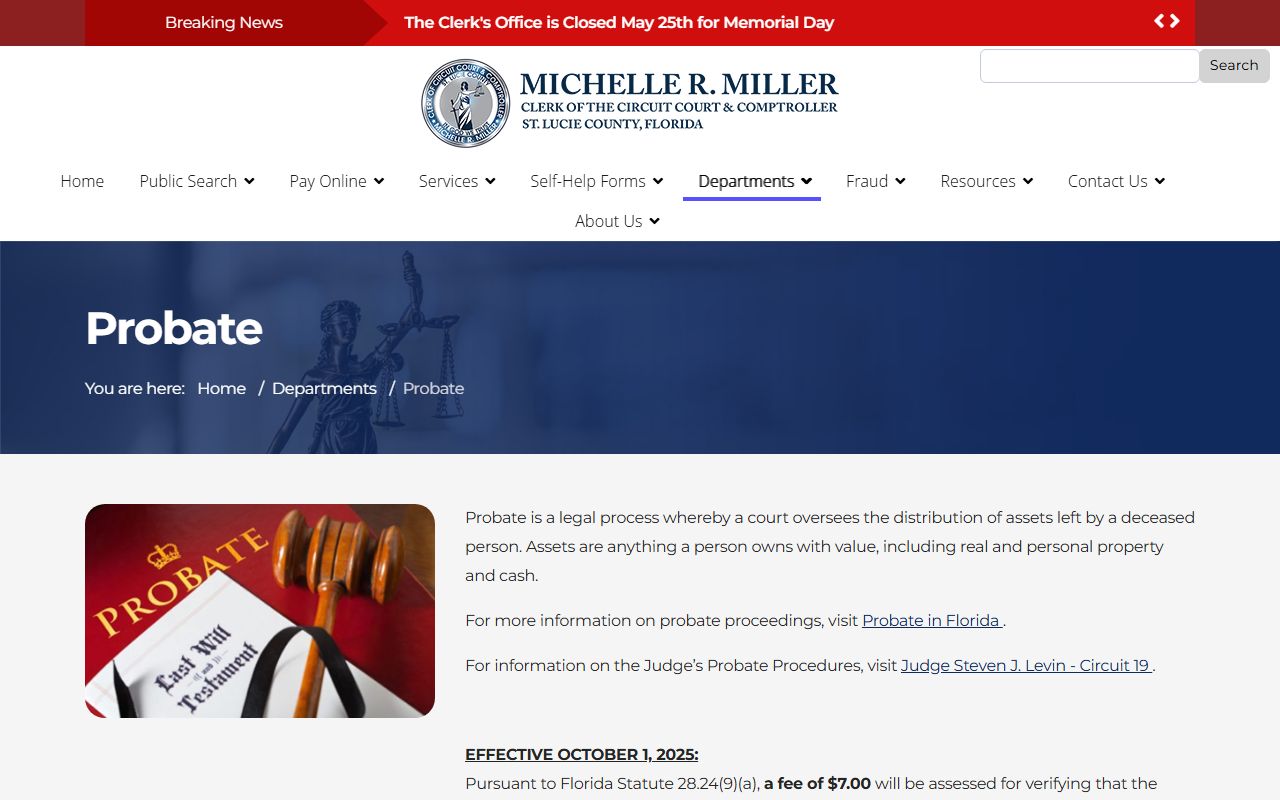
That page also links directly to the Benchmark case search portal, where pending and closed probate cases can be looked up by name or case number.
Probate Terms Used in St. Lucie Filings
Probate filings use legal terms that can be unfamiliar. Florida uses different terminology from some other states, notably, Florida calls the person who carries out a will a "personal representative," not an "executor." Knowing these terms helps when reading a docket or filing a petition.
- Testator
- The person who made and signed a will. When a testator dies, their will may be filed with the clerk and a probate case opened to administer the estate.
- Personal Representative
- Florida's term for the person appointed by the court to carry out a will or administer an estate. Other states use "executor" or "administrator." The personal representative gathers assets, pays debts and taxes, and distributes what remains to heirs or beneficiaries.
- Intestate
- Dying without a valid will. Florida's intestacy statutes govern who inherits when no will exists. The court appoints a personal representative, often a surviving spouse or adult child, to administer the estate.
- Guardianship
- A court-supervised arrangement where one person or entity (the guardian) is authorized to make decisions for an incapacitated adult or a minor. Guardianship may cover personal care decisions, financial matters, or both, depending on the court's order.
- Conservatorship
- In Florida practice, conservatorship most often refers to the financial management component of a guardianship arrangement. The conservator manages property and accounts under court oversight, filing annual accountings to document income, expenses, and asset values.
How to Search St. Lucie County Probate Records
The primary search tool is the Benchmark court case portal maintained by the St. Lucie Clerk. It covers Circuit Court cases, including all probate and guardianship matters filed in St. Lucie County. The portal is free to use and does not require an account for basic public searches. Most filed documents in active and closed cases are viewable online, though restricted items like confidential medical reports or sealed financial accounts will not appear in public results.
The search fields available in the probate portal are listed in the table below.
| Field Label | Type | Required | Format Notes |
|---|---|---|---|
| Case number | Text | Optional | Best way to locate a specific estate or guardianship file. |
| Decedent / Ward last name | Text | Conditional | Name search; last name of the deceased person or ward. |
| First name | Text | Optional | Narrows results when many records share the same last name. |
| Case type | Dropdown | Optional | Filter by probate, guardianship, estate, trust if shown. |
| Filing date range | Date | Optional | Useful for older estates or recent filings. |
| Search | Button | n/a | Runs the query in the court case portal. |
To search for a probate case, follow these steps.
- Go to the St. Lucie Benchmark court case portal and select the probate or guardianship case type from the filter options.
- Enter the decedent's or ward's last name, or the case number if you have it. A case number is the fastest route to the right file.
- Review the results list. Click the case number to open the docket. The docket shows each filing with the date, document type, and a link to the document image if it is public.
- To get a certified copy of any document, contact the Clerk of the Circuit Court. Certified copies are needed for legal proceedings such as transferring real property or closing financial accounts.
- If a document does not appear online but you believe it should be public, contact the clerk's office. Some older records may not yet be digitized.
Types of St. Lucie Probate Cases
Not every estate goes through the same process. Florida law offers several tracks depending on the size and complexity of the estate. Choosing the right track matters because the filing requirements, timelines, and costs differ. The clerk's staff can point you toward the correct forms, but they cannot give legal advice on which procedure fits your situation.
Formal administration is the full probate process. It applies when an estate has significant assets, debts, or disputes among heirs. A personal representative is appointed, creditors are notified, an inventory is filed, claims are resolved, and the court enters a final order of discharge. This track takes more time and usually involves an attorney.
Summary administration is an abbreviated process available when the value of the estate subject to administration does not exceed a certain statutory threshold, or when the decedent has been dead for more than two years. No personal representative is appointed; instead, the court issues an order of summary administration directing asset distribution directly to beneficiaries. Many families with modest estates use this route.
Disposition without administration is the simplest option. It applies when the only assets are exempt property or certain personal property of limited value. No full probate case is opened; the clerk issues authorization directly.
- Formal administration, full court-supervised estate process with personal representative appointment
- Summary administration, streamlined process for qualifying smaller estates or older deaths
- Disposition without administration, for very limited exempt or personal property assets
- Guardianship of an adult, incapacity proceedings with examining committee, court order, annual plans and accountings
- Guardianship of a minor, for property management or care decisions when parents cannot act
- Caveat filing, notice filed by an interested party to be informed before any order is entered in an estate
- Trust administration matters, certain trust disputes or trustee issues that come before the Circuit Court
What St. Lucie County Probate Records Contain
A probate case file can hold many different documents depending on the type of proceeding and how far it has progressed. The basic petition and death certificate reference are almost always present. In formal administration cases, you can expect to see a richer set of filings.
Common documents in a St. Lucie County probate file include the original petition, the decedent's will and any codicils, the oath and bond of the personal representative, letters of administration (the document that gives the personal representative legal authority to act), notices to creditors, the inventory of estate assets, creditor claims and court rulings on those claims, accountings showing income and disbursements, receipts from beneficiaries, and the final order of discharge or summary-administration order directing distribution.
Guardianship files tend to be larger over time. They include the initial petition, the examining committee reports documenting the ward's condition, the order determining incapacity, the letters of guardianship, annual guardianship plans covering personal care decisions, annual accountings covering financial management, any petitions to modify the guardianship, and court orders on each petition. Many of these documents contain medical or financial details that are partially or fully restricted from public view.
Note: The clerk's office can confirm whether a specific document in a case is public or restricted before you make a trip to Fort Pierce to inspect it.Probate Division Contact, St. Lucie Clerk
All probate and guardianship filings in St. Lucie County go through the Clerk of the Circuit Court and Comptroller. There is no separate probate courthouse. The main clerk office in Fort Pierce handles in-person filings, certified copy requests, and public record inspections. For phone numbers and current hours, use the contact page listed below, as those details can change.
Clerk of the Circuit Court and Comptroller
201 South Indian River Drive
Fort Pierce, FL 34950
Probate Filing Fees in St. Lucie County
Probate and guardianship filing fees in St. Lucie County are set by Florida statute and local court requirements. The clerk's fee schedule page lists current amounts for each category. No dollar amounts are listed here because fees can be updated by the legislature or court rule, and the official fee page is always the authoritative source. The table below lists the main fee categories and where to verify each one.
| Fee Category | Where to Verify |
|---|---|
| Original probate petition / estate application | stlucieclerk.gov/fees |
| Letters of administration / letters testamentary | stlucieclerk.gov/fees |
| Caveat filing | stlucieclerk.gov/fees |
| Creditor claim filing | stlucieclerk.gov/fees |
| Guardianship petition | stlucieclerk.gov/fees |
| Certified copy per page | stlucieclerk.gov/fees |
| Plain copy per page | stlucieclerk.gov/fees |
Some parties qualify for fee deferrals or waivers based on financial hardship. The clerk's office can explain the process for requesting a fee waiver when you file. Attorney fees in probate are governed by Florida Statutes and may be subject to court review if the estate is contested or if the amount is disputed by beneficiaries.
Confidential St. Lucie County Probate Materials
Most probate case documents are open to the public under Florida's broad public records framework. Some materials, however, are restricted by statute or court rule. Knowing which documents are off-limits helps you plan your research and avoid wasted trips.
Guardianship records are the area with the most restrictions. Examining committee reports describe a ward's mental and physical condition in clinical detail. Those reports, along with medical records attached to guardianship filings, are typically confidential. Annual accountings in a guardianship may contain full financial account numbers and other sensitive data that the court may order redacted or sealed from public view. Minor guardianship files follow similar rules because they involve a child's personal and financial information.
Adoption records are sealed under Florida law. Once a court enters a final judgment of adoption, all related records are confidential by operation of Florida Statute section 63.162. The adoptee, the birth parents, and the adoptive parents may access certain records under specific conditions set by that statute, but general public access is not permitted. Adoption cases that move through the Circuit Court in St. Lucie County are subject to this seal automatically.
Mental health records attached to involuntary commitment proceedings or Baker Act matters filed within the probate division are confidential under Florida Statute section 394.4615. That statute protects clinical records of patients receiving mental health services and limits disclosure to a defined set of authorized parties. Even if a mental health matter generates a court case number visible in a public docket, the underlying clinical documents are withheld.
The screenshot below shows the Florida Statutes page for section 63.162, which governs adoption record confidentiality in Florida.
The Florida Statutes section 63.162 text outlines when adoption records are sealed and what limited access rights apply to affected parties.
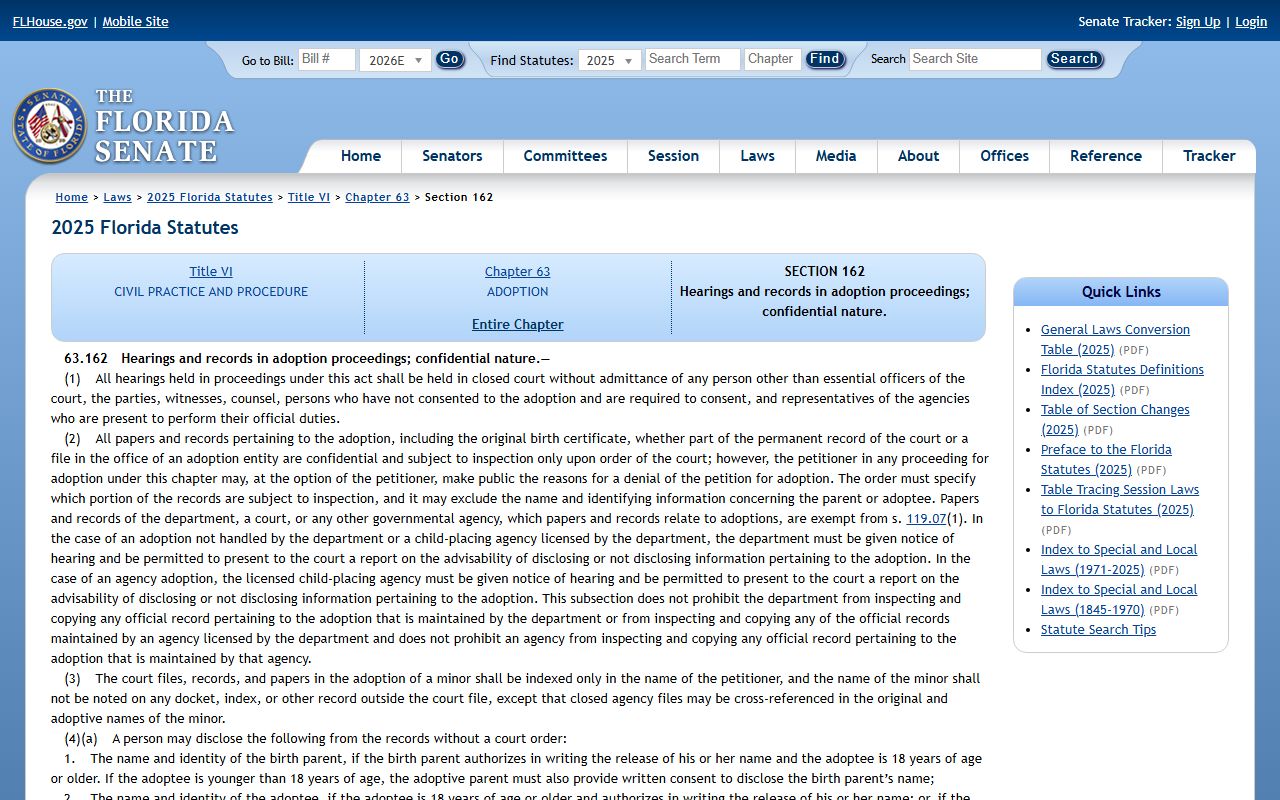
This statute is directly relevant to any St. Lucie County adoption case that was processed through the Circuit Court probate division; those files are sealed from public inspection after the adoption is finalized.
The screenshot below shows the Florida Statutes page for section 394.4615, which covers mental health clinical record protections.
The Florida Statutes section 394.4615 text defines which mental health clinical records are confidential and who may receive them under what conditions.
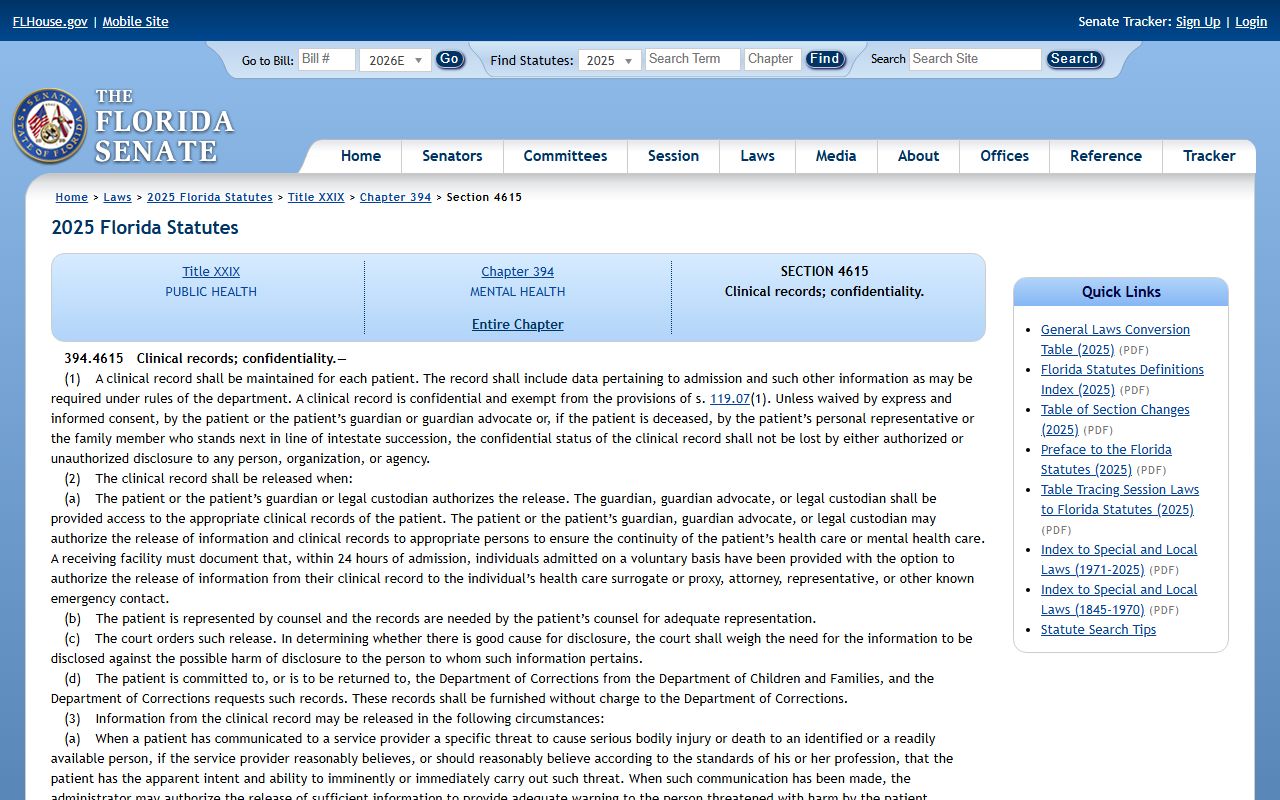
When a Baker Act or mental health matter creates a case in St. Lucie's probate division, the clinical documents attached to that case fall under this protection regardless of the docket being publicly searchable.
Closing a St. Lucie Probate Estate
An estate does not close automatically. The personal representative must take specific steps to wind down the administration and get the court's final approval. Most of these steps generate documents that become part of the public case file.
After paying debts, taxes, and costs of administration, the personal representative files a final accounting (or gets waivers from all beneficiaries) and a petition for discharge. The court reviews those filings and, if satisfied, enters an order of discharge. That order ends the personal representative's authority and the court's active supervision. Once the discharge order is entered, the clerk closes the case. A closed case remains searchable through the Benchmark portal and the case file remains available for inspection.
For summary administration, the closing step is simpler. The court enters the order of summary administration, which itself directs who gets what and in what amount. There is no personal representative and no formal accounting requirement in most summary cases. Once the order is entered, the proceedings are over.
Guardianship cases close when the ward dies, when the ward's incapacity is restored, when a minor ward turns 18, or when the court determines guardianship is no longer needed. Termination requires a petition and court order. The guardian files a final accounting before discharge is granted.
Note: Certified copies of the final discharge order or summary-administration order are often needed to transfer real property, close bank accounts, or update title records after an estate is resolved.