
Florida Chapter 119 and St. Lucie County
Florida's public-records law is found in Chapter 119 of the Florida Statutes, sometimes called the "Sunshine Law" for public records. The core rule is simple: public records are open for personal inspection and copying by any person. No reason, no justification, and no statement of purpose is required to make a request. That policy applies to records held by county agencies, state offices, clerks, sheriffs, and most other government bodies in Florida.
Section 119.01 sets out the foundational policy: Florida government works in the open, and the burden is on the agency to justify withholding a record, not on the requester to justify access. This distinguishes Florida from many other states, where open-records laws are narrower or place more conditions on public access. In St. Lucie County, that means the Clerk's office, the Sheriff's office, county administration, and other local agencies must respond to requests and cannot ignore them without legal justification.
The Florida Legislature has built Chapter 119 around the principle that records belong to the public. However, the law also recognizes that some records touch on privacy, safety, or other interests. Exemptions exist, and they must be specific. A custodian who withholds a record must identify the exemption that applies. Blanket denials are not permitted. When an agency says a record is exempt, the requester can ask which statute or rule covers it.
The screenshot below shows Chapter 119 as it appears on the Florida Legislature's official site, which is the most current and authoritative source for the text of the law.
The Florida Statutes Chapter 119 page is maintained by the Florida Legislature and updated each session.
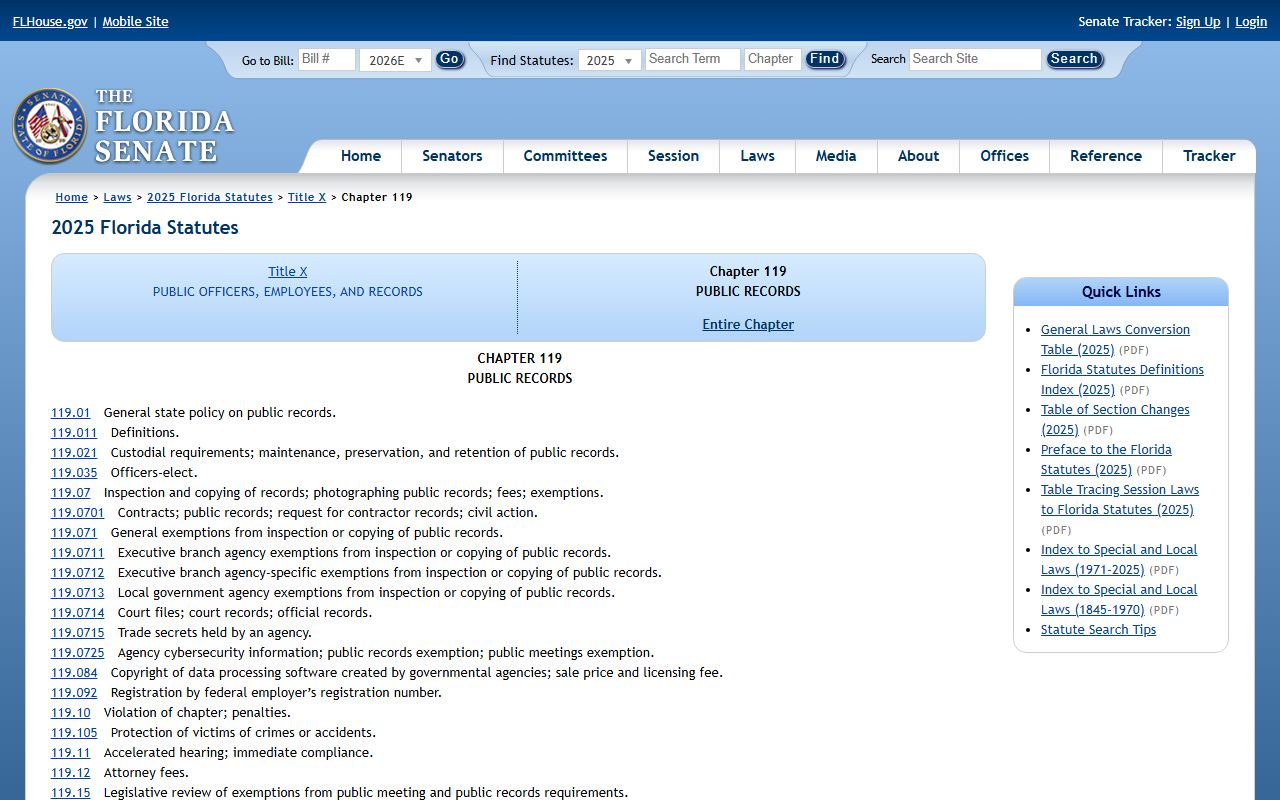
Chapter 119 governs how St. Lucie County agencies respond to requests, what fees they may charge, and which categories of information are exempt from disclosure.
Note: Chapter 119 covers executive-branch agency records; court records in the judicial branch are also governed by Florida Rule of General Practice and Judicial Administration 2.420.
The Public-Records Policy Under Section 119.01
The policy statement in Florida Statutes Section 119.01 is clear: it is the policy of this state that all state, county, and municipal records are open for personal inspection and copying by any person. That includes records of the St. Lucie County Clerk of the Circuit Court and Comptroller, the St. Lucie County Sheriff's Office, the county tax collector, county administration, and every other covered agency in the county.
Section 119.01 also sets out the rule that an exemption from this policy must be created by the Legislature and stated explicitly. Courts have consistently read the law to favor access when there is any doubt. That means if an agency is not sure whether a record is exempt, the default is to provide it.
The screenshot below shows Section 119.01 as published on the Florida Legislature's official statutes site.
Visit flsenate.gov to read Section 119.01 in full.
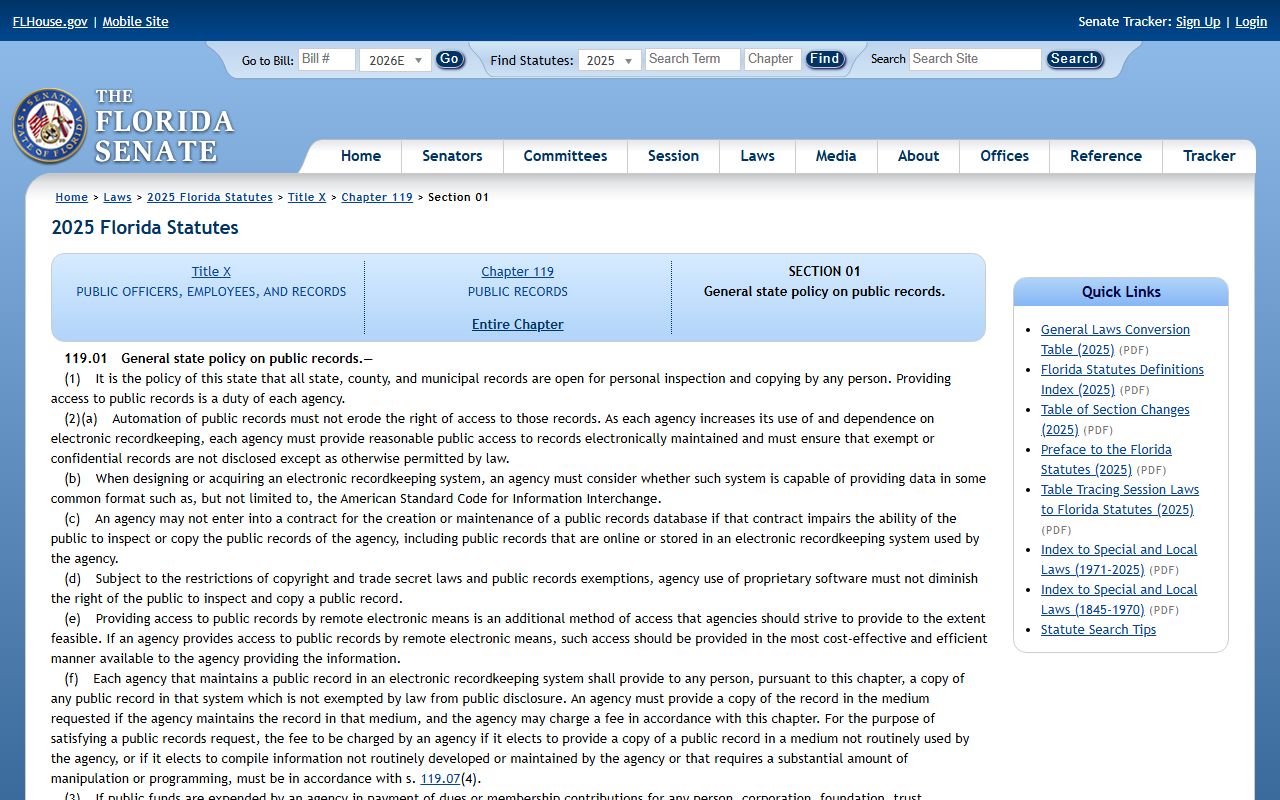
This statute is the starting point for any public-records request in St. Lucie County, whether you are seeking court files, official records, Sheriff reports, or county administration documents.
Records the St. Lucie County Clerk Maintains
The Clerk of the Circuit Court and Comptroller in St. Lucie County holds two broad categories of records: court records and official records. These are separate systems with separate search portals. Knowing which type you need determines where you search and how you request access.
Court records are the files generated by judicial proceedings. They include civil case files, criminal case files, family court matters such as dissolution of marriage and paternity, traffic court files, probate and guardianship cases, and juvenile records where authorized. Every case the Circuit Court or County Court handles generates a court record managed by the Clerk. Many court records are searchable through the court case portal at stlucieclerk.gov/public-search-gen/search-court-cases. Some documents within those cases may be restricted or require a formal copy request.
Official records are instruments recorded with the Clerk under Florida law. The Clerk serves as the county recorder under Florida Statutes Section 28.222. These records include deeds, mortgages, liens, satisfactions of mortgage, plats, notices of commencement, and similar instruments that affect real property or legal rights. Official records are searchable at stlucieclerk.gov/public-search-gen/search-official-records. If you are looking for a recorded deed to a property in St. Lucie County, that is the portal to use, not the court case search.
Beyond those two main categories, the Clerk also maintains:
- Marriage licenses and marriage records
- Probate records, estate files, and guardianship proceedings
- Traffic citation and payment records
- Certified copies of court judgments and official instruments
- Plats and property maps recorded in the official records
- Clerk financial records as part of the Comptroller function
Inspection and Copying Under Section 119.07
Florida Statutes Section 119.07 spells out how inspection and copying work in practice. Every custodian of public records must permit access to inspect public records and must provide copies when requested. The custodian must acknowledge receipt of a request and respond in a reasonable time. If a record cannot be produced right away, the custodian must say when it will be available.
Section 119.07 also covers fees. Custodians may charge for copies, and certain extensive-use charges can include labor costs beyond a set threshold of pages. For St. Lucie County records, the Clerk's fee schedule at stlucieclerk.gov/fees shows the current rates for plain copies, certified copies, and other services. Fees authorized by statute, such as those under Florida Statutes Section 28.24, are the baseline for what the Clerk may charge.
The screenshot below shows Section 119.07 on the Florida Legislature's site.
Read the full text of Section 119.07 at flsenate.gov.
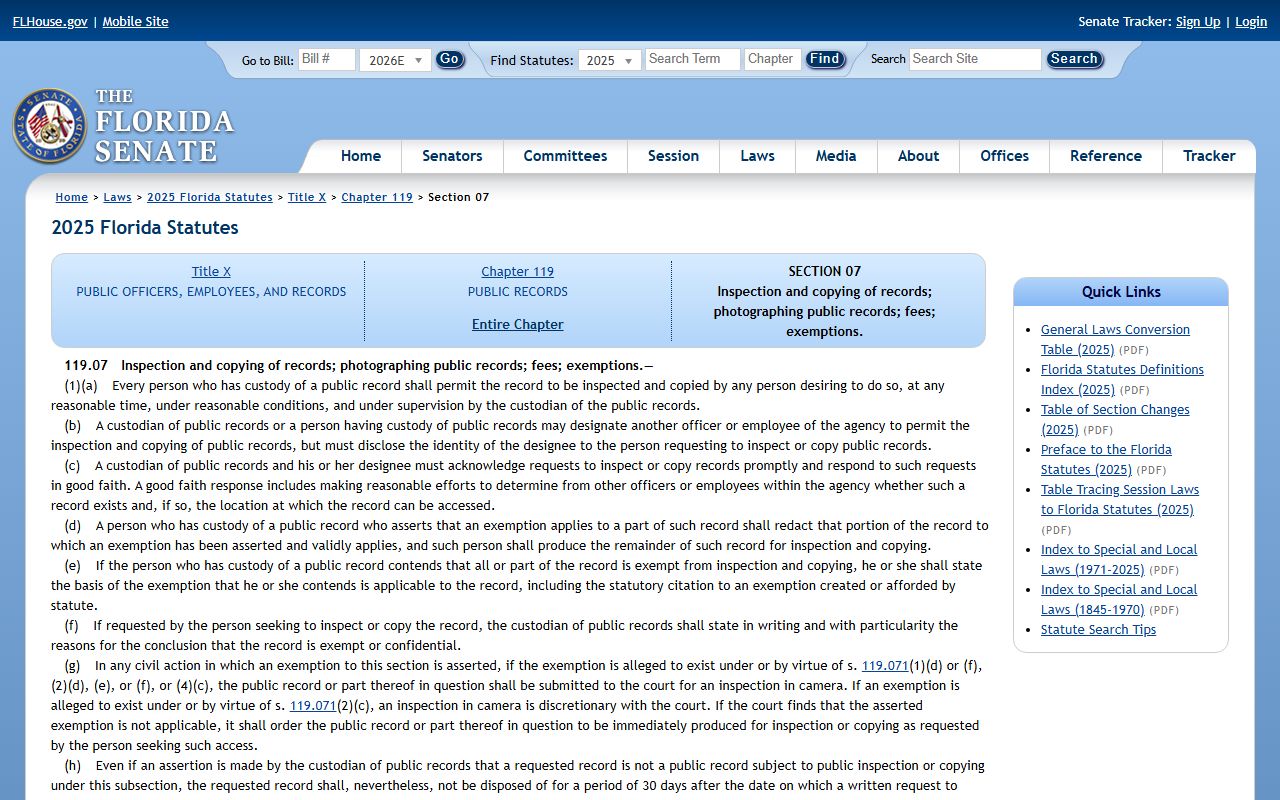
Section 119.07 is the procedural backbone for public-records access in St. Lucie County, governing how the Clerk and other agencies respond to requests and what they may charge.
How to File a Public Records Request in St. Lucie County
A public-records request does not need to follow a special form or use specific language. You can make a request in person, by mail, by email, or through a web form if the agency provides one. The key is to describe the record clearly enough for the custodian to find it. Court records go to the Clerk's office; Sheriff incident reports go to the St. Lucie County Sheriff's Office; property appraiser records go to that office. Each agency is the custodian of its own records.
- Identify the right office. Decide which agency holds the record. For court cases and official instruments (deeds, mortgages), contact the Clerk of the Circuit Court and Comptroller, located at 201 South Indian River Drive, Fort Pierce, FL 34950. For Sheriff incident reports or arrest records, contact the St. Lucie County Sheriff's Office. For county government records, contact the county administration office.
- Describe the record as specifically as you can. Include case numbers, instrument numbers, party names, date ranges, record type, and any other details that help narrow the search. You do not need to know the exact record number, but the more detail you provide, the faster the response.
- Choose a submission method. The Clerk accepts requests in person at Fort Pierce and at the St. Lucie West service location, by mail, by email, or through online portals where available. Check stlucieclerk.gov/contact-us for current contact details and any online request tools.
- Wait for acknowledgment and a response. Florida law requires the custodian to acknowledge the request and either provide the records or explain when they will be available. If the record is readily on hand, the turnaround can be very fast. Larger or more complex requests may take longer.
- Pay any applicable fees and receive your records. If copies are needed, fees apply. Review the current schedule at stlucieclerk.gov/fees for copy, certification, and search charges. Pay by the method the office accepts, then receive your copies in the format you requested.
Note: Florida law does not require a requester to identify themselves or state a reason for the request, but providing a name and contact information helps the office respond and send invoices for copies.
Public Records Request Form Fields
When the Clerk's office or another St. Lucie County agency provides a records-request form, the form typically collects enough information to locate the record and deliver or bill for copies. The table below shows the standard fields drawn from the Clerk's request process. You do not need to fill in every field, but the more you provide, the faster the search.
| Field | Required | Notes |
|---|---|---|
| Requester Name | Usually yes | Used for copy requests and public-records responses; Florida law does not require identification, but providing a name allows the office to communicate with you. |
| Contact Phone | Usually yes | Allows the office to call if clarification is needed or if records are ready for pickup. |
| Email Address | Yes for electronic response | Required if you want records or an invoice sent by email; also used for clarification questions. |
| Mailing Address | Conditional | Needed when you want copies mailed to you rather than picked up in person or sent electronically. |
| Case Number / Instrument Number | Optional but strongly recommended | Court case numbers or official records book, page, or instrument numbers speed retrieval significantly; provide one if you have it. |
| Party Names | Optional | Use full legal names and include any known aliases; helpful when you don't have a case or instrument number. |
| Record Type | Usually yes | Specify court record, official record, marriage record, probate, traffic, criminal, family, civil, or certified copy so the request goes to the right team. |
| Date Range | Optional | Needed when the exact case or instrument number is unknown; narrows the search to a manageable set of records. |
| Copy Type | Yes when requesting copies | Choose plain copy, certified copy, exemplified copy, electronic format, or mailed copy depending on your needs. |
| Delivery Method | Yes | Select email, mail, in-person pickup, or online download if available for the record type you requested. |
| Payment Method | Yes if a fee is due | Follow the Clerk's current payment instructions; do not mail cash unless the official page explicitly allows it. |
St. Lucie County Court Files Under Section 119.0714
Court records in St. Lucie County are subject to an additional layer of rules beyond Chapter 119. Florida Statutes Section 119.0714 addresses court files and court records directly. It recognizes that court records are held by the Clerk but that judicial branch rules, not just executive-branch public-records law, govern what is public and what is confidential within those files. Florida Rule of General Practice and Judicial Administration 2.420 works alongside Section 119.0714 to define the full framework for court-file access.
The practical result is that many court records in St. Lucie County are fully public and searchable online through the court case search portal. Others are available only by request. Some documents within a case file are redacted, sealed, or restricted entirely. The Clerk must follow both the statute and the judicial rule when deciding what to release.
The screenshot below shows Section 119.0714 on the Florida Legislature's official site.
Review Section 119.0714 at flsenate.gov for the current text governing court files.
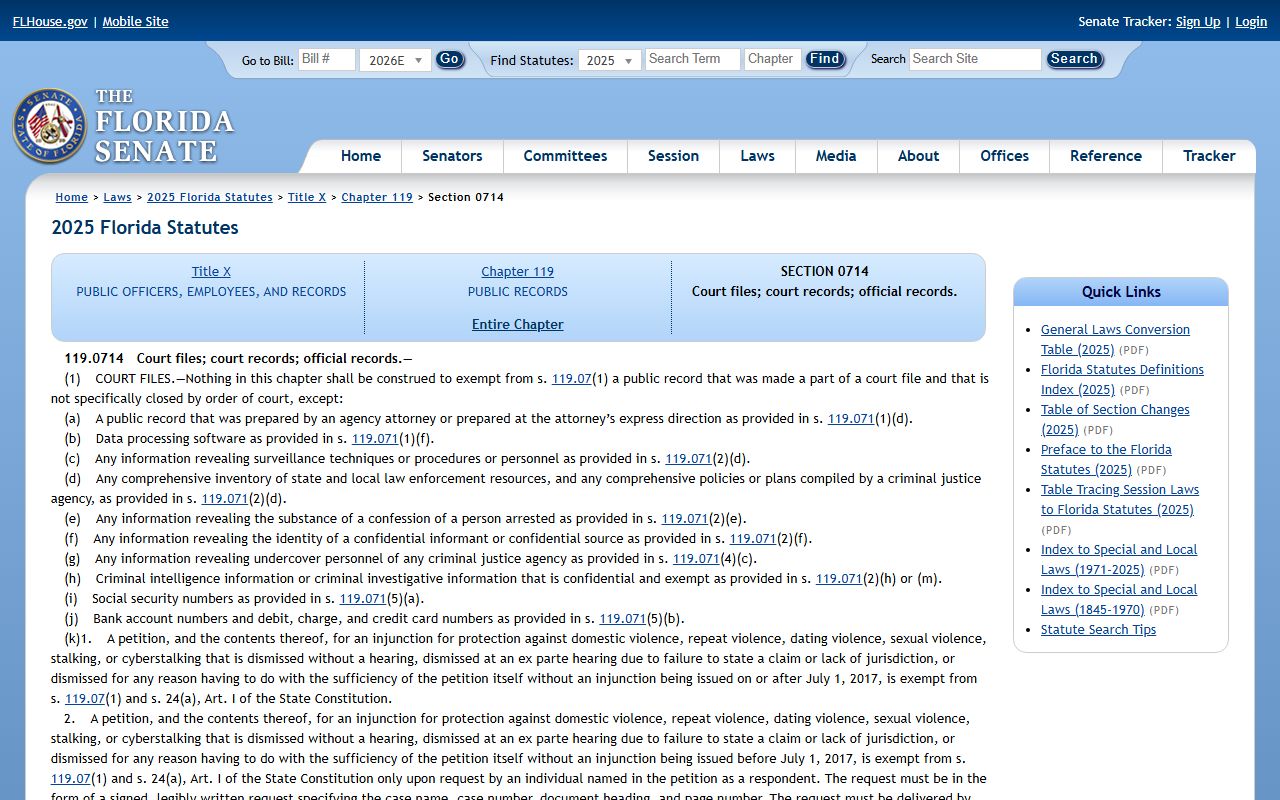
Section 119.0714 is particularly relevant when requesting court records from the St. Lucie County Clerk, because it defines how court files are treated under both the public-records law and the judicial branch's confidentiality rules.
Note: Court records and official records are stored in separate systems; a divorce filing is a court record searched in the court case portal, while a recorded deed is an official record searched in the official records portal.
Public Records Fees in St. Lucie County
Florida law permits agencies to charge for copies of public records and, under certain conditions, for the labor cost of extensive searches. Fees for the St. Lucie County Clerk's office are governed by Florida Statutes Section 28.24, which authorizes specific charges for copies, certifications, recordings, and related services. The actual current amounts are listed on the Clerk's fee schedule. Because fees can change, always verify the current schedule before sending payment.
The table below shows the fee categories and where to confirm the current rate. No dollar amounts are listed here because the official source is the most accurate reference.
| Fee Category | Where to Verify |
|---|---|
| Plain copy (per page) | stlucieclerk.gov/fees |
| Certified copy | stlucieclerk.gov/fees |
| Electronic / digital copy | stlucieclerk.gov/fees |
| Record search / labor (extensive use) | stlucieclerk.gov/fees |
| Official records recording fee | stlucieclerk.gov/fees |
| Civil filing fees (circuit and county civil) | stlucieclerk.gov/fees |
| Probate and guardianship filing fees | stlucieclerk.gov/fees |
| Marriage license fee | stlucieclerk.gov/fees |
Florida law does allow fee waivers for indigent requesters in some circumstances and limits the situations where labor charges can be added. If you believe a fee is incorrect or unreasonably high, you can ask the Clerk to identify the specific statutory authority for the charge.
Exempt Records Under Section 119.071
Not all government records in St. Lucie County are open to the public. Florida Statutes Section 119.071 contains the general exemptions from inspection or copying. These exemptions cover personal identifying information, active law enforcement investigations, security plans, agency work product in pending litigation, and a range of other protected categories. Each exemption is specific. The agency must cite the exemption when withholding a record.
Beyond Section 119.071, other statutes create additional exemptions for specific record types held in St. Lucie County. Juvenile records are protected under Section 985.04. Adoption records are confidential under Section 63.162. Mental health clinical records are protected under Section 394.4615. Sealed criminal records are governed by Section 943.059 and expunged records by Section 943.0585. Dependency and child welfare records are covered by Section 39.0132.
The following categories are routinely withheld or heavily redacted from St. Lucie County public records:
- Juvenile delinquency and dependency records
- Adoption files
- Mental health and Baker Act records
- Sealed and expunged criminal records
- Social Security numbers, bank account numbers, and similar personal identifiers
- Victim and witness identifying information in many case types
- Grand jury proceedings and materials
The screenshot below shows Section 119.071 on the Florida Legislature's site, which is the authoritative source for the full list of general exemptions.
Read Section 119.071 at flsenate.gov to see all general exemptions in detail.
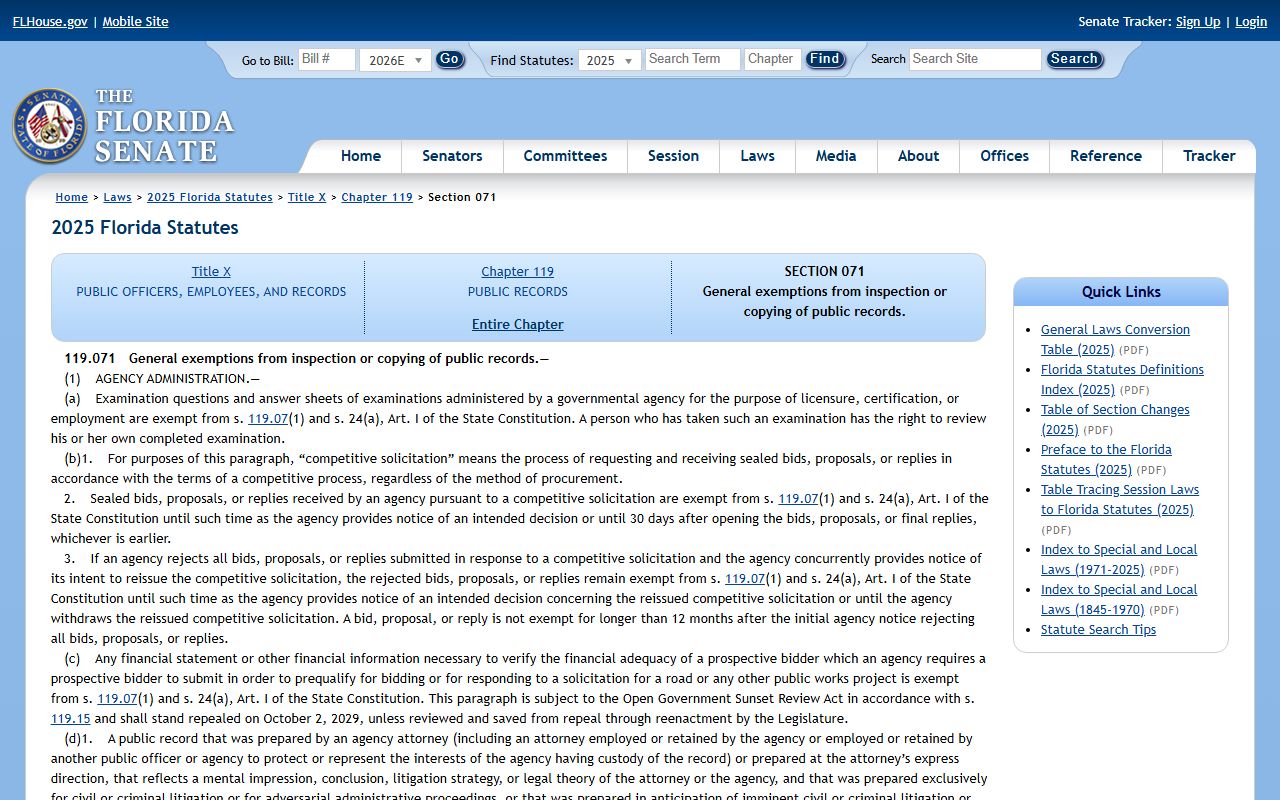
When the Clerk or another St. Lucie County agency withholds a record, Section 119.071 is often the source of the specific exemption they rely on, though other statutes also apply to particular record categories.
Response Timelines for St. Lucie County Requests
Florida's public-records law does not set a hard deadline in the same way some other states' open-records laws do. The standard is "reasonable time." What counts as reasonable depends on the type and volume of records, the complexity of any required redaction, the staffing of the office, and other practical factors. Simple requests for a single case number or a recorded document can often be filled the same day or within a few days. Requests that require searching across large sets of files, reviewing for exemptions, or involving multiple offices may take longer.
The custodian must acknowledge the request and either provide the records or give an estimated time for production. If the agency needs to identify and redact exempt material, that process takes time. If you ask only for documents that are already publicly accessible online, the fastest path is usually the self-service portals: the court case search at stlucieclerk.gov for court files and the official records search at stlucieclerk.gov for deeds and other instruments.
If the agency cannot produce the records in a reasonable time, or if it provides no response at all, the requester can raise a formal objection. Florida does not have a single administrative appeal route for public-records denials. Instead, a person whose request is denied or ignored can seek judicial review by filing suit in circuit court. The Florida Attorney General also provides open-government guidance and opinions, though those opinions are advisory rather than binding on agencies. The courts have final say on whether a record must be disclosed.
If Your St. Lucie County Public Records Request Is Denied
A denial of a public-records request must come with an explanation. The agency must cite the specific exemption that covers the withheld record. If the agency says a record is exempt but won't tell you which statute applies, you can ask for that information. A blanket refusal with no legal basis is not permitted under Chapter 119.
When a record is partially exempt, the agency must redact only the exempt portion and release the rest. It cannot withhold an entire document just because one line or one field falls under an exemption. This rule protects your right to see the non-exempt parts of public records even when some content must be removed.
If you believe the denial is wrong, your options include:
- Asking the agency to identify the specific statute or rule used to withhold the record
- Consulting the Florida Attorney General's open-government guidance for an informal opinion
- Filing suit in the circuit court serving St. Lucie County to compel production of the records
Florida law allows a court to award attorney's fees to a requester who prevails in a public-records lawsuit, which gives requesters a real enforcement mechanism when agencies improperly withhold records. For court records specifically, the judicial branch rules under Rule 2.420 also provide a process to challenge confidentiality determinations.
Official Records Search in St. Lucie County
The official records search is a separate portal from the court case search. It covers instruments recorded in the Clerk's official records system under the Clerk's role as county recorder. Property deeds, mortgage recordings, liens, lien releases, plats, notices of commencement, and similar documents are all found here. If you are researching property ownership in St. Lucie County, checking for recorded liens, or verifying a mortgage, the official records portal is the right tool.
Search the St. Lucie County official records at stlucieclerk.gov/public-search-gen/search-official-records. The search lets you look up by party name, instrument number, or book and page. Results show the type of instrument, date recorded, parties, and the document itself in many cases. Some older instruments may not be available digitally and require an in-person or mail request.
The Clerk's recording function is authorized under Florida Statutes Section 28.222. Recording a document in the official records makes it part of the permanent public record for the county. Certified copies of recorded instruments are available from the Clerk's office; fees are listed on the fee schedule at stlucieclerk.gov/fees.
Note: A divorce case is a court record searched in the court case portal, not in the official records search, even though a final judgment of dissolution may sometimes also be recorded as an official record.