
How to Search St. Lucie County Court Records
The official starting point for St. Lucie County court case lookups is the Benchmark portal maintained by the Clerk of the Circuit Court and Comptroller. The public search page at stlucieclerk.gov/public-search-gen/search-court-cases routes users to the live Benchmark system. That system covers Circuit Court and County Court cases, including civil, criminal, family, probate, traffic, and guardianship matters. A case number is the most reliable search input. Name searches work too but require exact spelling.
Before searching, gather what you have. A complete case number returns results instantly. If you only have a name, use the legal name as it appears in official filings and try narrowing the results by date range or case type. Traffic matters are often easier to find by citation number than by name. If a record does not appear online, it may be archived, sealed, juvenile, or entered under a different spelling.
The Clerk's website at stlucieclerk.gov captured below shows the main access point for court services and records.
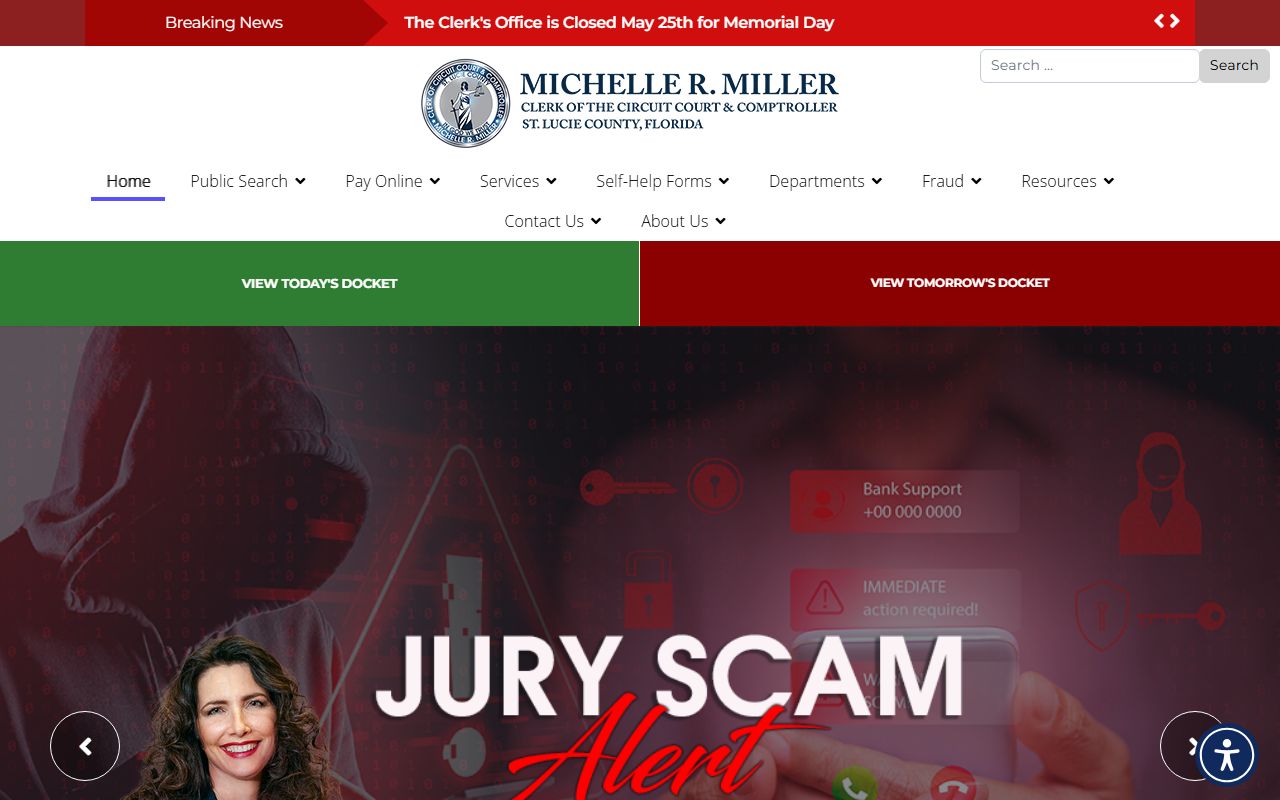
From this main page, users can navigate to case search, traffic payments, official records, and clerk service information for both the Fort Pierce and Port St. Lucie branch locations.
- Open stlucieclerk.gov/public-search-gen/search-court-cases and proceed to the Benchmark public search portal.
- Select the search mode: party name, case number, or citation number depending on what you have.
- Enter the most precise identifier available. Use last name first when searching by name. Use exact format for case or citation numbers.
- Apply date range, court type, or division filters if the portal exposes them to narrow a broad name search.
- Review the results list for matching names, case numbers, filing dates, and case types.
- Open the case detail to read the docket chronologically, noting filings, orders, hearings, judgments, and dispositions.
- For documents not available online, contact the Clerk to request copies, certified copies, or in-person access.
The Clerk's search routing page links directly to the Benchmark portal for St. Lucie County court case lookups.
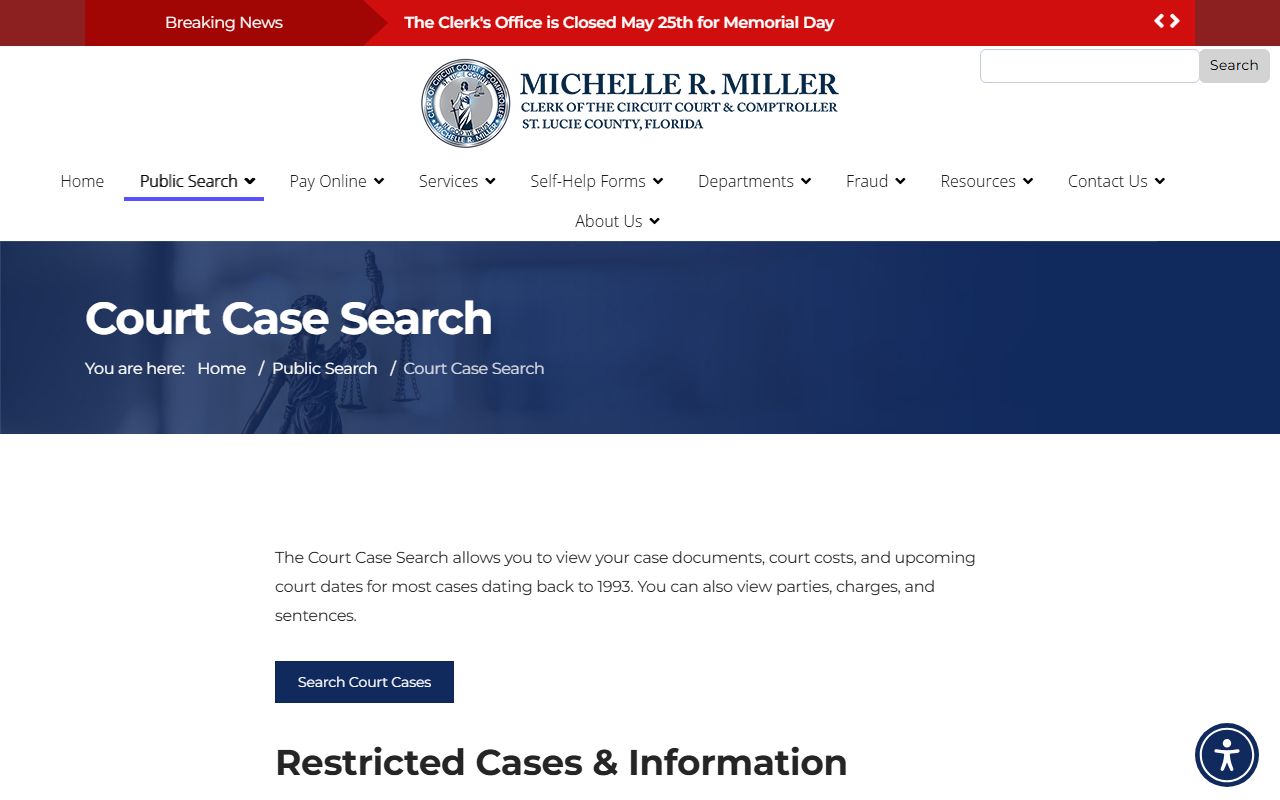
That routing page lets users pick the right search tool, whether looking for court cases, official recorded documents, or traffic payment options.
St. Lucie County Benchmark Portal Search Fields
The public Benchmark portal at courtcasesearch.stlucieclerk.gov exposes several search fields. Knowing the field types and format requirements saves time and reduces missed results. The table below comes from a direct inspection of the live portal.
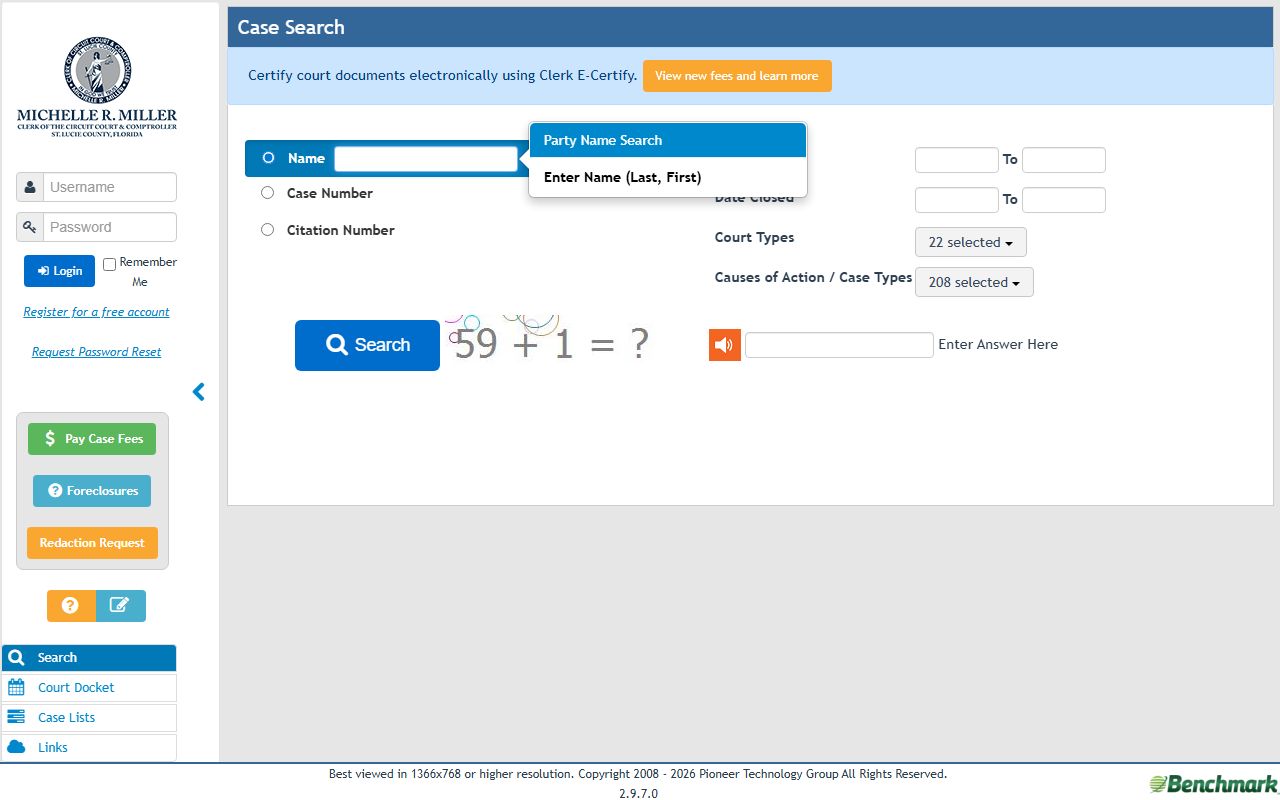
The Benchmark portal is the primary tool for searching St. Lucie County Circuit Court and County Court cases by name, case number, or citation number.
| Field Label | Type | Required | Format Notes |
|---|---|---|---|
| Search Type / Search By | Tab or dropdown | Required | Party name, case number, citation number, or other modes depending on portal configuration. |
| Last Name / Business Name | Text | Conditional | Use when searching by party. Spelling matters; try variations for common names. |
| First Name | Text | Optional | Narrows person searches when combined with last name. |
| Middle Name / Initial | Text | Optional | Useful for common last names. |
| Case Number | Text | Conditional | Best identifier. Use exact format from court notices or filings. |
| Citation Number | Text | Conditional | For traffic and citation records. |
| Filing Date From | Date | Optional | MM/DD/YYYY format if date filter is shown. |
| Filing Date To | Date | Optional | Pair with from-date to narrow a date range. |
| Court Type / Division | Dropdown | Optional | Circuit civil, county civil, criminal, traffic, family, probate, juvenile if shown. |
| Party Role | Dropdown | Optional | Plaintiff, defendant, petitioner, respondent, appellant, appellee. |
Note: Online access does not equal complete access. Sealed records, juvenile files, adoption cases, and protected victim information may not appear or may show limited data.
Florida Court Structure in St. Lucie County
St. Lucie County sits within the Nineteenth Judicial Circuit, which groups St. Lucie, Martin, Indian River, and Okeechobee counties under shared judicial administration. Each county keeps its own courthouse and clerk operations. The Nineteenth Judicial Circuit's administrative information, judge assignments, and program details are published at circuit19.org.
Florida has a four-level court structure. The two trial court levels that matter most for local cases are Circuit Court and County Court. Circuit Court is the higher trial court and handles felony criminal cases, family law, probate, guardianship, juvenile matters, and circuit-level civil cases. County Court handles misdemeanors, traffic infractions, small claims, county civil matters, and evictions. Appeals from both levels go to a District Court of Appeal, and the Florida Supreme Court sits at the top of the state system.
Case flow: County Court › Circuit Court › District Court of Appeal › Florida Supreme Court
| Court | Jurisdiction | Case Types |
|---|---|---|
| Florida Supreme Court | Statewide final appellate | Constitutional matters, death penalty, certified questions, and discretionary review. |
| District Courts of Appeal | Intermediate appellate statewide | Appeals from circuit and county courts, and certain agency actions. |
| Circuit Court (Nineteenth Judicial Circuit) | St. Lucie County primary trial court | Felony, family, probate, guardianship, juvenile, circuit civil over county-court limit. |
| County Court | St. Lucie County lower trial court | Misdemeanor, traffic, small claims, county civil, eviction, local ordinance. |
A St. Lucie County felony case, divorce, probate estate, or high-value civil claim is a Circuit Court matter. A traffic ticket, misdemeanor, small claim, eviction, or county civil collection matter is handled in County Court. Both courts share the same courthouse building in Fort Pierce, and records for both are maintained by the same Clerk's office.
St. Lucie County Courthouses and Clerk Locations
The main courthouse is in downtown Fort Pierce, which has been the center of St. Lucie County judicial activity since the county was established in the early twentieth century. The Fort Pierce location handles Circuit Court and County Court matters. The Clerk of the Circuit Court and Comptroller operates a separate service office on Indian River Drive in Fort Pierce and a branch in Port St. Lucie for convenience. Visitors should confirm hearing locations and clerk counter availability before traveling because some services are location-specific.
Clerk of the Circuit Court and Comptroller (Fort Pierce)
201 South Indian River Drive
Fort Pierce, FL 34950
Clerk Branch (Port St. Lucie)
250 NW Country Club Drive
Port St. Lucie, FL 34986
The Clerk of the Circuit Court and Comptroller, currently led by Michelle R. Miller, is the official custodian of court files, official records, and clerk services for St. Lucie County. The Clerk's office handles court filings, certified copies, traffic payments, marriage licenses, and probate services.
Types of Court Records Available in St. Lucie County
The St. Lucie County court system generates several distinct record categories. Civil and criminal records are the most common, but the Clerk also maintains family, probate, traffic, and guardianship files. Most adult public case dockets are searchable through the Benchmark portal. Document availability varies by case type and whether restrictions apply.
Court case records are different from official records. Court case search covers judicial case files. Official records cover recorded instruments like deeds, mortgages, and liens. A probate case appears in court case search, but a deed transferring estate property after closing shows up in official records. Both systems are separate, and a researcher may need to check both depending on the question.
- Criminal records - Felony cases in Circuit Court; misdemeanors in County Court. Files include charging documents, plea forms, bond orders, sentencing, probation, and warrants. See St. Lucie County arrest records for full detail.
- Civil records - County civil and small claims for lower-dollar disputes; circuit civil for larger claims, injunctions, and real property matters. Dockets show complaints, answers, motions, and judgments.
- Family and divorce records - Dissolution of marriage, paternity, timesharing, child support, domestic violence injunctions, and name changes are Circuit Court family matters. See marriage and divorce records for more.
- Probate records - Petitions for administration, wills, personal representative appointments, inventories, creditor notices, and closing documents are managed in the Circuit Court probate division. See St. Lucie County probate records.
- Traffic court records - Citation number, plea, fine, school election, disposition, and payment status for traffic infractions handled in County Court.
What St. Lucie County Court Records Show
A typical public case record in the Benchmark portal includes both header-level data and a docket log of case events. The header fields identify the parties and the basic case facts. The docket entries form a chronological record of every filing, hearing, order, payment, and disposition entered by the court. Some documents are viewable as PDFs; others require a copy request from the Clerk because they are redacted, fee-based, or restricted from public download.
| Field | What It Shows |
|---|---|
| Case Number | Unique court case identifier assigned by the Clerk at filing. |
| Division | Circuit civil, county civil, family, probate, felony, misdemeanor, traffic, juvenile, or guardianship. |
| Filing Date | Date the case was opened or the citation was filed. |
| Case Status | Pending, open, disposed, closed, transferred, sealed, or reopened. |
| Parties | Plaintiff, defendant, petitioner, respondent, decedent, ward, personal representative, or guardian with their roles. |
| Attorneys | Attorney name, firm, and party represented when associated with the case. |
| Judge / Judicial Officer | Assigned judge or magistrate if public. |
| Docket Entries | Chronological events including complaint, summons, answer, motion, order, hearing, judgment, disposition, and payment. |
| Financial Data | Fines, court costs, restitution, bond amounts, payment plans, and balances in traffic and criminal matters. |
| Hearing Data | Date, time, hearing type, courtroom, and judge when public. |
| Redactions | Social Security numbers, bank accounts, victim information, minor names, medical details, and sealed material are withheld. |
Public Access Laws for St. Lucie County Court Records
Florida has one of the strongest public-record policies in the country. Chapter 119 of the Florida Statutes creates a broad presumption that public records are open for personal inspection and copying. Court records operate under both the Chapter 119 framework and Florida Rule of General Practice and Judicial Administration 2.420, which governs judicial branch records, confidential categories, and clerk procedures. The practical result is that most adult court dockets are publicly searchable online, but specific documents may be redacted, restricted, or available only through a copy request. The Clerk must provide access to public material while protecting confidential information. When access is denied, the Clerk should identify the applicable exemption.
Key Florida Statutes for St. Lucie County Court Records:
Florida Statutes § 119.07 - Sets out how public-record custodians respond to requests, when fees may be charged, and how exemptions must be cited when access is withheld.
Florida Statutes § 119.0714 - Addresses court-file information and the confidentiality requirements clerks must follow when handling judicial records.
Florida Statutes § 943.0585 - Governs court-ordered expunction, the process that removes qualifying criminal history records from ordinary public access when statutory requirements are met and a court grants relief.
Florida Statutes § 943.059 - Governs court-ordered sealing, which restricts public access to a qualifying criminal record without the more complete removal that expunction provides.
Florida Statutes § 28.24 - Authorizes the clerk fees charged for copies, certifications, recordings, and other court services in St. Lucie County and statewide.
A person denied access to a public record can ask the Clerk to identify the specific exemption in writing and may seek judicial review. The Florida Attorney General publishes open-government guidance, but courts resolve disputes. Most clerk fees must be authorized by statute or reflect actual extensive-use costs.
Records That Are Restricted or Confidential
Not every court record in St. Lucie County is open to the public. Florida law and court rules restrict several categories of records regardless of whether they appear in the public search portal. Restricted records include juvenile delinquency files governed by Florida Statutes § 985.04, dependency records covered by Florida Statutes § 39.0132, adoption files restricted under Florida Statutes § 63.162, and mental health clinical records protected by Florida Statutes § 394.4615. Sealed and expunged criminal records also have limited or removed public access depending on the relief granted.
Personal identifiers are redacted from public court records even when the case itself is public. Social Security numbers, bank account numbers, minor names, victim addresses protected by court order, and medical details are routinely withheld. If a court record shows fewer details than expected, redaction under Florida Rule of General Practice and Judicial Administration 2.420 is the most likely reason. Grand jury proceedings and materials are traditionally secret. Protective orders and injunctions may have public dockets but restricted victim-identifying information.
To access a sealed record, a requesting party must file a motion, identify the record, explain legal authority or need, serve affected parties when required, and get a court order. The court balances confidentiality law against the access need. Expunged records require even stronger authority for access because the statute removes them from ordinary public view more completely than sealing does.
Specialty Courts in St. Lucie County
The Nineteenth Judicial Circuit operates several problem-solving court programs that serve St. Lucie County. These programs combine judicial supervision with treatment and monitoring to address the root causes of justice involvement. Program availability and eligibility criteria can change, so current details should be confirmed through circuit19.org/programs-services.
Drug Court and Treatment Court programs have historically operated in the circuit for eligible defendants with substance-use needs. Participants may be required to attend treatment, submit to drug testing, appear regularly before the judge, maintain employment or education goals, and meet probation-style conditions. Successful completion can result in reduced sanctions depending on the referral path and plea structure. Eligibility depends on offense type, criminal history, public-safety screening, treatment need, and prosecutor and court approval.
Veterans Treatment Court connects eligible justice-involved veterans with treatment, supervision, VA resources, peer mentors, and judicial monitoring. The program focuses on defendants whose military service, trauma, substance use, mental health needs, or reentry challenges are connected to justice involvement. St. Lucie residents should confirm eligibility through the Nineteenth Judicial Circuit and the State Attorney or Public Defender because program criteria can change.
A Mental Health Court or Behavioral Health Docket in the circuit diverts or supervises defendants with serious behavioral health needs. Court teams may include the judge, prosecutor, defense counsel, treatment providers, case managers, probation officers, and community providers. Records from these proceedings can include sensitive treatment information, so public access may be more limited even when the underlying criminal docket remains public.
St. Lucie County Sheriff and Jail
The St. Lucie County Sheriff's Office is the primary law enforcement and jail operation for the county. The official Sheriff's site at stluciesheriff.com provides access to the public inmate lookup, release report, visitation rules, mail procedures, and inmate account information. The inmate lookup page at stluciesheriff.com/215/Inmate-Lookup allows searching by name or booking number. Custody status, bond information, and charges can change quickly after an arrest, so any result from the online system should be confirmed directly with the jail because release, holds, and court orders may not update instantly.
When a person is arrested in St. Lucie County, the booking process includes identity confirmation, warrant check, property inventory, booking photograph, fingerprints, medical and classification screening, charge entry, and bond review. First appearance under Florida criminal procedure typically happens within 24 hours of booking. Bond can be cash, surety, recognizance, conditional release, or no bond depending on the offense and judicial order. Warrants and holds from other agencies can block release even when one charge shows a bond amount. For full inmate search details and booking field information, see St. Lucie County inmate records. For active warrants and wanted persons, see warrant records.
Marriage, Divorce, and Probate Records
Marriage licenses, divorce records, and probate files are all maintained by the Clerk of the Circuit Court and Comptroller. Marriage licenses are issued by the Clerk's office, and certified copies of marriage records are available from the same office after the license is returned and recorded. Divorce cases are Circuit Court family matters, so they appear in the court case search portal just like other civil cases. For step-by-step details on applying for a license or finding a divorce docket, see marriage and divorce records. Probate and guardianship are Circuit Court probate division matters also searched through the Clerk's portal. For estate filings, will searches, and guardianship records, see St. Lucie County probate records.
- Testator
- A person who has made and signed a will. In a Florida probate case, the testator is the decedent whose will is offered for probate.
- Personal Representative
- Florida's term for the person or institution appointed by the court to manage and settle an estate. Florida uses "personal representative" rather than "executor." The personal representative collects assets, pays valid debts, and distributes the estate under court supervision.
- Conservator
- A person or entity appointed to manage the property of a ward who cannot manage it alone. Florida guardianship cases may involve both a guardian of the person and a guardian of the property, the latter being comparable to a conservator in other states.
- Intestate
- Dying without a valid will. Florida's intestacy statutes determine how the estate is distributed when no will exists or when the will fails.
St. Lucie County Court Records Fees
The Clerk of the Circuit Court and Comptroller charges fees for copies, certified copies, filings, recordings, and related services. Florida Statutes § 28.24 authorizes most clerk service charges. Specific fee amounts change when the Legislature updates the statute or when the Clerk posts a revised schedule. The authoritative source for current St. Lucie County clerk fees is the Clerk's fee schedule page at stlucieclerk.gov/fees. Always verify before paying or budgeting for a records request.
| Fee Category | Where to Verify |
|---|---|
| Court copies (plain, per page) | stlucieclerk.gov/fees |
| Certified copies (per page plus certification) | stlucieclerk.gov/fees |
| Civil filing fees (circuit, county, small claims, family) | stlucieclerk.gov/fees |
| Criminal and traffic costs | stlucieclerk.gov/fees |
| Probate and guardianship filing fees | stlucieclerk.gov/fees |
| Marriage license fee | stlucieclerk.gov/services/marriage-licenses |
| Official records recording fees | stlucieclerk.gov/fees |
Searching basic docket information online is generally free. Copy fees, certification fees, and extensive staff research charges apply when requesting physical or certified records. Fee waiver applications are available for qualifying indigent filers in civil cases.
How to Read St. Lucie County Court Records
Court dockets use abbreviations and legal terms that can be confusing for first-time readers. A disposition code like "NOL PROS" means the prosecution has been dropped. "NOLO" is a no-contest plea. "SOJ" stands for sentence of jail. "FTA" means failure to appear, which often triggers a capias or bench warrant. Charges listed in a docket reflect what was filed, not what was proven. A charge entry does not mean a conviction occurred. Look at the disposition field to see whether a case ended in a guilty plea, conviction at trial, dismissal, acquittal, or some other outcome.
Criminal case records show charges, but charges and convictions are different. A charge is an allegation. A conviction requires a guilty plea, no-contest plea accepted by the court, or a jury or judge finding of guilt. An arrest that led to no conviction may still appear in public docket results unless the record was sealed or expunged. For background-check or employment purposes, a certified criminal history from FDLE is more reliable than a raw court docket search because it applies statutory sealing and expunction rules. The court docket is useful for case-level research but is not a substitute for an official certified criminal history report.
In civil cases, a default judgment means the defendant did not respond and the court entered judgment for the plaintiff. A satisfaction of judgment means the judgment debt was paid. A garnishment or levy entry means post-judgment collection is underway. These entries matter when searching for judgments that may affect credit or property.
Accuracy, Updates, and Record Limitations
Online court records are generally updated as the Clerk's office processes filings, but there can be a lag between when an event occurs in court and when it appears in the public portal. A judgment entered on a Monday may not show online until the following day. A bond posted at the jail may clear before the court docket updates. Dismissed charges do not always disappear immediately from a search result because the docket entry remains even after dismissal. For any decision that depends on the current status of a case, confirm directly with the Clerk's office using the current contact information at stlucieclerk.gov/contact-us.
Note: Always verify case status with the St. Lucie Clerk's office before relying on online records for legal, employment, or financial decisions.
Older records may not be in the online system at all. Pre-digitization case files may exist only in paper form. If the portal returns no result for a case that should exist, call or visit the Clerk and ask whether the record is archived, on microfilm, or accessible only in person. Provide names, date ranges, case types, and any known case number to speed retrieval.
Self-Help and Legal Aid Resources
Parties who cannot afford an attorney can access self-help resources through several official channels. The Florida Courts self-help page at flcourts.gov provides forms and procedural guidance for family cases, small claims, evictions, name changes, and other common matters. The Clerk's website at stlucieclerk.gov links to forms for divorce, probate, small claims, traffic elections, and fee waivers. The Nineteenth Judicial Circuit programs page at circuit19.org/programs-services lists court-connected resources including specialty courts and self-help programs.
Clerks provide forms and general procedural information but cannot give legal advice. Court staff cannot tell a party what to argue, what evidence to use, or what strategy to follow. Self-represented litigants must meet the same deadlines, service rules, and court-order requirements as attorneys. For civil legal aid, Florida Rural Legal Services covers parts of the Treasure Coast including areas serving St. Lucie County residents. Verify current coverage and contact details through the official Florida Rural Legal Services site before visiting. The Florida Bar lawyer referral service at floridabar.org/public/lrs can connect residents with local attorneys. The Public Defender for the Nineteenth Judicial Circuit at pd19.org represents qualifying indigent defendants in criminal and related matters when appointed by the court.
The Clerk's jury duty page provides reporting instructions, juror call-in or online check-in details, and arrival reminders for St. Lucie County jury service. The jury information page at stlucieclerk.gov/services/jury-duty is shown below.
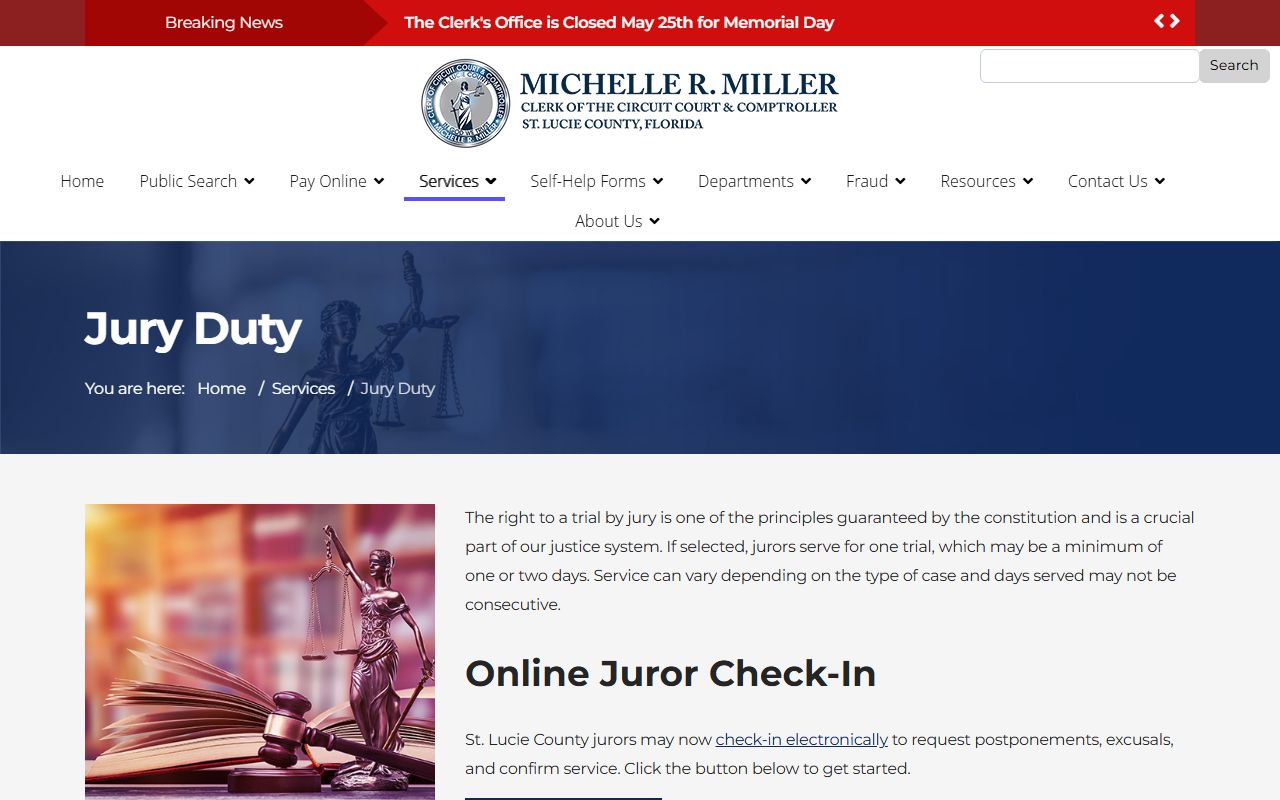
Jury service instructions for St. Lucie County are published and updated on the Clerk's site, including call-in instructions, parking tips, and dress guidance for jurors.
History of St. Lucie County Courts
St. Lucie County was created in the early twentieth century, and Fort Pierce became the county seat and center of local court activity. Court records from that era reflect the county's development alongside Florida's east-coast growth, agricultural economy, Indian River Lagoon port activity, and later Treasure Coast suburban expansion. Fort Pierce has remained the main courthouse location as the judicial system grew and modernized over the decades.
The modern court structure reflects statewide reforms that consolidated Florida's trial courts into two tiers: Circuit Court for the higher-level matters and County Court for lower-level matters. St. Lucie was incorporated into the Nineteenth Judicial Circuit, which groups several Treasure Coast counties under shared judicial administration while each county keeps its own clerk and courthouse operations. Technology milestones include statewide electronic filing, online docket access through the Benchmark portal, electronic recording of official records, and the broad public-access standard for digital court records that Florida now maintains. The Clerk of the Circuit Court has played a central role in each of these transitions, expanding from paper-based filing and recording into a full electronic records and services operation.
Frequently Asked Questions
How do I search St. Lucie County court records?
Use the Clerk's court case search page at stlucieclerk.gov/public-search-gen/search-court-cases, which leads to the Benchmark public portal. Search by case number when possible. If searching by name, use the legal name exactly as it may appear in court files. Narrow results by case type, date range, or division if the portal offers those filters. If a record does not appear, contact the Clerk because it may be archived, sealed, juvenile, or entered under a different name.
Are St. Lucie County court records free to search?
Searching basic docket information through the online portal is generally free. Copies, certified copies, exemplified copies, and extensive staff research may require statutory fees authorized by Florida Statutes § 28.24. Verify the current fee schedule at stlucieclerk.gov/fees before submitting a copy request. Online access does not cover every document; some materials require a paid copy request even if the case docket appears online.
What is the difference between sealing and expunction?
Sealing restricts public access to a qualifying criminal record under Florida Statutes § 943.059. The record still exists but the public cannot see it. Expunction under Florida Statutes § 943.0585 removes the record from ordinary public access more completely. Both require statutory eligibility, FDLE certificates in most cases, and a court order. Neither is automatic. A St. Lucie Circuit Court judge must grant the petition, and the order is then sent to the Clerk and FDLE to update the record. See the St. Lucie County Court Records FAQ for more common questions.